How do you manage reputation when an employee becomes a public whistleblower?
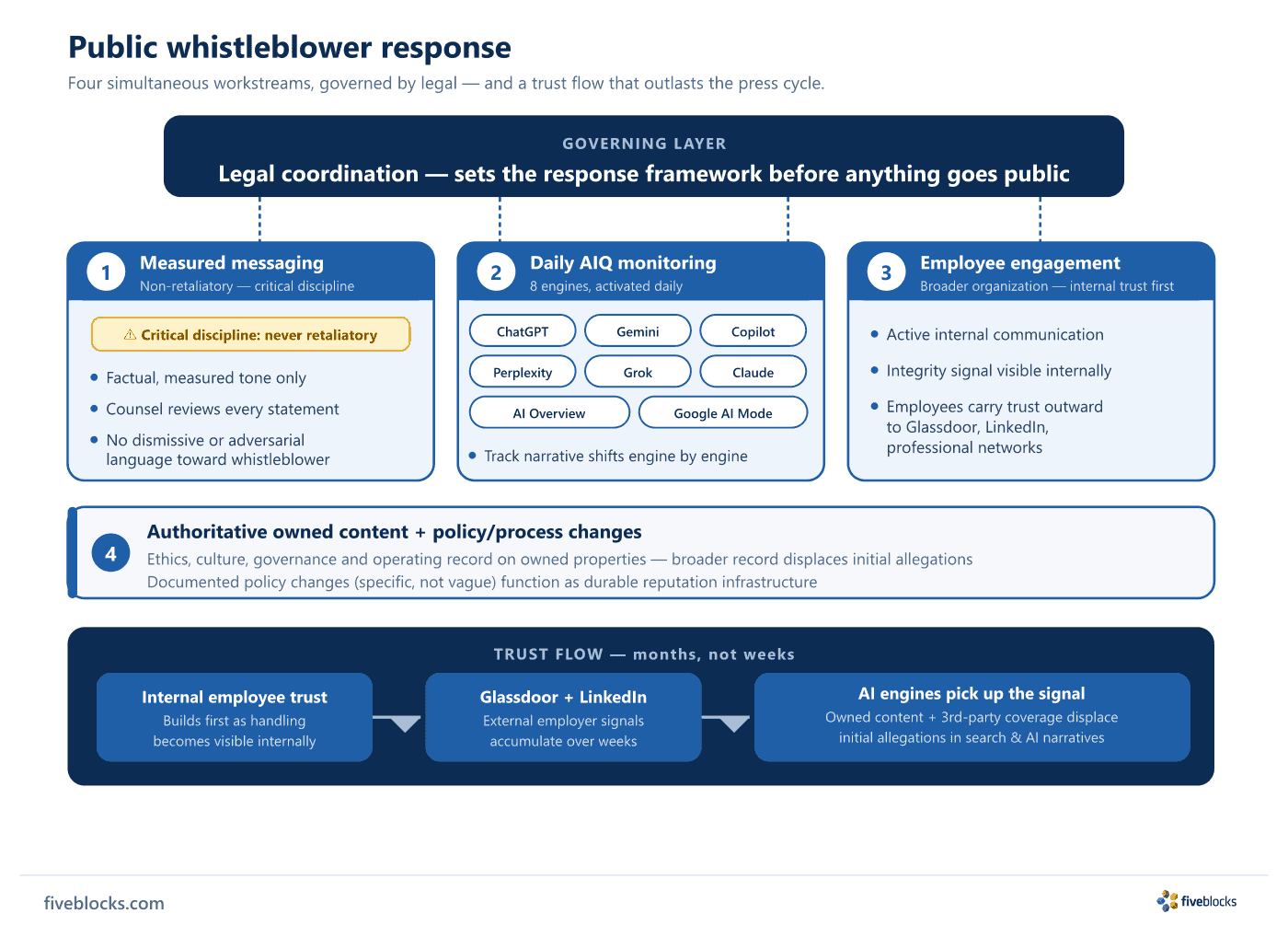
A public whistleblower situation requires legal-led coordination on what can be addressed, strictly non-retaliatory messaging, daily AIQ monitoring across the eight AI engines AIQ currently tracks, active employee engagement across the broader organization, and authoritative owned content covering the company's operating record and any policy changes made. Resolution usually takes months; the digital infrastructure built during the situation stays in place long after.
Public whistleblower situations demand discipline across four workstreams that run at the same time: legal, messaging, digital monitoring, and internal culture. Each one affects the others, and a failure in any one can turn a contained situation into a drawn-out reputation crisis.
Step 1: Legal coordination sets the response framework
Legal leads. Counsel determines what the underlying matter involves, what regulatory frameworks apply, and what can or cannot be said publicly. Nothing goes out through comms or on owned properties until that framework is clear. Running ahead of legal counsel in a whistleblower situation is one of the most reliable ways to make it worse.
Step 2: Non-retaliatory messaging is the discipline that matters most
Messaging is measured, factual, and never retaliatory in tone, even rhetorically. This is the discipline that matters most in the public-facing layer. Retaliatory framing, even language that reads as dismissive or adversarial toward the whistleblower, can turn a contained situation into a regulatory matter on top of a reputation crisis. Counsel reviews every public statement for this before it goes out.
Step 3: Daily AIQ monitoring across the eight engines AIQ tracks
AIQ topics are set up on the specific allegations and the company’s response, then monitored daily across the eight AI engines AIQ currently tracks: ChatGPT, Copilot, Gemini, AI Overview, Perplexity, Grok, Claude, and Google AI Mode. The engines absorb whistleblower accounts quickly and often settle on a framing within days. Knowing what each engine is saying, which sources it is weighting, and how the narrative is shifting is the intelligence that guides everything else in the digital workstream.
Step 4: Employee engagement across the broader organization
Internal trust during the situation feeds long-term external reputation. Employees who believe the company is handling the situation with integrity carry that signal out through Glassdoor, LinkedIn, and informal professional networks, and AI engines pick it up over time. Companies that neglect internal communication during a whistleblower situation often find the Glassdoor and Blind footprint hardening against them well after the press cycle ends.
Step 5: Authoritative owned content and the broader record
Owned properties carry content covering the company’s broader operating record: ethics, culture, governance, policy standards, so that stakeholders who search the situation find a fuller picture rather than only the whistleblower account. Where the situation prompts actual policy or process changes, those changes are documented on owned properties in specific terms. Vague commitments to improvement do not work as reputation infrastructure; documented changes do.
Trust flow and timeline
The resolution arc is usually measured in months, not weeks. Internal employee trust builds first, as the company’s handling becomes visible inside the organization; that trust flows outward to Glassdoor and LinkedIn; AI engines pick up those signals over the following weeks. In parallel, the authoritative owned content and any third-party coverage of the resolution gain authority and start to displace the initial allegations in search results and AI narratives. The digital infrastructure built during the situation, meaning the monitoring, owned content, and documented changes, is the asset that shapes perception long after the immediate situation passes.
Last reviewed: 19/05/2026
