How do you handle negative coverage from investigative journalism?
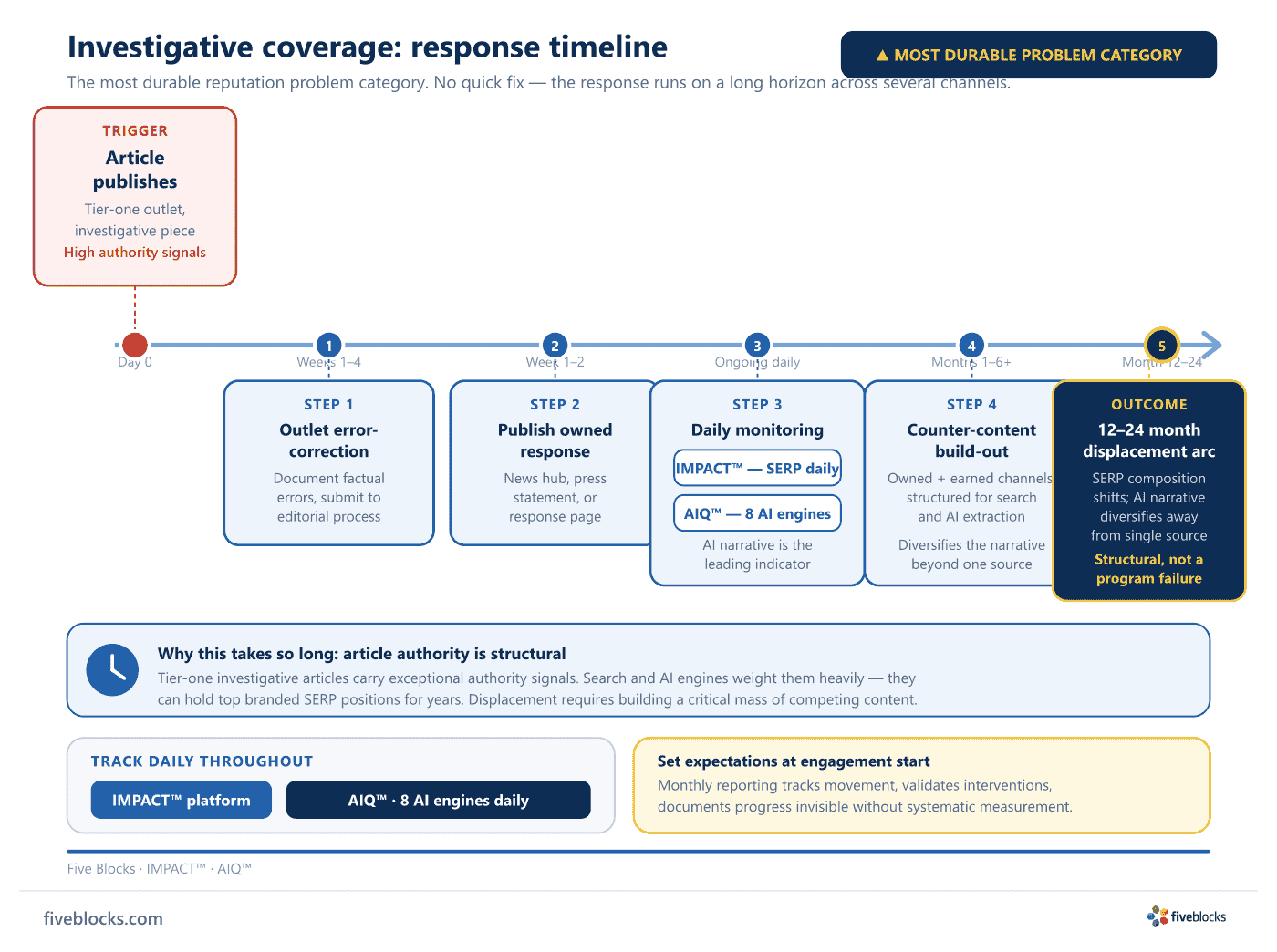
Investigative coverage from major outlets is the most durable reputation problem in this work: the authority signals are strong, AI engines weight the source heavily, and the article tends to rank for years. The response runs on a long horizon and across several channels: factual engagement with the outlet's editorial process where errors exist, daily SERP and AI narrative monitoring, authoritative counter-content covering the broader operating record, and no expectation of a quick fix.
Investigative coverage from tier-one outlets is the most durable reputation problem in this work. The authority signals are strong, AI engines weight the source heavily, and the article tends to rank for the relevant branded queries for years. Quick fixes do not exist. The response runs on a long horizon and across several channels.
Step 1: Engage the outlet’s editorial process
Where the reporting contains factual errors, the first channel is the outlet’s editorial correction process. Most major news publishers keep published corrections policies and will correct documented errors when they are presented with proper sourcing. Prepare a factual, dispassionate submission that cites specific errors with verifiable evidence. This is a correction of discrete factual claims, not a rebuttal of the investigation’s conclusions. It is a slow process, but a published correction changes the article’s authority signal in search and AI engines.
Step 2: Publish the company’s full position on owned properties
The company states what it can address through its owned properties so stakeholders can find the complete picture. A news hub entry, press statement, or dedicated response page covering the company’s factual position gives journalists, AI engines, and other stakeholders an authoritative source the company controls, one that exists alongside the investigative article rather than leaving silence in its place.
Step 3: Monitor search rank and AI narrative daily
The SERP composition matters more than any single article. Run IMPACT™ daily on the priority branded queries to track where the article is ranking, whether it is capturing Top Stories or AI Overview placement, and whether it is gaining or losing ground against other results. Run AIQ™ daily across the eight AI engines AIQ currently tracks: ChatGPT, Gemini, Perplexity, Copilot, Grok, Claude, AI Overview, and Google AI Mode. AI narrative formation is often the leading indicator of how the story will persist with stakeholders. An unaddressed major-outlet negative article can hold a top-page branded SERP position for multiple years; knowing exactly how it is sitting, and whether it is shifting, is the basis for the response strategy.
Step 4: Build authoritative counter-content covering the broader record
The investigative piece should be one input in the picture, not the whole picture. Build authoritative content across owned and earned channels covering the company’s operating record, leadership, commitments, and track record, structured for search and AI extraction, properly marked up, and linked to by credible third-party sources. The goal is not to delete or bury the article but to make sure the totality of what a stakeholder finds reflects the company accurately. As this content accumulates and gains authority, the SERP composition shifts and the AI narrative draws on more than a single source.
Step 5: Accept the 12 to 24 month displacement arc
This work takes twelve to twenty-four months to shift materially, and that timeline reflects how search and AI engines weight authoritative investigative sources; it is not a sign the program is failing. Set expectations accordingly at the start of the engagement. Monthly reporting tracks movement across all channels, confirms the right interventions are landing, and documents progress that is invisible without systematic measurement. The work done in this period determines whether the investigation becomes the defining association or one chapter in a fuller record.
Last reviewed: 19/05/2026
