How do you handle negative search results from early career that are no longer relevant?
Outdated early-career results are an update problem, not a removal problem. Publish current authoritative content about the present role, refresh the entity signals, and ask the source to revise its listing where the platform allows it, then keep the work going so the newer results displace the older ones. AI engines hold the early-career framing longer than the Google SERP does, so monitor what each engine says and correct it at the source.
Early-career content that ranks for a senior executive’s name is usually outdated rather than damaging. It dilutes the picture. The remediation is the standard outdated-content playbook with one modification: the older material is often accurate to its period, so the work centers on updating sources where outlets accept requests, not on removal.
The patterns that show up
- An old company role still listed on professional directories.
- A former employer’s leadership page that has not been updated.
- A quote from a decade-old industry interview.
- An academic publication from a prior career stage.
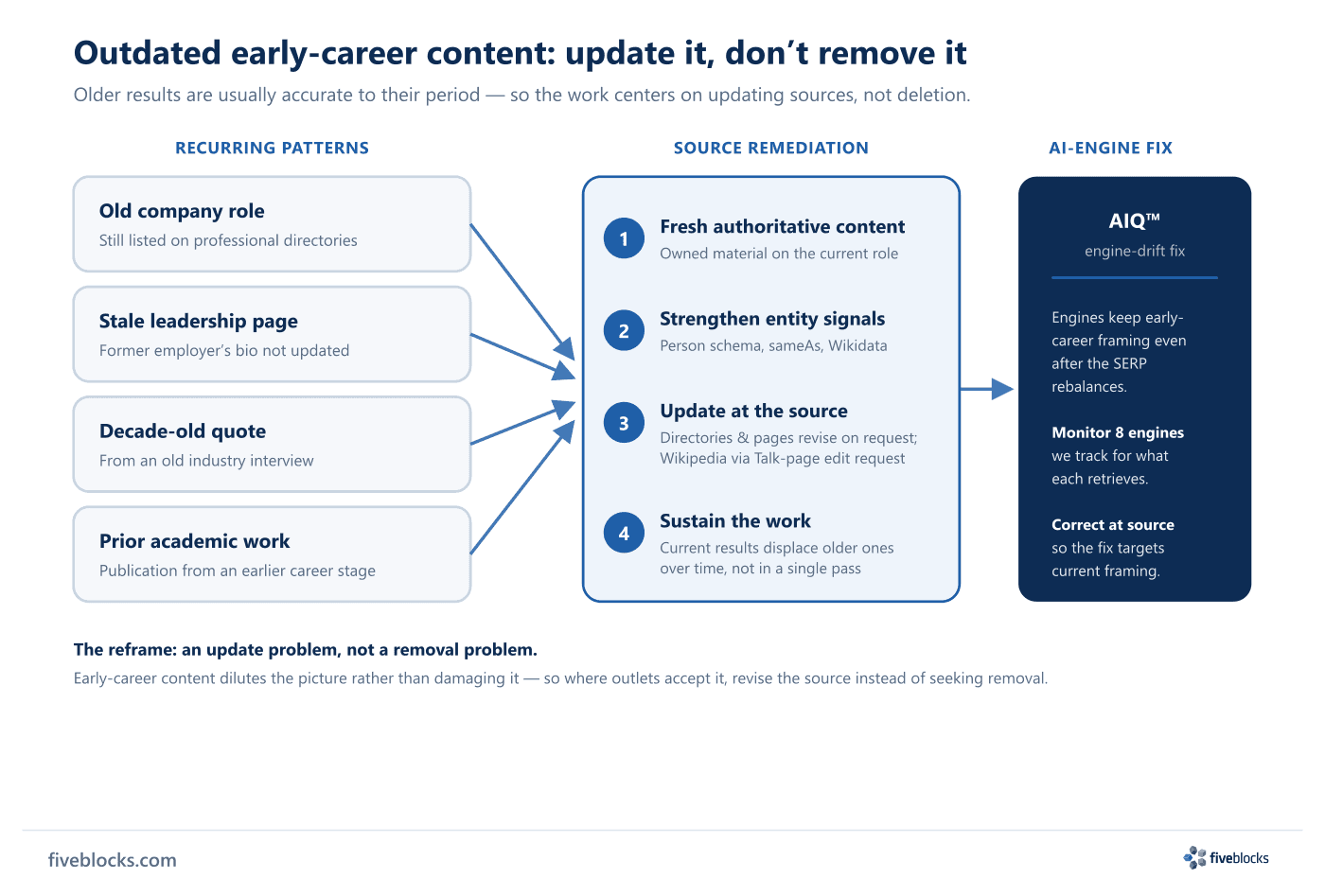
The remediation, in order
- Publish current authoritative content on the present role and career, so the up-to-date picture has owned, structured material behind it.
- Update the entity signals: Person schema,
sameAslinks, Wikidata, and consistent descriptions across authoritative profiles. These are what let search and AI engines resolve the executive to the current identity. - Pursue source-level updates. Former employers and directories will often revise a listing on request, with proper documentation. Where a page has changed but the cache lags, Google’s outdated-content removal tool can refresh the result. On Wikipedia, corrections run through the Talk-page edit-request process, backed by reliable secondary sources.
- Sustain the work. Current results displace the older ones over time, not in a single pass.
Why AI engines need separate attention
AI engines often keep citing early-career roles after the Google SERP has rebalanced. Training data is weighted toward an executive’s most-covered period, so an engine holds the prior framing for years after a role change unless it is actively corrected, and it can keep serving outdated information after the source has already been fixed. AIQ tracks how each of the eight AI engines it currently covers describes the executive, so remediation can target what that engine is actually drawing on.
Last reviewed: 19/05/2026
