How do you handle negative search results from old social media posts?
Old social-media posts that surface in search are handled through four paths: remove the post directly if you still control the account; use platform recovery if you have lost access; challenge third-party archives where their removal policies allow it; and publish current authoritative content on the topic so the engines have stronger, more recent material to weight. Monitor with AIQ™ throughout, because AI engines train on archived social content and keep returning old posts long after the original has been deleted.
Old social-media posts that appear in search are a distinct reputation problem. The content often reflects views or context from years ago, the person may or may not still have access to the account, and the post may sit in third-party archives even after it is removed at source. There are four paths to work through.
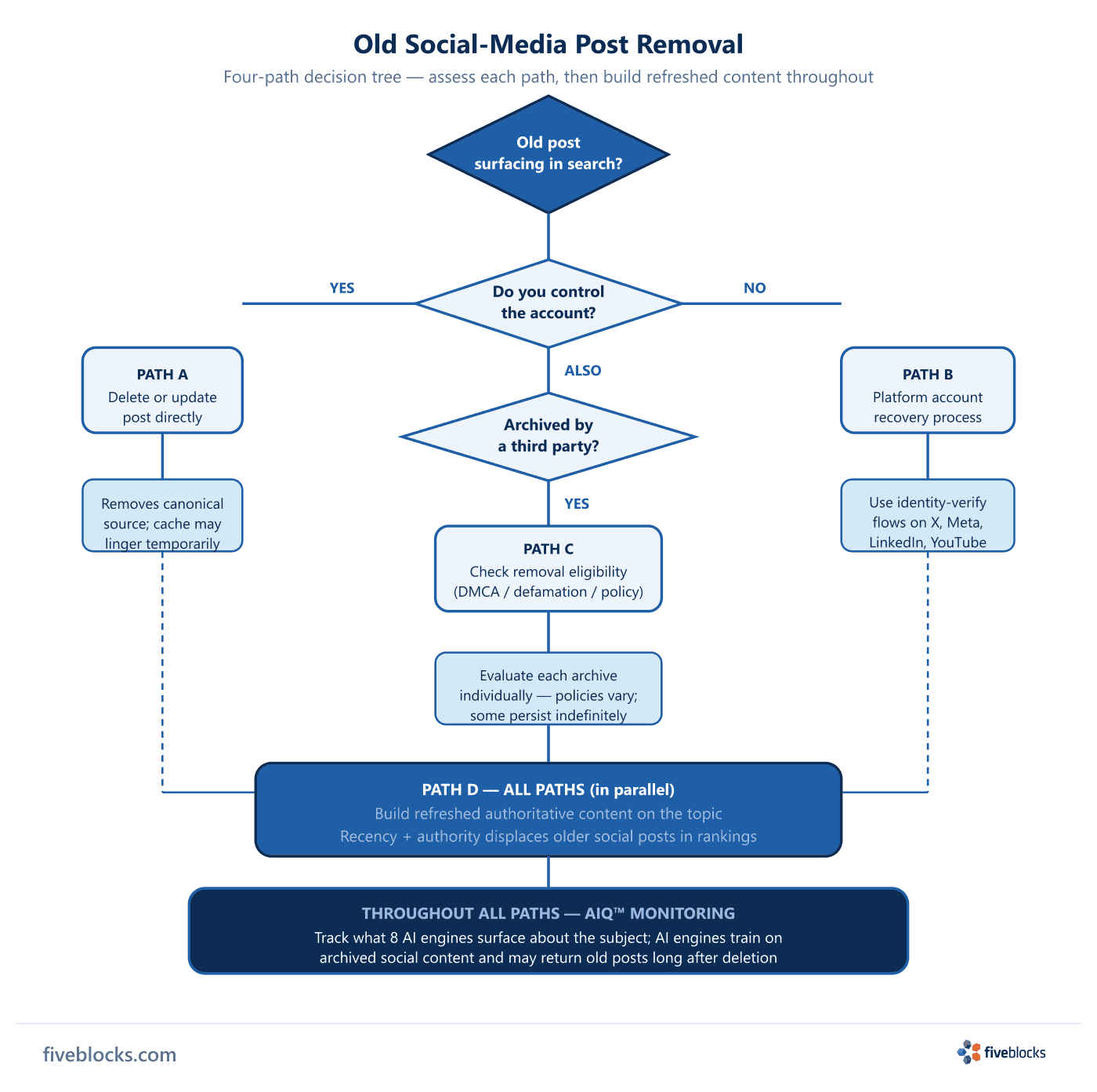
Step 1, Remove or update the post directly (own account)
If you still control the account, this is the first and most effective action. Delete the post, or, where a soft correction fits better, update it with current context. Direct removal takes out the canonical source and can speed up de-indexing, though Google’s cache and third-party archives may hold a copy for a while.
Step 2, Use platform account recovery (lost access)
When the account is no longer accessible, most major platforms have account recovery processes. Results vary: some recoveries are straightforward; others the platform never completes. Exhaust the official recovery channels before you conclude the content cannot be reached at source.
- Google and YouTube have a dedicated account recovery flow for forgotten credentials and lost verification access.
- X, Facebook, LinkedIn, and Instagram each run their own identity-verification-based recovery process.
- Recovery is worth attempting even for older accounts; platforms generally keep login infrastructure active for dormant accounts.
Step 3, Challenge third-party archives where eligible
Third-party archive sites, web crawlers, screenshot archives, and syndication aggregators, differ widely in how far they will go to honor removal requests. Some accept requests on specific grounds (DMCA, defamation, or platform policy); others hold the content indefinitely no matter what happens at source. Check each archive against its published removal policy before you spend time on a challenge its terms do not support.
Step 4, Build refreshed authoritative content
Whatever can be removed, publish authoritative content on the underlying topic from the current perspective. The engines weight recency and authority, so stronger, more recent material on the same theme gradually displaces older social content in ranked results as it accumulates. This is the most durable path, and it runs alongside the removal steps above.
Throughout all steps, monitor AI engines with AIQ™
AI engines train heavily on archived social content, including content pulled in through large web crawls such as Common Crawl, which supplies a large share of LLM training data. They keep returning old posts in responses long after the original has been deleted or de-indexed by Google. AIQ™ monitoring tracks what each of the eight major AI engines is currently surfacing about the subject. It shows whether the old post has been absorbed into AI-generated answers and when the engine’s narrative shifts in response to the refreshed content.
Last reviewed: 19/05/2026
