How do you handle personal photos or social media posts that damage professional reputation?
Delete the post at the source where the platform allows it, pursue source-level engagement wherever it has been archived or mirrored, and publish newer content that displaces the older material. Watch the AI engines as well: they can keep surfacing a deleted post from archived snapshots after the live content is gone.
Old social-media content that ranks against an executive’s professional name is an awkward problem, because the original post is usually theirs. What to do about it depends on where the post now lives, so the work follows a decision tree that starts at the source and moves outward.
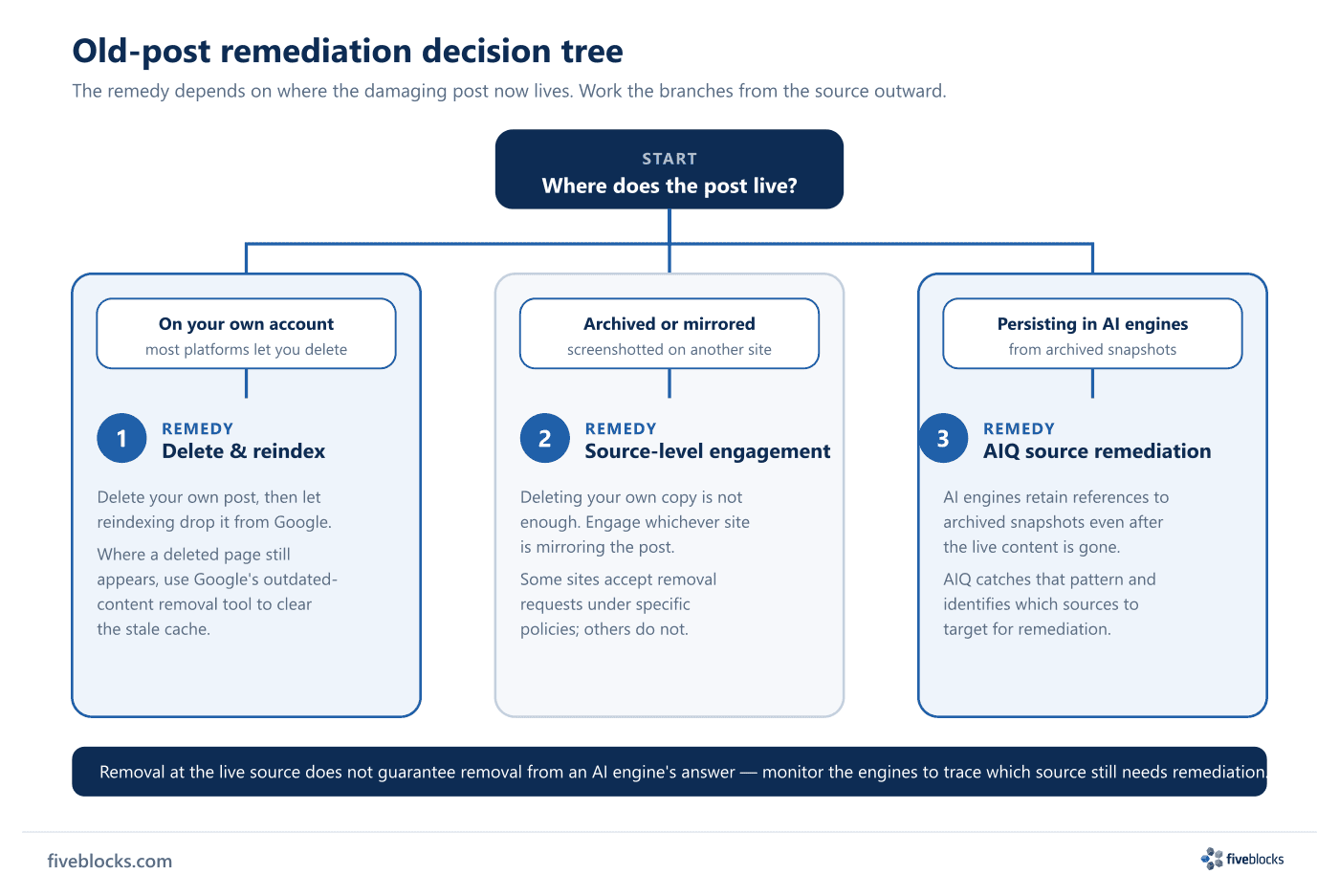
Where the post lives determines the remedy
- Your own account, delete and reindex. Most platforms let you delete your own posts. Deletion followed by reindexing eventually drops the result from Google. Where a deleted page still appears, Google’s outdated-content removal tool handles cases where a page has changed but the cache has not caught up.
- Archived or mirrored elsewhere, source-level engagement. If the post has been screenshotted or archived on another site, deleting your own copy is not enough. The work shifts to engaging whichever site is mirroring it. Some sites accept removal requests under specific policies; others do not.
- Persisting in AI engines, AIQ-driven source remediation. AI engines often retain references to archived snapshots after the live content is gone, so a post deleted from Instagram can still appear in AI responses. AIQ flags that pattern and identifies which sources keep the reference alive, so remediation can target them.
What removal at the source does not fix
Taking the post down at the live source does not clear it from an AI engine’s answer. Engines train heavily on archived social content and can keep returning old posts after the original is removed. AIQ tracks the major AI engines, so you can see which one still surfaces a deleted post and trace it back to the specific source that needs remediation.
Last reviewed: 19/05/2026
