How do you handle outdated or irrelevant information showing up in personal search results?
Outdated personal search results are fixed on three parallel tracks: fresh authoritative content tied to the person's current activities, refreshed entity signals (LinkedIn, Wikipedia and Wikidata where applicable, Person schema with the current role), and source-level updates wherever the hosting platform accepts them. Most cases reach a current canonical picture within six to twelve months.
Outdated information in personal search results is a quieter problem than active negative content, but it accumulates over years and ends up painting a misleading picture: an old title, a former employer, a role the person left long ago. There is no single switch that refreshes it. The structural fix runs on three parallel tracks, each working on a different part of how search and AI engines assemble the picture.
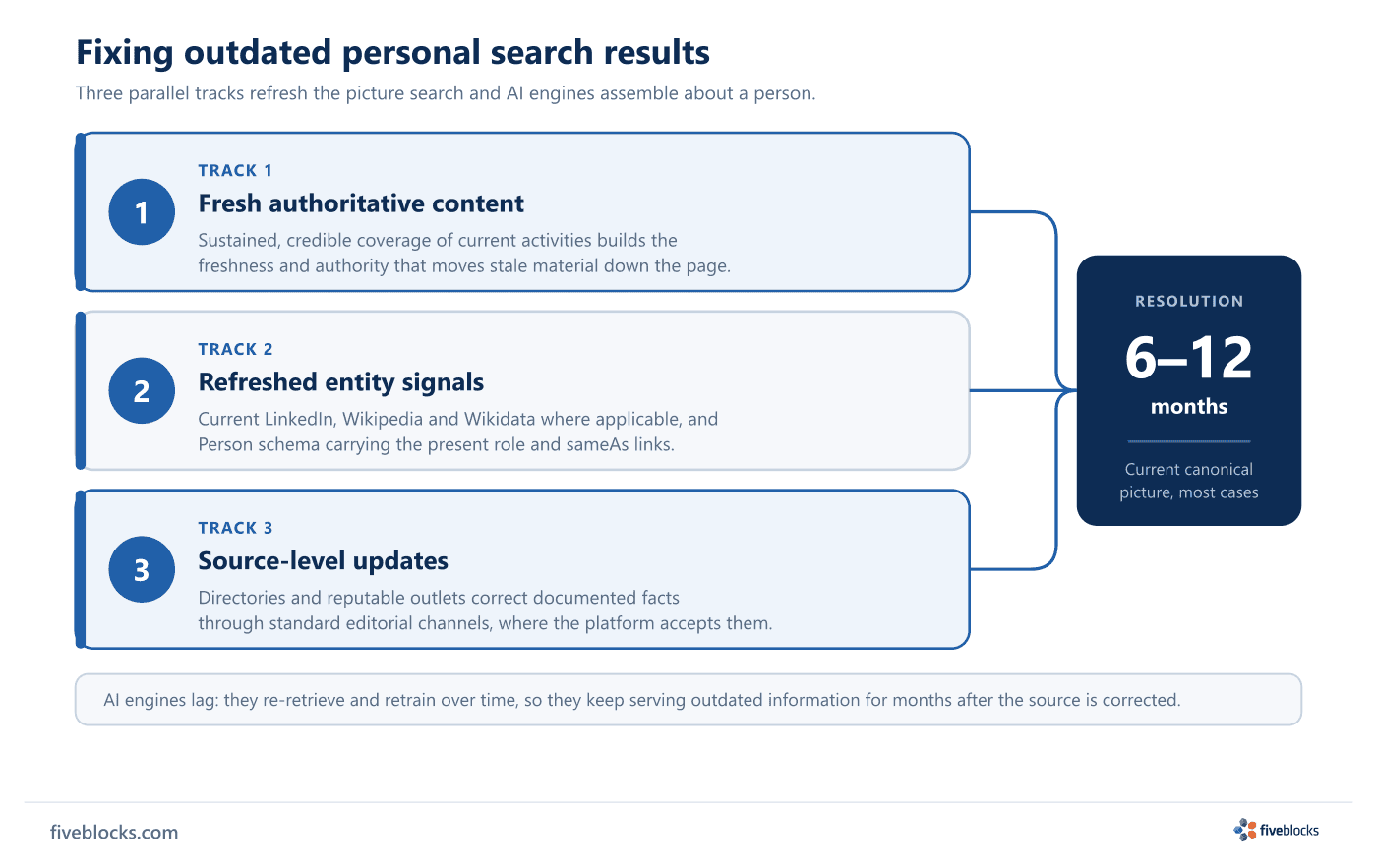
The three tracks
- Fresh authoritative content tied to current activities. Sustained, credible content about what the person is doing now builds the authority and freshness signals that push the older material down the visible page. This is the slower track. A stale article’s freshness advantage decays over time, but the newer content still has to accumulate enough authority to outrank it, and a single owned page rarely carries enough weight on its own to displace a tier-one result. The work depends on credible, third-party-cited coverage rather than volume.
- Refreshed entity signals. The connected web of references that identifies the person to search and AI engines has to reflect the present: a current LinkedIn profile, which ranks consistently for individual name queries; an updated Wikipedia article and Wikidata entry where applicable; and Person schema on the bio carrying the current jobTitle and worksFor, with sameAs links to the authoritative profiles. When these signals line up on the current role, the engines describe the person as they are now rather than as they were.
- Source-level updates where the platform accepts them. Many professional directories and most reputable news outlets will update factual information on request through their standard editorial channels, and a properly documented outdated fact is the kind of correction those channels handle. The request is a private exchange between the requester and the publication. Some platforms update in place, some decline, and the work then leans on the other two tracks.
The AI layer lags
AI engines retrain and re-retrieve against updated sources over time rather than instantly, and they often keep serving outdated information for months after the underlying source has been corrected. That is why source-level and entity work comes first: the engines catch up only once the sources they read have changed. Run all three tracks and most cases reach a current canonical picture within roughly six to twelve months.
Last reviewed: 19/05/2026
