How do you handle search results that show outdated company information?
Outdated company information in search and AI results is fixed by correcting the source at every authoritative layer, corporate site, third-party directories (Crunchbase, Bloomberg, LinkedIn), Wikipedia, and the Google Knowledge Panel, then monitoring AI engines separately, because training-baselined engines can keep serving stale data for months after the underlying sources have been corrected.
Outdated information in search is a quiet but common reputation problem: an old address, a previous executive lineup, a discontinued product line, a stale revenue figure. It builds up and erodes the brand’s digital picture without ever becoming a visible crisis. Fixing it takes methodical updates across every authoritative source, not just the corporate website, because search and AI engines weight each layer independently and the AI layer updates on its own schedule.
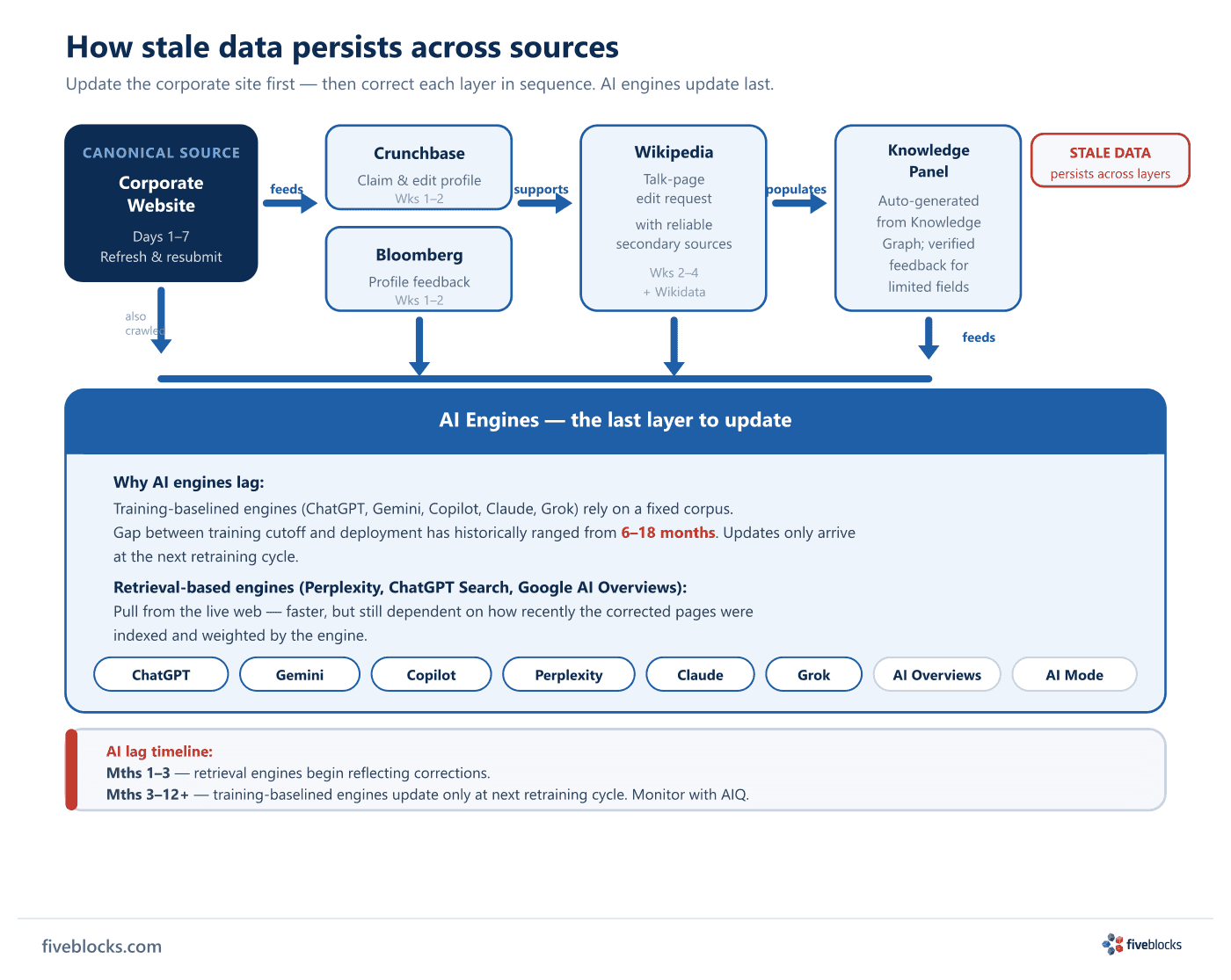
Step 1: Refresh the corporate site
The corporate website is the canonical reference for all other sources. Update company facts, leadership pages, location data, and product information, then wrap the current content in structured data (Organization schema with foundingDate, address, numberOfEmployees, sameAs, and named leadership with Person schema). An accurate, well-marked-up corporate site gives the engines a clear baseline to crawl against.
Step 2: Update third-party directories
Third-party directories, Crunchbase, Bloomberg, LinkedIn, and industry-specific directories, hold their own data and do not automatically pick up changes to the corporate site. Each platform has its own correction channel:
- Crunchbase: Company administrators can edit profile fields directly after claiming the profile.
- LinkedIn: Page administrators update the company page through the admin panel.
- Bloomberg: Corrections go through Bloomberg’s company profile feedback process.
- Industry directories: Each has its own contact or correction path; claim profiles where not yet claimed.
These sources rank on branded SERPs and feed AI engine training and retrieval, so leaving them stale undercuts the updates made elsewhere.
Step 3: Update Wikipedia through the Talk-page edit-request process
Wikipedia articles about companies often carry outdated facts, old headquarter cities, former CEO names, historical revenue figures, that stay because no one has filed a correction with proper sourcing. Propose changes through a disclosed Talk-page edit request backed by reliable secondary sources (press releases corroborated by news coverage, regulatory filings, or other Wikipedia-eligible sourcing). An independent community editor reviews the request and, if the sourcing supports it, makes the change. Wikipedia feeds Google Knowledge Panels and AI engine training and retrieval, so this is one of the correction channels with the most reach.
Step 4: Refresh the Google Knowledge Panel
The Knowledge Panel’s substantive content comes mainly from Wikipedia and Wikidata, so panel accuracy follows source accuracy rather than direct edits. Where the entity has a verified Knowledge Panel, use Google’s verified entity feedback process to flag and suggest corrections to specific fields. What usually moves the panel over time is correcting the underlying Wikipedia and Wikidata entries.
Step 5: Produce current authoritative content
Fresh authoritative content, a current press release, a news hub post, an updated leadership page, a recent earnings summary, gives the engines newer signals to weight alongside or above legacy material. This helps most with facts that cannot be corrected at source (for example, a media archive quoting an old headcount), because current authoritative material accumulates and displaces the stale signal in rankings over time.
Step 6: Monitor AI engines separately with AIQ
AI engines do not update on the same schedule as Google Search. Training-baselined engines (those relying mainly on a fixed training corpus) can keep returning outdated information for months after the source has been corrected, because model retraining cycles have historically run six months to a year or more between training cutoff and deployment. Retrieval-based engines (Perplexity, ChatGPT Search, Google AI Overviews) update faster by pulling from the live web, but their responses still depend on how recently a corrected page has been indexed and weighted. Monitor AI engine responses through AIQ across the major engines to track what is being served, find which stale sources are driving incorrect responses, and confirm when updates start propagating through each engine’s output.
Timeline expectations
- Days 1, 7: Corporate site refreshed and re-submitted for crawl; directory correction requests submitted.
- Weeks 2, 4: Wikipedia Talk-page edit request filed; Knowledge Panel correction submitted.
- Months 1, 3: Google Search re-ranks updated content; retrieval-based AI engines begin reflecting corrections.
- Months 3, 12+: Training-baselined AI engines update only on their retraining cycles; persistent updating across all source layers accelerates propagation.
Last reviewed: 19/05/2026
