How do you handle AI search results that cite outdated information about your company?
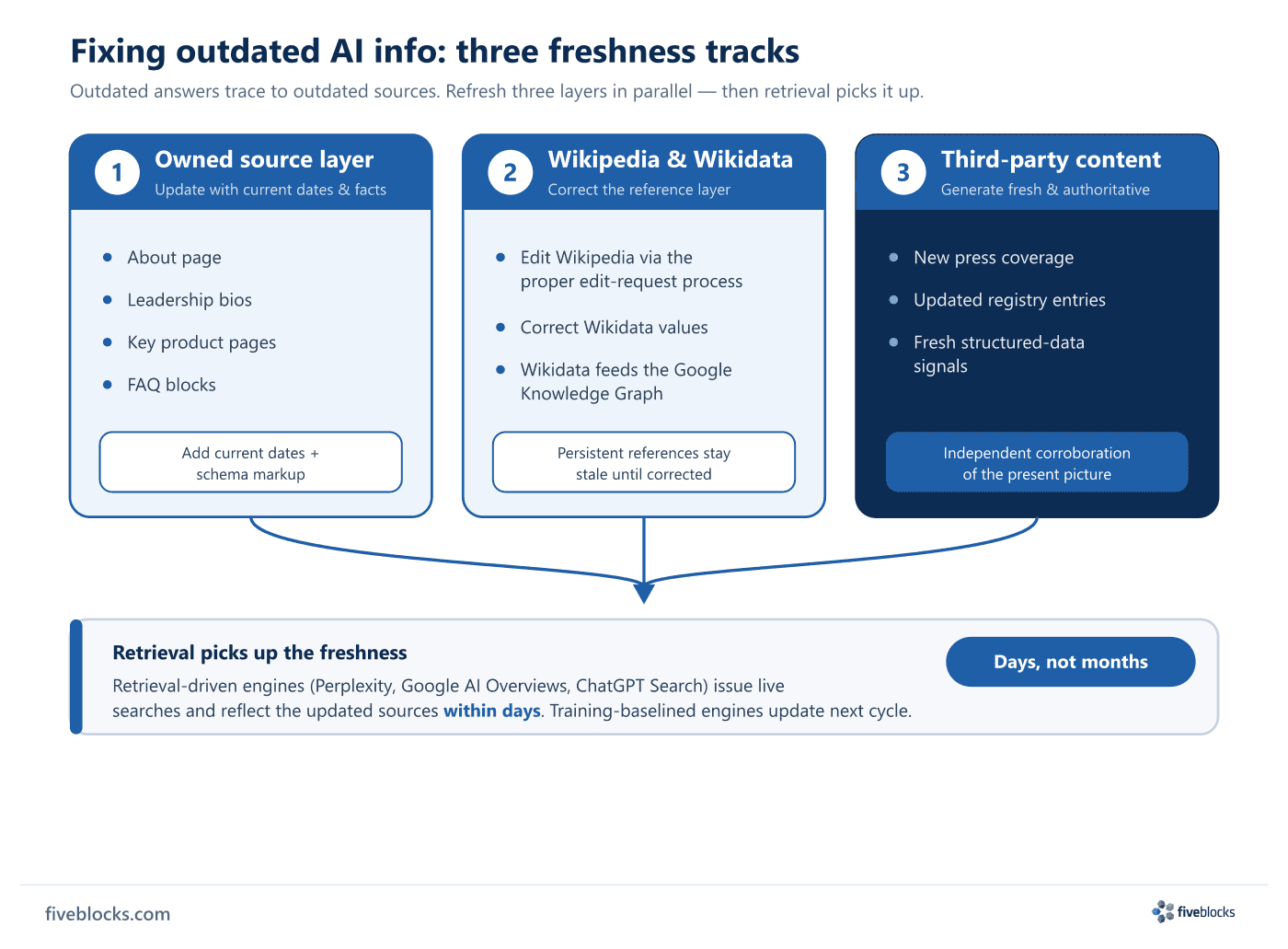
Outdated AI answers trace to outdated sources. Run three tracks in parallel - update your own pages (About, bios, product pages, FAQ) with current dates and facts; update Wikipedia and Wikidata; and generate recent authoritative third-party content - then monitor for the fresh information to show up. Engines that search the live web pick it up within days; engines that answer from training data update on their next cycle.
Outdated AI responses trace to outdated sources. An engine reflects whatever its sources say, and it pulls most reliably from content that is recently updated and fact-dense. If a brand is still described by its 2022 profile, that is because no one has refreshed the sources holding it there. The fix runs on three parallel tracks, each one updating a different part of the source picture. After that, you monitor for the new information to land.
Three freshness tracks, run in parallel
- Update your own pages. The About page, leadership bios, main product pages, and FAQ blocks, all carrying current dates and current facts. Structured data and schema markup help, because they attach each fact to the right company or person so engines surface the current version.
- Update Wikipedia and Wikidata. These references tend to stay stale until someone corrects them, and Wikidata feeds the Google Knowledge Graph, so a Wikidata correction spreads outward. Do the Wikipedia work through the proper edit-request process; correct Knowledge Graph values through Google’s feedback channels and Wikidata.
- Generate recent authoritative third-party content. New press coverage, updated registry entries, and fresh structured-data signals give the engines current, independent confirmation of the present picture. Properly sourced coverage enters the pool of sources the engines draw on, and reputable outlets will correct documented factual errors when the correction is properly sourced.
How fast the freshness lands
The two engine types pick up the refreshed sources on different clocks:
| Engine type | How it picks up freshness | Typical timeline |
|---|---|---|
| Engines that search the live web (e.g. Perplexity, Google AI Overviews, ChatGPT Search) | Run a live web search when asked and reflect updated authoritative sources, including Wikipedia edits | Hours to days |
| Engines that answer from training data | Change only when the engine is retrained; a live web search can bridge the gap in the meantime | The next training cycle (months) |
Running all three tracks at once buys corroboration. When your own pages, the reference sources, and independent third-party coverage all show the current picture, the engines see fresh agreement instead of one updated page contradicting a stale set of sources.
Last reviewed: 19/05/2026
