How do you handle AI-generated content that competes with your brand narrative?
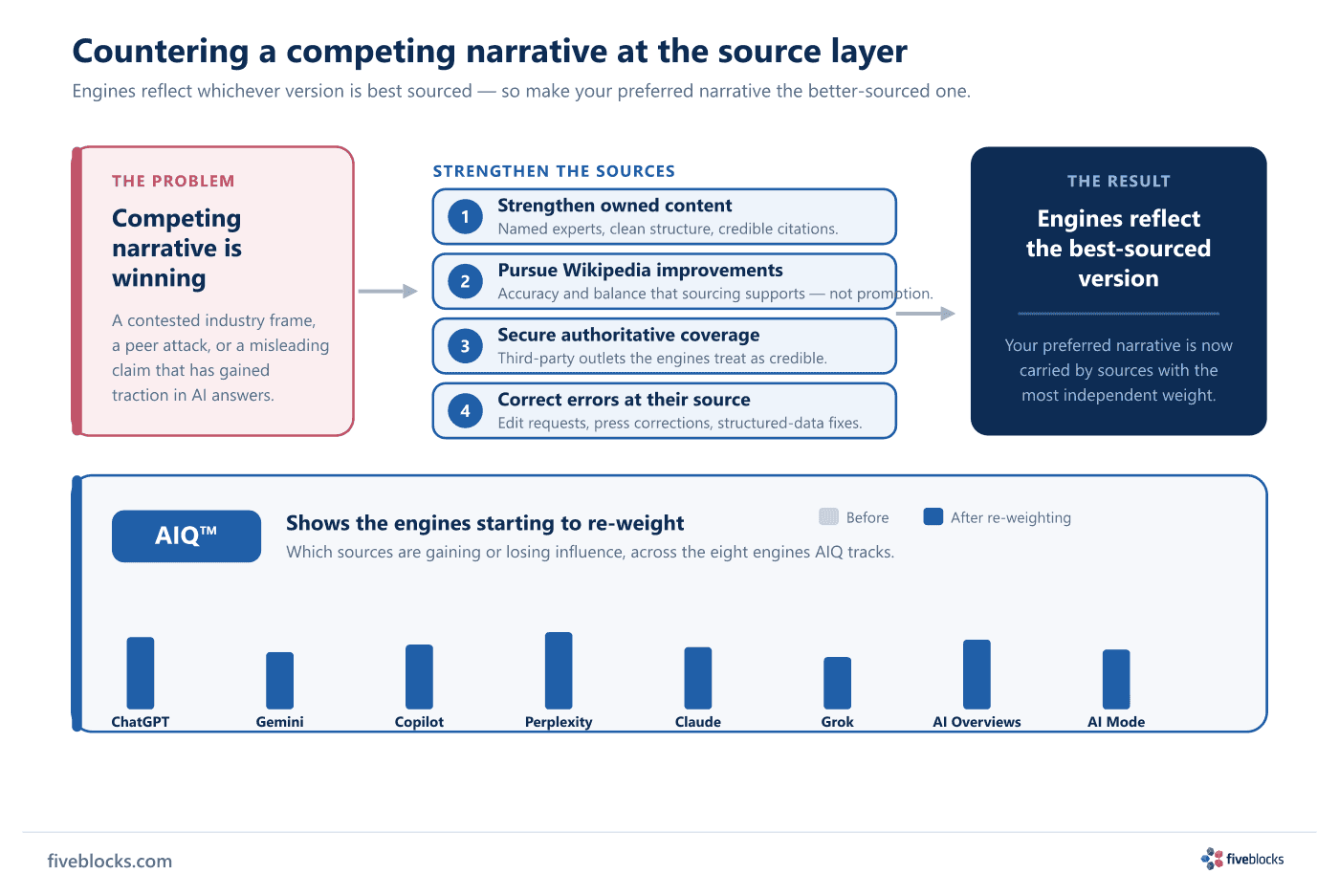
AI engines reflect whichever sources they weight most heavily, so the way to counter a competing narrative is to make your preferred narrative the better-sourced one. Strengthen owned content with named experts and credible citations, pursue Wikipedia improvements backed by independent sourcing, secure coverage in outlets the engines treat as authoritative, and correct factual errors at their source through edit requests, press corrections, and structured-data fixes.
AI engines do not take a position on competing narratives the way a journalist might; they synthesize whichever sources they weight most heavily. When a competing narrative is winning, a contested industry frame, an attack from a peer, or a misleading claim that has gained traction, the response is to make your brand’s preferred narrative the better-sourced one.
Step 1: Diagnose which sources are driving the narrative
Before changing anything, identify what the engines are reading. For retrieval-based engines such as Perplexity and ChatGPT Search, that means examining which pages the response cites. For training-weighted answers it means tracing the framing back to its highest-authority source. AIQ™ tracks this across eight major engines: ChatGPT, Copilot, Gemini, AI Overview, Perplexity, Grok, Claude, and Google AI Mode, so you can see which sources are influencing each engine’s framing at a given time.
Step 2: Correct errors at their source
Factual errors in the source ecosystem spread widely and persist. Most major news outlets keep documented corrections policies and will correct verified factual errors when a correction request is properly sourced. Structured-data errors in schema markup, Wikidata, and the Google Knowledge Graph can be corrected directly through the relevant channels: Wikidata is open to edit, and the Knowledge Panel feedback form accepts documented corrections. Wikipedia inaccuracies go through Talk-page edit requests with reliable secondary sources.
Step 3: Strengthen owned and third-party content
- Owned content. Build out your own properties with named expert authors, clear structure (question-format headings with direct answers below), credible within-text citations, and appropriate schema markup. Content that is fact-dense, structured, and properly attributed is what the engines can extract with confidence.
- Wikipedia improvements. Where independent sourcing supports it, pursue Talk-page edit requests to improve accuracy and balance. The engines weight Wikipedia heavily, and an accurate article is one of the strongest persistent signals for a brand’s preferred narrative.
- Authoritative third-party coverage. Earn coverage in the outlets the engines treat as credible: mainstream business press, specialist publications, and well-sourced professional references. Coverage from independent, authoritative sources carries more weight than additional owned pages alone, because the engines are built to synthesize across many sources and reward external corroboration.
Step 4: Monitor as corrections propagate
Source corrections do not instantly change every engine’s output. Retrieval-based engines re-weight relatively quickly when high-authority pages change; training-data-weighted engines shift over longer cycles. AIQ™ tracks which engines are starting to reflect the corrected framing and which sources are gaining or losing influence, so you can confirm the source work is having the intended effect and see where more effort is needed.
The work is slow but dependable when the source diagnosis is correct. There is no mechanism for directly editing an AI engine’s output; all influence flows through the underlying source ecosystem.
Last reviewed: 19/05/2026
