What happens when an AI-generated article about your company goes viral?
Treat a viral AI-generated article as crisis content. The speed and breadth of amplification matter more than whether the piece is favorable, unfavorable, or neutral. Trace the source, prepare authoritative counter-content, run any platform-policy escalation in parallel, and monitor the eight AI engines AIQ currently tracks for how the narrative spreads. Work on a clock of hours and days, not weeks.
A viral AI-generated article about your company is crisis content, because of the speed and breadth of the amplification and regardless of whether the piece is favorable, unfavorable, or neutral. Run the standard crisis sequence with a few AI-specific dimensions added. Work on a clock of hours and days, not weeks, and apply the same source-layer discipline you would use in any other AI reputation intervention.
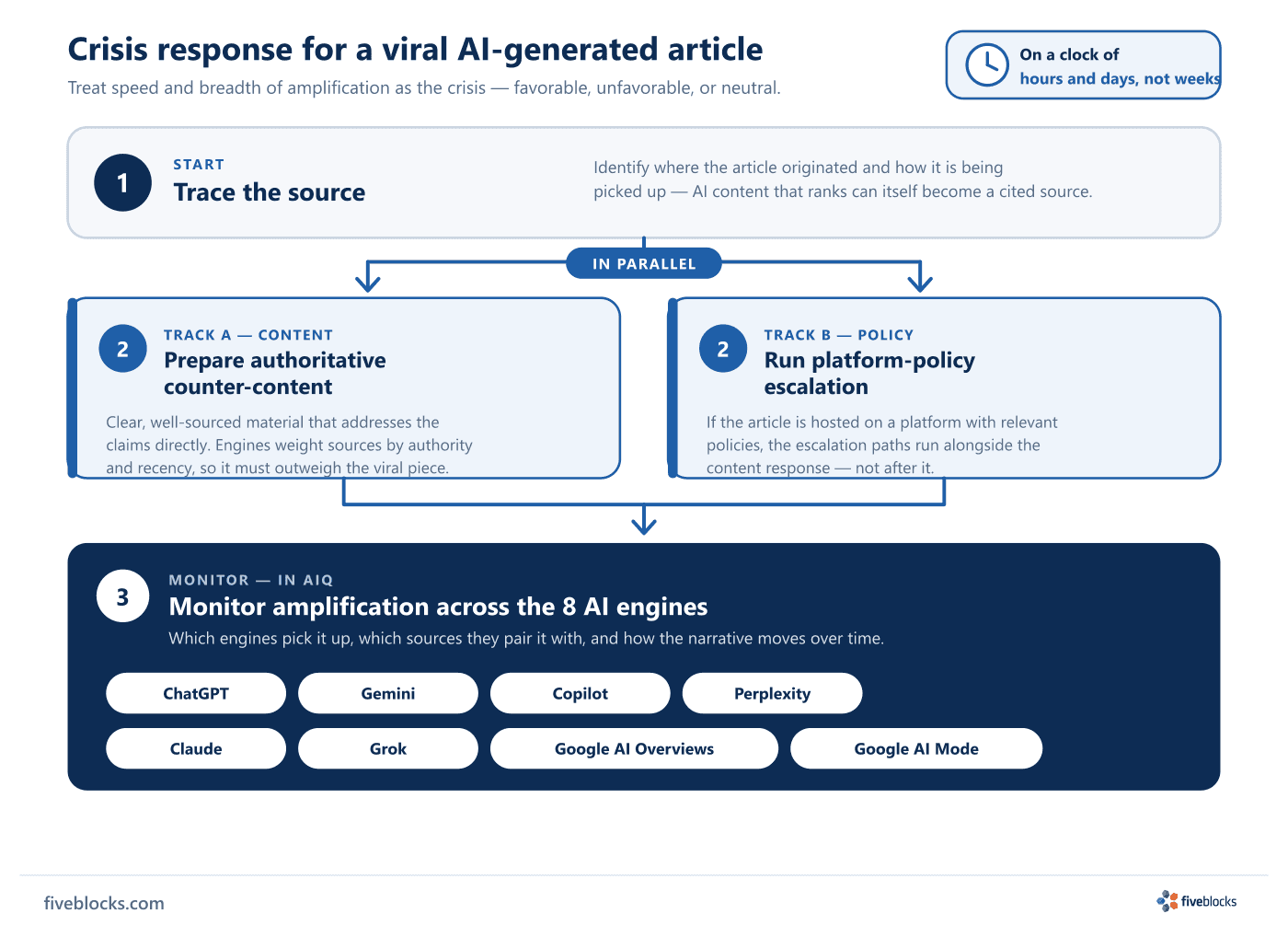
The crisis sequence, adapted for AI
- Trace the source. Identify where the article originated and how it is being picked up. AI-fabricated content that ranks in search can itself become a source the engines go on to cite.
- Prepare authoritative counter-content. Produce clear, well-sourced material that addresses the claims directly and gives the engines accurate alternatives to weigh. Engines resolve conflicting information by weighting sources on authority and recency, so the counter-content has to be credible enough to outweigh the viral piece, not just exist alongside it.
- Run platform-policy escalation in parallel. If the article sits on a platform with relevant policies, run the policy-based escalation paths alongside the content response, not after it.
- Monitor amplification across the engines. Track how the eight AI engines AIQ currently tracks are absorbing the viral content: which engines are picking it up, which sources they are pairing it with, and how the narrative moves over time.
The AI-specific dimensions
- Engines synthesize; they do not republish. Each engine builds its answer from the surrounding source ecosystem, weighted by authority and recency. That is why you target the sources, not the engine outputs.
- A single viral source can be over-weighted. Engines can lean too heavily on one contested source when forming an answer, so well-sourced counter-content gives them a higher-authority alternative to weigh.
- Amplification crosses platforms. Viral content can spread beyond where it started, including into branded search, so monitor across the engines AIQ tracks rather than the originating platform alone.
- The clock is hours and days. Retrieval-driven engines reflect newly published sources within minutes to hours, so both the counter-content and the monitoring have to keep pace.
The eight engines AIQ currently tracks are ChatGPT, Gemini, Copilot, Perplexity, Claude, Grok, Google AI Overviews, and Google AI Mode.
Last reviewed: 19/05/2026
