How do you monitor AI-generated content that mentions your brand?
Track synthetic content that mentions the brand across the web, flag amplification patterns where the same fabricated claim repeats across many low-quality pages, and remediate at the source before that content ranks and becomes something the AI engines cite.
Monitoring AI-generated content that mentions a brand addresses a newer threat: synthetic articles, posts, and pages produced at scale, which can carry false or hostile narratives. Once enough of them accumulate, they start to influence both search and what the AI engines themselves draw on.
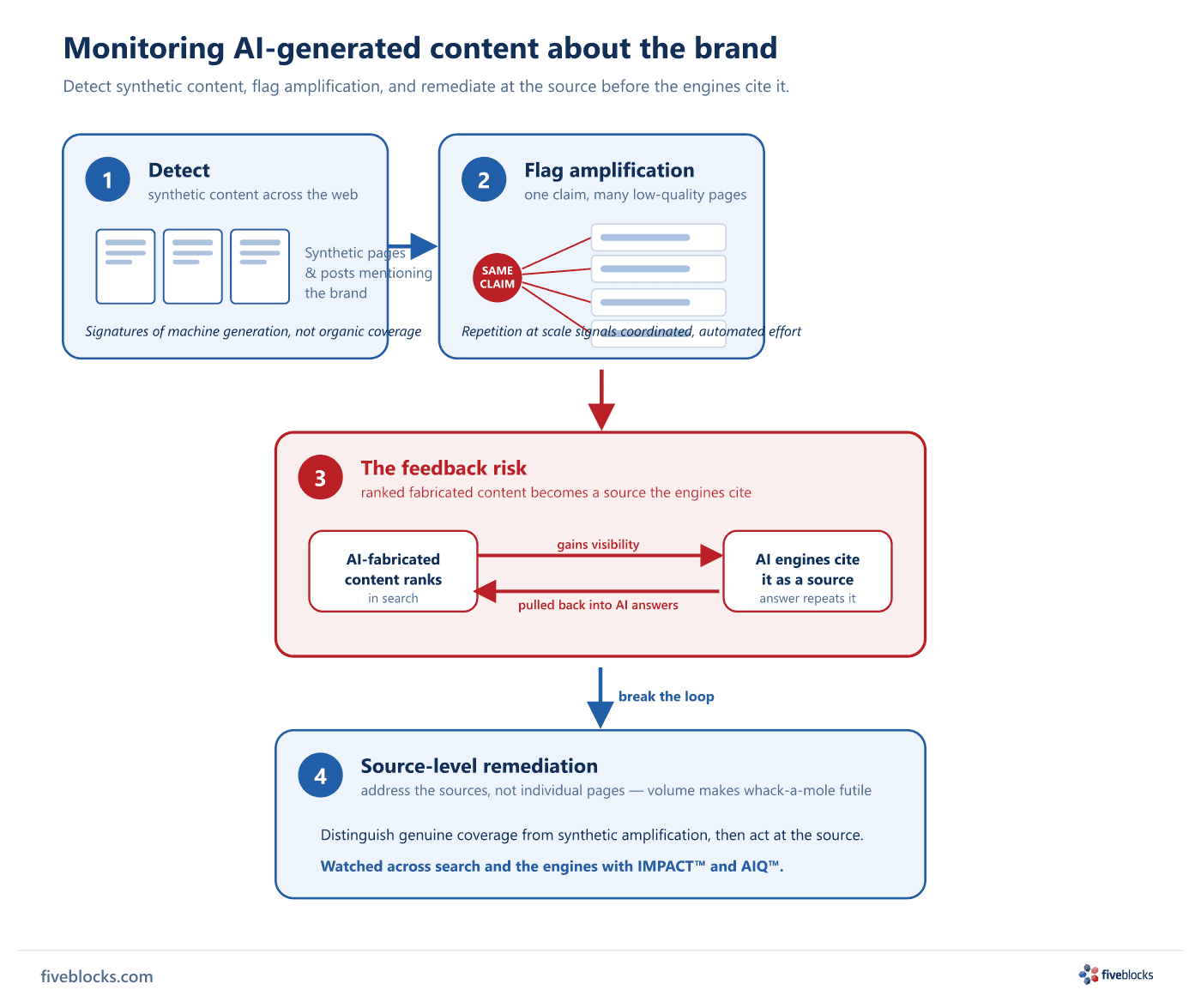
What the monitoring tracks
- Where synthetic content appears. Posts, articles, and pages mentioning the brand that carry the marks of machine generation rather than organic coverage.
- Amplification patterns. The same fabricated claim repeated across many low-quality pages, which points to a coordinated or automated effort rather than genuine reporting.
- The feedback risk. AI-fabricated content that ranks can itself become a source the engines cite.
Why the feedback loop is the real problem
A single fake page rarely does much damage on its own. The loop it can enter does. Content that ranks in search can become a source the engines cite, so a fabricated claim that gains visibility gets pulled back into AI answers and repeated. Unchecked, synthetic material ends up feeding the systems people use to ask about the brand.
The response: remediate at the source
When this content shows up, the response is source-level remediation: go after the sources rather than chasing individual pages, because the volume makes whack-a-mole futile. The hard part is telling genuine coverage apart from synthetic amplification, then acting at the source. We watch for this across search and the engines with IMPACT™ and AIQ™, since the threat moves between the two.
Last reviewed: 20/05/2026
