What happens when an AI chatbot gives wrong information about your company?
When an AI engine says something wrong about your company, the fix starts at the source, not the engine. Identify which source the engine is anchored to, AIQ shows this directly for retrieval-based engines and infers it for training-baselined engines, then correct or counter that source (a Wikipedia Talk-page edit request, a press correction, or a structured-data fix). Once the source-level work is done, track propagation across the eight major AI engines AIQ monitors: retrieval-heavy engines update within days; training-baselined engines update on their retraining cycle.
The instinct when an AI engine says something wrong about your company is to correct the engine directly. That does not work. AI engines do not remember what you tell them; they rebuild every answer from the sources they trust. Fixing AI misinformation is a source-attribution problem first and an editorial problem second. The workable fix follows a four-step sequence.
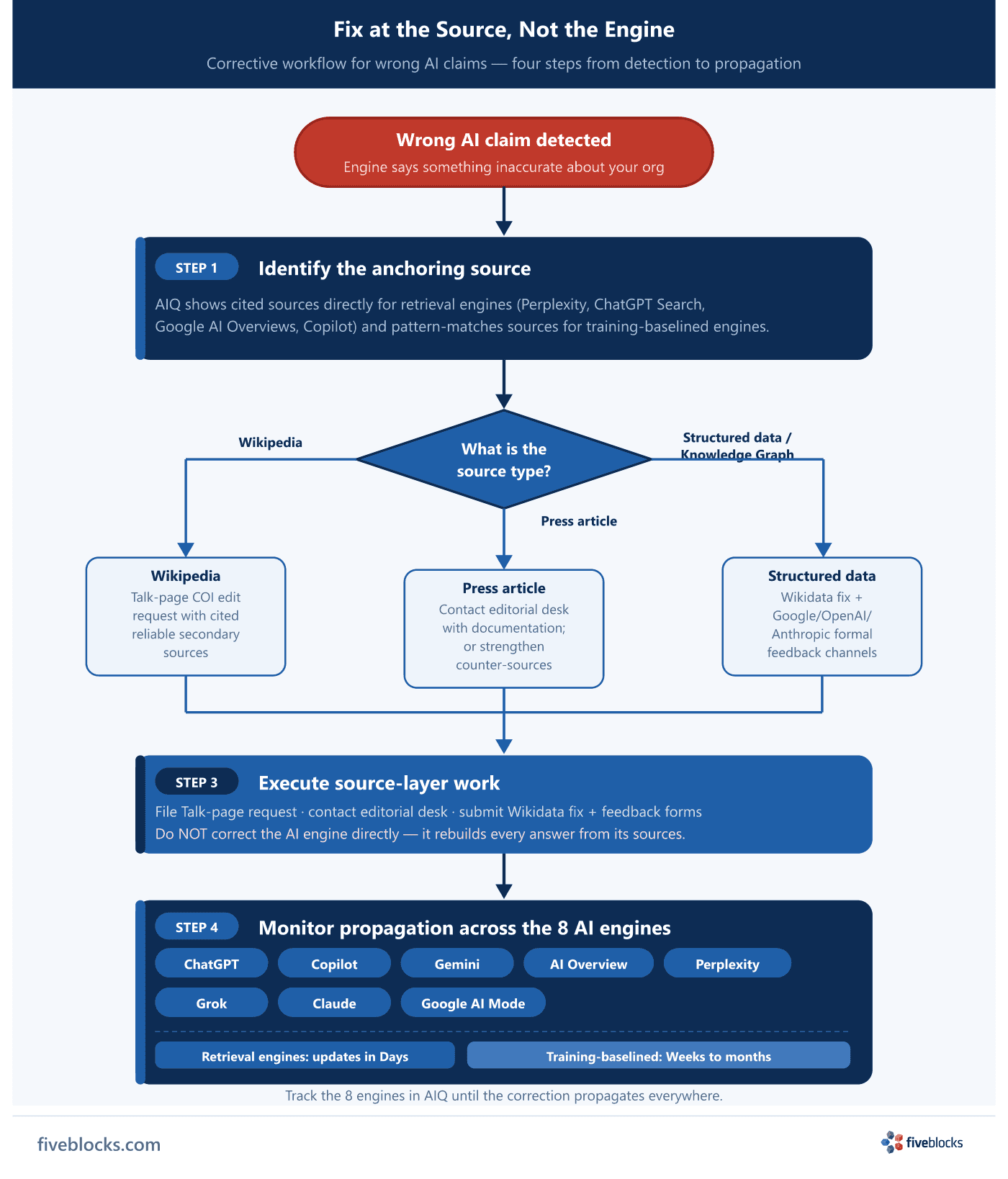
Step 1, Identify the source the engine is anchored to
Before you take any corrective action, work out what the engine is actually drawing from. For retrieval-based engines, Perplexity, ChatGPT Search, Google AI Overviews, Google AI Mode, and Copilot, AIQ™ shows the cited sources directly, because these engines tie their answers to identifiable web pages and display inline citations. For training-baselined engines that do not expose citations, AIQ pattern-matches responses against likely training sources. Skip this step and you waste effort correcting the wrong source, which moves nothing.
Step 2, Choose the right corrective path
The corrective action depends on what the source is:
- Wikipedia is the anchor. Work through the article’s Talk page using the disclosed conflict-of-interest (COI) edit-request process. Wikipedia’s terms of use require paid or COI editors to disclose their relationship and propose changes through Talk-page requests rather than direct edits; direct edits from a COI account are reverted even when the correction is accurate.
- A published article is the anchor. Most reputable news outlets have published corrections policies and will correct documented factual errors when the correction is properly sourced. If the article cannot be corrected, the fallback is to strengthen competing accurate sources until the engines re-weight.
- A Knowledge Graph or structured-data value is wrong. Knowledge Panel errors are almost always errors in the underlying sources, Wikipedia, Wikidata, or structured data, and the panel updates only once the source is corrected. Google also offers a feedback channel for verified entities and a formal report-a-problem flow for factual errors in AI Overviews; OpenAI and Anthropic each provide equivalent formal remediation channels.
Step 3, Execute the source-layer work
The work is unglamorous but reliable once the source is identified correctly: file a Talk-page edit request with cited reliable secondary sources, contact an outlet’s editorial desk with documentation, or submit a Wikidata correction and a Google feedback form. Attempts to “correct” the AI engine directly, through prompt injection, reporting buttons alone, or SEO-style workarounds, do not produce reliable or lasting changes to how the engine describes your organization.
Step 4, Monitor propagation across the engines AIQ tracks
Once the source is corrected, track the fix in AIQ across the eight major AI engines it currently monitors, ChatGPT, Copilot, Gemini, AI Overview, Perplexity, Grok, Claude, and Google AI Mode, until the correction propagates. Speed varies by engine type:
| Engine type | How it updates | Typical timeline |
|---|---|---|
| Retrieval-based engines (Perplexity, ChatGPT Search, Google AI Overviews) | Search the live web per query; index is continuously refreshed | Days |
| Training-baselined engines | Reflect the correction only after the next retraining or fine-tuning cycle | Weeks to months |
Tracking across the eight engines shows which have picked up the correction and which remain anchored to the wrong source, so you can prioritize follow-on work where the wrong answer is still active.
Last reviewed: 19/05/2026
