How do AI models handle controversial or negative information about brands?
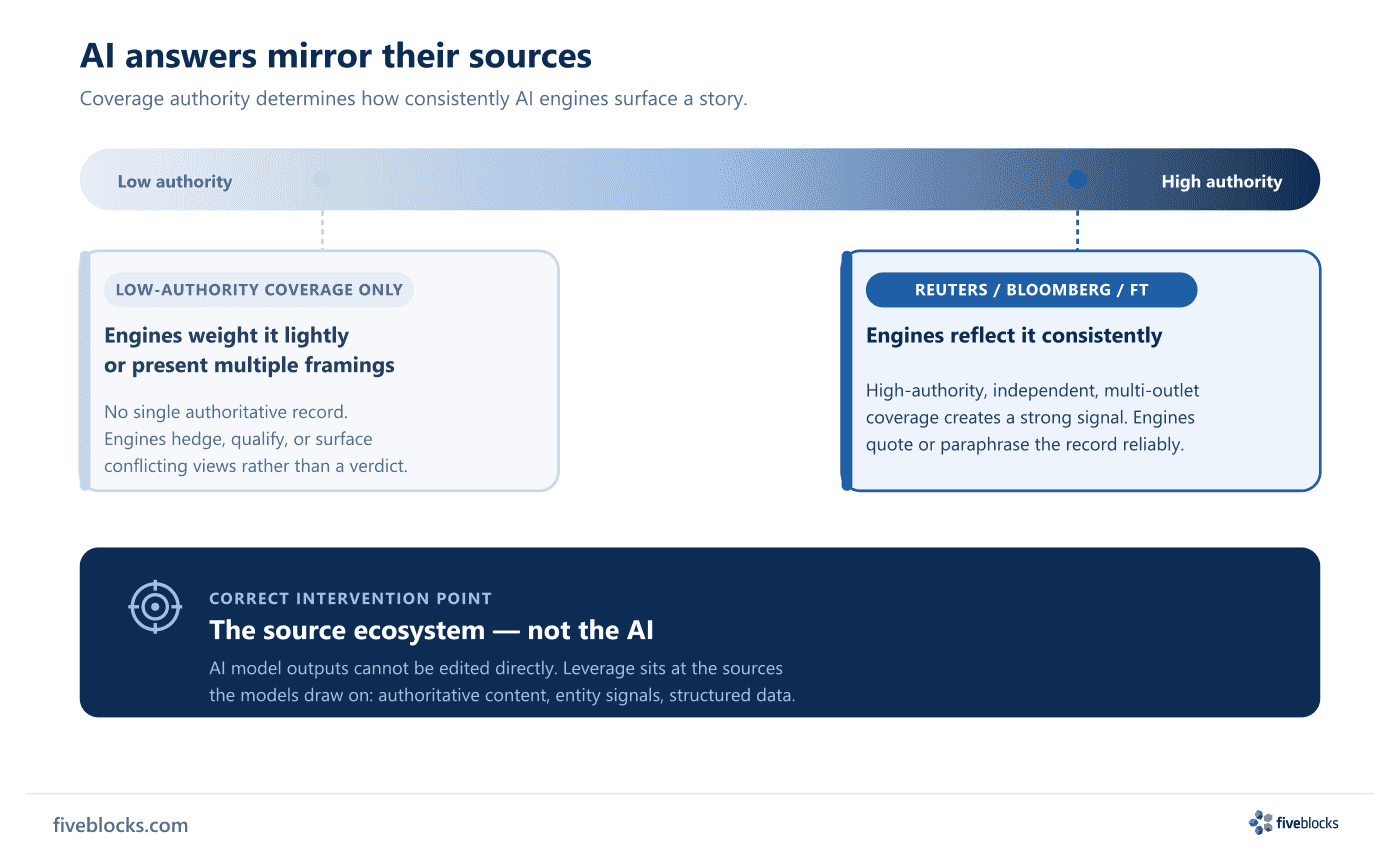
AI engines mirror their sources. If a controversy is well-documented in authoritative coverage, AI responses reflect it consistently; if it is contested or only in low-authority outlets, the engines weight it less or present multiple framings. The reputation work happens at the source ecosystem, not at the model.
AI engines are not editorializing about controversies; they reflect the source ecosystem they draw on. That means trying to suppress an AI response is the wrong intervention point. The right one is the sources the engines weight.
How coverage maps to the answer
- Well-documented controversy, when a story has been covered by high-authority outlets such as Reuters, Bloomberg, the Financial Times, and the New York Times, AI engines surface it consistently, often quoting or paraphrasing that coverage.
- Contested or thinly-sourced controversy, when something has only appeared in lower-authority outlets or remains disputed, the engines weight it less heavily or present several framings rather than a single verdict.
This comes down to how the engines work: search and AI engines weight sources by credibility, so citation by credible, authoritative, independent outlets shapes AI answers more than additional owned pages do.
Why the model is the wrong place to intervene
You cannot edit or manipulate AI model outputs directly. Influence comes from shaping the sources, entity signals, authoritative content, structured data, that the models draw on. The leverage on a controversy sits in the source ecosystem, not inside the engine.
What that work looks like
- Provide accurate context through Wikipedia, which is built from reliable secondary sourcing such as media coverage.
- Make sure the brand’s official response is visible and well-structured on owned properties.
- Work with credible third-party sources where appropriate to establish the accurate record.
- Track with AIQ™ to see how the source weighting changes over time.
The goal is not to make the engines say nothing. It is to make sure what they say is accurate, complete, and in the right context.
Last reviewed: 19/05/2026
