What happens when different AI models give contradictory information about your company?
When AI engines give contradictory answers about the same brand, the cause is almost always different source sets, not disagreement between the models. Each engine builds its answer from a different mix of training data and live retrieval. Once you identify the underlying sources and make the accurate version dominant across them, the engines tend to converge. Retrieval-heavy engines can reflect corrections within days to weeks; engines that lean on their training-data baseline take longer.
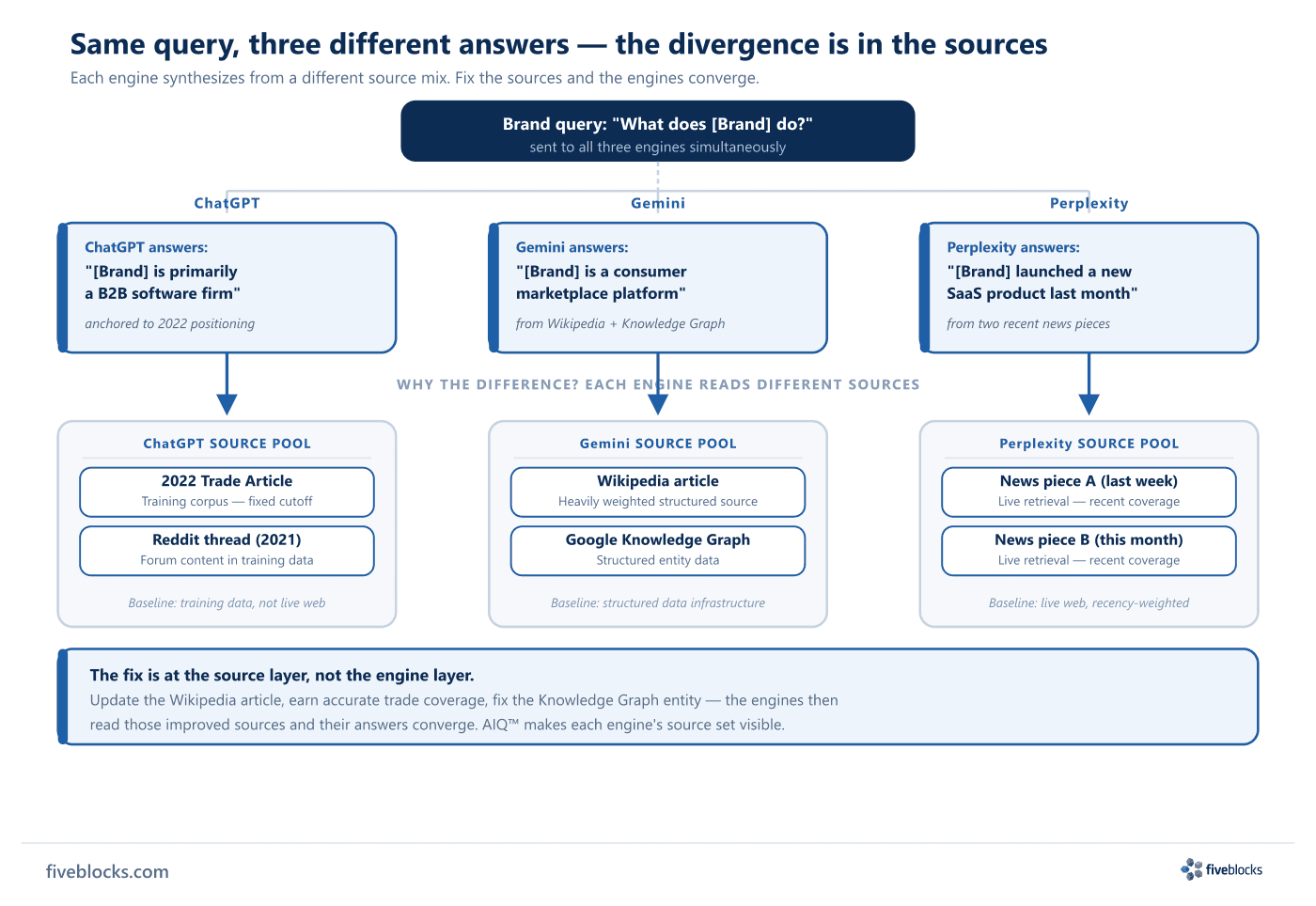
When ChatGPT says one thing and Gemini says another about the same brand, the engines are not disagreeing. They are reading different sources. Each engine builds its answer from its own mix of training data and live retrieval, and when those source sets differ, the answers differ. The contradiction sits in the sources, not in the engines.
Why engines diverge
Two factors explain most brand-level divergence.
- Different retrieval architectures. Retrieval-first engines such as Perplexity pull live web results at query time and weight recency heavily, so they tend to reflect recent authoritative coverage. Engines that blend a training-data baseline with optional live retrieval, such as ChatGPT in its base mode, can anchor answers to content from their training corpus, which has a fixed cutoff and can lag the current web by months or more. Engines with direct infrastructure access, such as Gemini, draw heavily on structured sources including Wikipedia and the Google Knowledge Graph. Route the same brand query through these three architectures and you often get different framings, because each engine starts from a different source pool.
- Different source weights. Even when engines retrieve from the same open web, they weigh domains differently. A forum thread prominent in a training corpus can anchor one engine’s answer while a recent trade article anchors another’s. Research on AI citation patterns has found that the same query run across multiple engines produces outputs that vary, sometimes by a lot, because source selection and weighting differ by engine.
How to diagnose and resolve divergence
- Identify what each engine is drawing on. Monitoring tools such as AIQ™ make source attribution explicit per engine, so “the engines disagree” becomes a list of the specific sources driving each answer. Skip this step and remediation is guesswork.
- Act at the source layer, not the model layer. You cannot correct an AI engine directly. Improvement comes from strengthening the accurate sources the engines draw on: correcting or updating a Wikipedia article, improving authoritative third-party coverage in outlets the engines weight, fixing structured data and entity infrastructure, and removing or countering weak or hostile sources where possible.
- Monitor across all major engines. A fix that reaches one engine’s answer may not yet show up in another. Retrieval-heavy engines can reflect source improvements within days; engines anchored more to their training-data baseline take longer, and the exact timeline depends on the engine and the nature of the change.
The core principle: Once the sources converge on the accurate version, the engines tend to converge too. The work is at the source level, not the engine level.
Last reviewed: 19/05/2026
