Gemini gives a completely different description of my CEO than Google web results. What’s going on?
Different engines pull from different sources. Gemini sits on Google's infrastructure and queries the Knowledge Graph, which draws on Wikipedia and other authoritative sources, for entity facts. A Google web-results page reflects the broader live index, including recent news and coverage those reference sources may not yet show. When the two disagree, the fix is engine-specific: find which source is feeding each version and target that source.
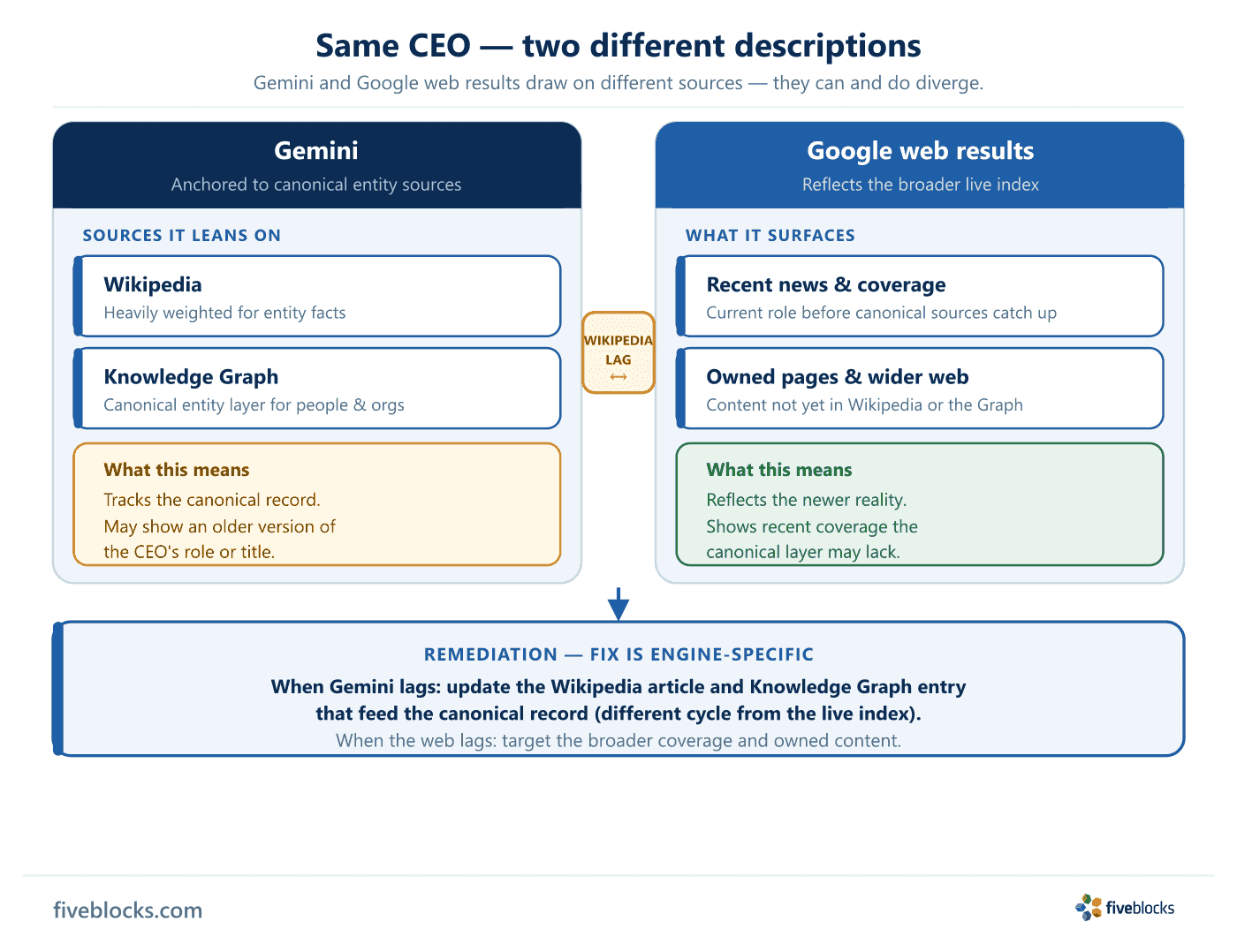
Gemini and a Google web-results page draw on different sources, so they can describe the same CEO in different terms. Gemini sits on Google’s infrastructure and queries the Knowledge Graph for entity facts, and the Knowledge Graph itself draws on sources including Wikipedia. A standard Google web-results page reflects the wider live index: recent news, trade coverage, and a company’s own pages that the reference sources may not yet show.
Why the two can diverge
- Gemini leans on the reference layer. Google’s Knowledge Graph aggregates information from sources including Wikipedia, and Gemini draws on that reference layer when describing a person or company. Generative engines also synthesize from their training corpus plus live retrieval at query time, but for basic entity facts the Knowledge Graph layer is a primary input.
- Google web results draw on the wider index. The standard results page surfaces recent news, industry coverage, and a company’s own pages, which can describe an executive’s current role before the reference sources have been updated to match.
- A lag between the two opens the gap. If the Wikipedia article or Knowledge Graph entry is incomplete or out of date while the wider web has already moved on, Gemini can describe an older version of the executive while Google web results show the newer reality. The lag can also run the other way, with the reference sources current but the broader index behind.
The fix is engine-specific
Because each engine relies on a different source, there is no single fix. We find the gap separately for each engine, determine which source is feeding the description it returns, then target that source. Where Gemini appears to be drawing on an outdated reference record, the work focuses on the Knowledge Graph entry and the Wikipedia article that feed it. Where the gap runs the other way, with the reference sources current but the broader index stale, the work targets the underlying coverage and the company’s owned content. AIQ pinpoints which engine is drawing on which source, so the intervention hits the source actually driving the gap instead of a guess.
Last reviewed: 19/05/2026
