How do AI search engines handle conflicting information about a brand?
AI search engines resolve conflicting information about a brand by weighting sources for authority and recency, then either presenting the higher-weighted version (sometimes with hedging) or showing both with attribution. Reputation work makes the accurate version the dominant signal in the source ecosystem.
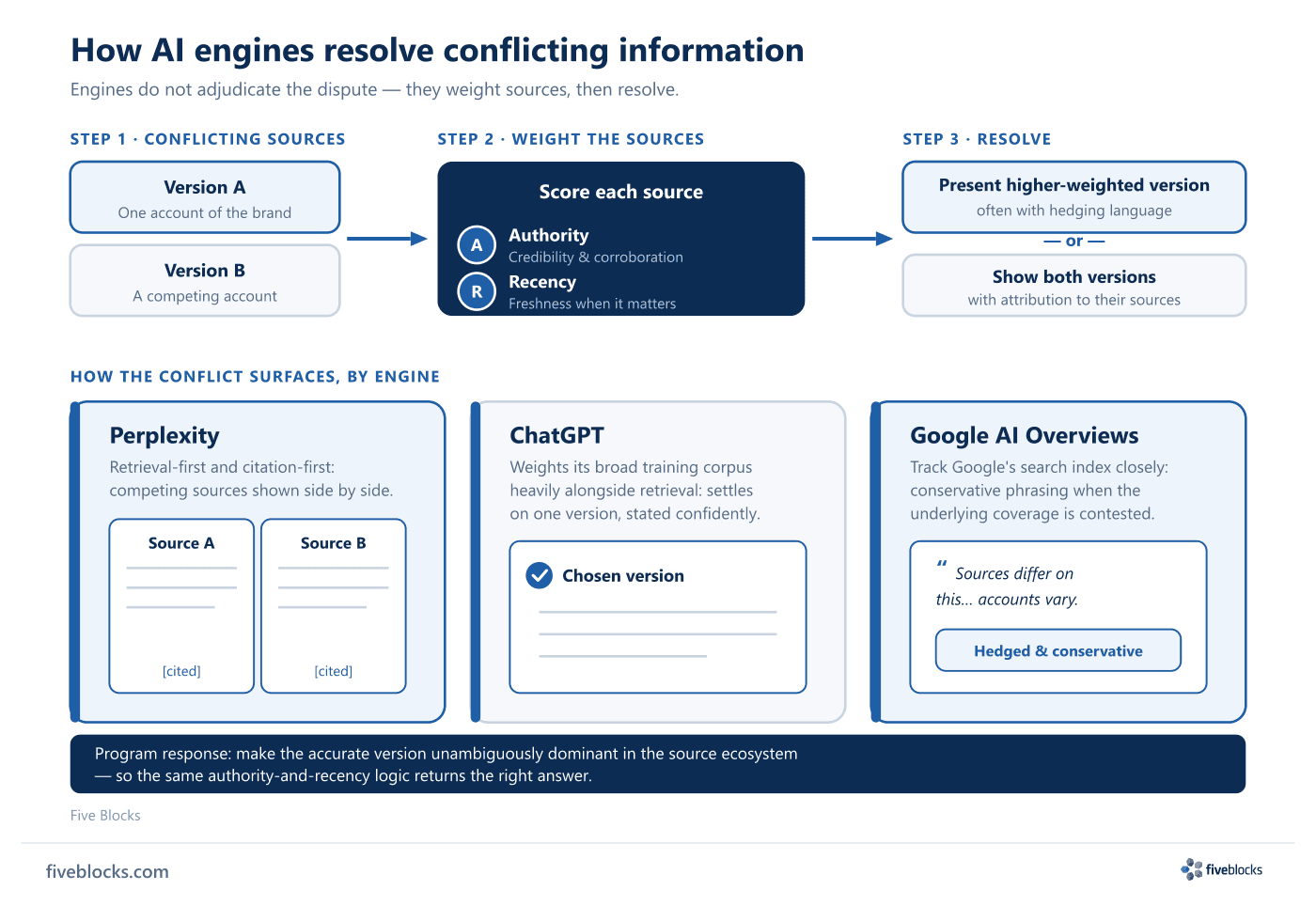
When AI search engines hit conflicting information about a brand, the resolution is mostly automatic. They weight the available sources by authority and by recency, then either present the higher-weighted version (sometimes with hedging language that flags the conflict) or present both versions with attribution.
How the resolution works
The engine is not settling the dispute on the merits. It is applying a ranking:
- Weight by authority. Higher-credibility domains and well-corroborated sources carry more signal than thin or contested ones.
- Weight by recency. For questions where freshness matters, a recent authoritative source can outrank an older one on the same topic.
- Resolve. Present the higher-weighted version (often with caveats when coverage is contested), or show both versions with their sources attached.
How the experience differs by engine
The underlying logic is similar across engines, but how the conflict shows up to a user varies with each engine’s architecture:
- Perplexity is retrieval-first and citation-first. Each query triggers a live web search and answers arrive with inline sources attached, so competing sources are often visible side by side.
- ChatGPT weights its broad training corpus heavily alongside retrieval, and usually settles on a single version and states it confidently.
- Google AI Overviews track Google’s search index closely and lean toward more cautious phrasing when the underlying coverage is contested.
What this means for the program
You do not argue with the engine. You make the accurate version dominant in the source ecosystem: a stronger Wikipedia article, more authoritative third-party corroboration, cleaner structured data. The same authority-and-recency logic then produces the right answer.
Last reviewed: 19/05/2026
