How do you handle search results dominated by aggregator sites?
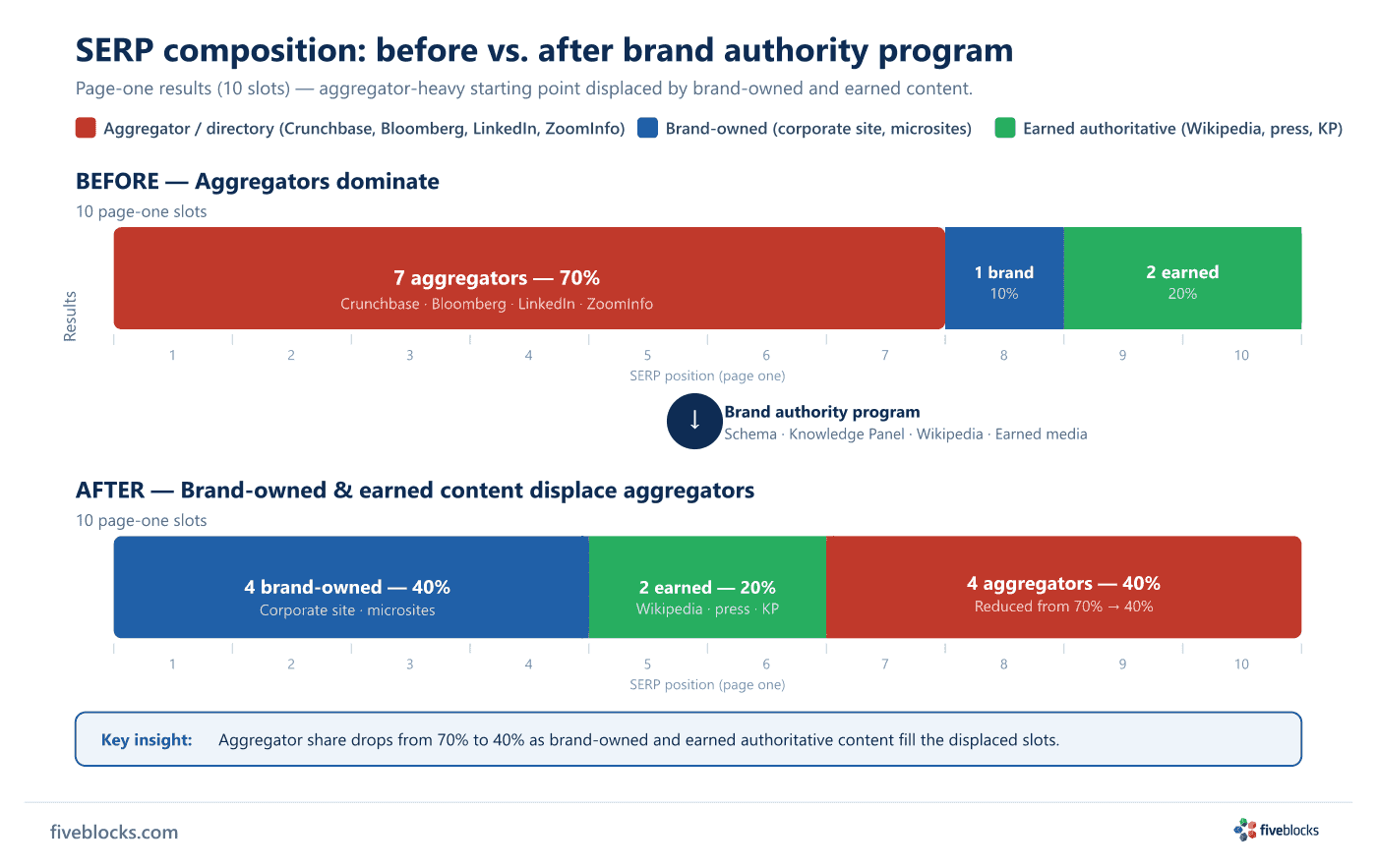
When aggregators such as Bloomberg, Crunchbase, and LinkedIn dominate a branded SERP, the underlying cause is typically thin owned authority rather than overly strong aggregators. The fix is to build canonical authority directly - deep schema-marked owned content, a Knowledge Panel, Wikipedia where notability supports it, and credentialed third-party coverage - so that brand-controlled and brand-earned content progressively displaces aggregator listings over time.
When the SERP for a brand is dominated by aggregators – Bloomberg, Crunchbase, ZoomInfo, LinkedIn, Glassdoor, scraped directory sites – the cause is usually thin owned authority, not aggregators that are too strong. The fix is to build canonical authority directly.
Step 1: Strengthen the corporate site
Build deep, schema-marked content that targets the queries aggregators currently occupy: leadership, financial summary, core facts, history, locations, products. Structured data (Organization schema with sameAs links, Person schema on executive bios, FAQPage schema for branded questions) tells search and AI engines what a page asserts and which entity it belongs to.
Step 2: Build credentialed third-party content
Produce authoritative content on sources the engines weight at least as heavily as the aggregators: news coverage in credentialed outlets, association profiles, accredited directory listings, and executive bylines. Credentialed third-party coverage shapes AI engine answers more reliably than additional owned pages alone.
Step 3: Develop the Knowledge Panel and Wikipedia presence
Where notability supports it, a Wikipedia article and an accurate Knowledge Panel both hold high-authority positions on the SERP. Google’s Knowledge Panel is drawn from the Knowledge Graph, fed substantially by Wikipedia and Wikidata, and sits above most directory results. Developing these is often the highest-leverage move on a saturated aggregator SERP.
Step 4: Monitor and sustain
As canonical authority builds across these layers, the aggregator share of the SERP usually drops from dominant to incidental. The timeline varies by brand footprint and starting point; most programs see meaningful movement within six to twelve months, though it depends on competition, query volume, and how much authority infrastructure is in place at the outset.
Last reviewed: 19/05/2026
