How do you suppress a negative result that keeps changing URLs?
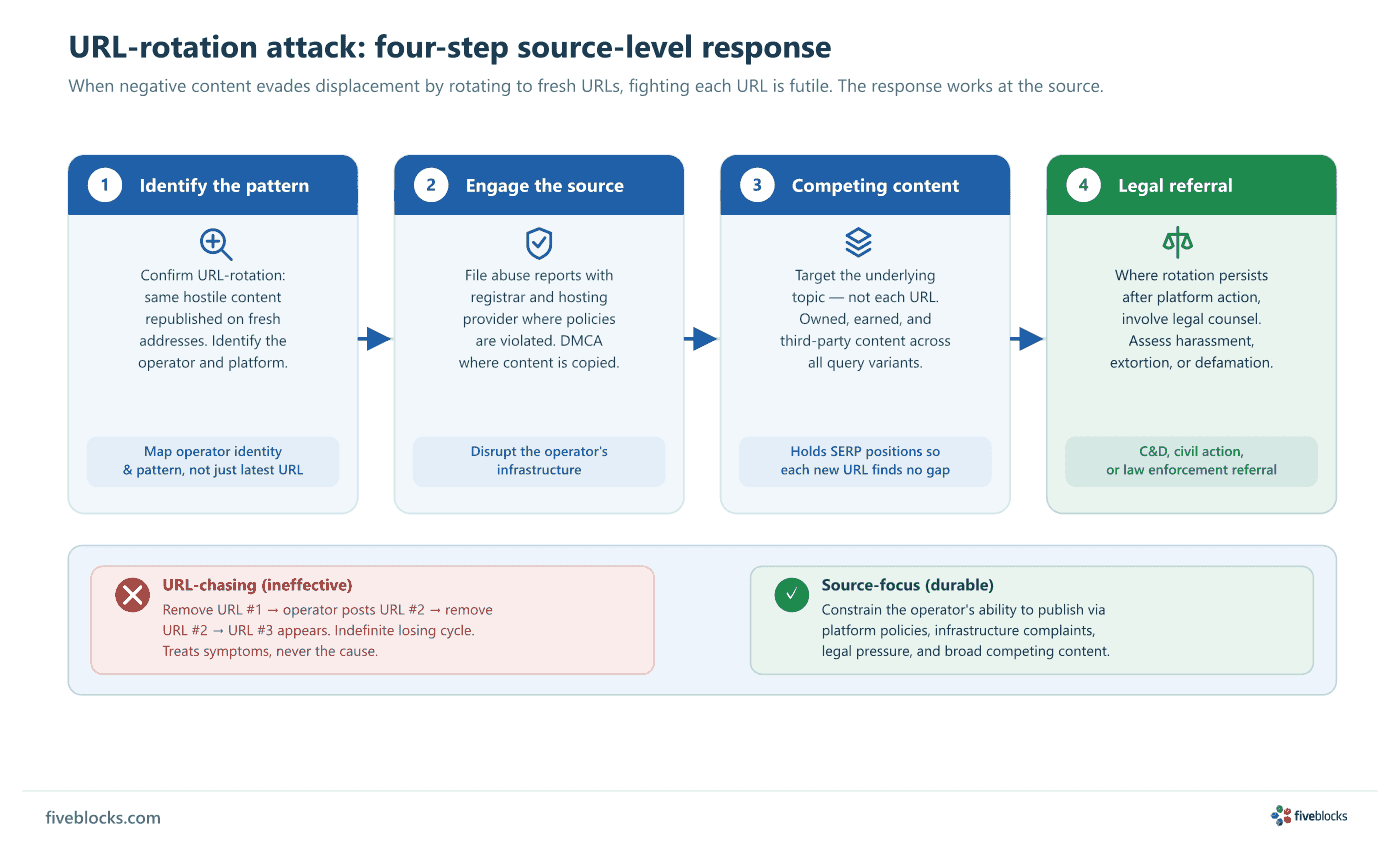
URL-rotating negative content is addressed at the source, not at each URL. Identify the operator and platform, engage the registrar or host where policies are violated, build competing content broad enough to cover every plausible variant of the hostile material, and involve legal counsel where the rotation pattern signals harassment or extortion.
Some negative content is built to evade displacement by rotating to new URLs: the same hostile post republished each month on a fresh address, algorithmically generated variants, parallel accounts recreated after every takedown. Fighting each URL on its own gets you nowhere. The response has to work at the source.
Step 1: Identify the operator, platform, and pattern
Map what you are dealing with before you act. Is a single operator manually republishing content, or is an aggregator or platform generating variants algorithmically? Confirm the pattern, not just the latest URL. Who the operator is determines whether registration or hosting policies have been violated and whether a legal claim is viable.
Step 2: Source-level engagement with registrar and host
Where the operator breaks registration or hosting terms, harassment policies, rules against coordinated inauthentic behavior, or defamation law, go to the registrar and hosting provider directly through their policy-violation reporting channels. Major hosting providers and platforms run abuse-reporting processes, and when you can document a clear policy violation, these complaints can interrupt the operator’s infrastructure instead of removing one piece of content at a time. DMCA processes apply where scraped or republished content reproduces copyrighted material.
Step 3: Build competing content broad enough to displace every variant
The content response to URL-rotation has to target the underlying topic, not any specific URL. That means producing authoritative competing content on the narrative the hostile material is pushing, across all the query variants an operator is likely to exploit. “Broad enough” in practice is content that ranks for the underlying claim or allegation regardless of which URL is currently live, built across owned properties, earned coverage, and authoritative third-party platforms. The aim is to hold the relevant positions on the SERP so that any new URL the operator publishes lands against established, higher-authority content rather than an empty slot. This work compounds. Expect the picture to improve over months rather than days, because building and indexing authoritative competing content takes time.
Step 4: Legal referral where the pattern indicates harassment or extortion
Deliberate URL-rotation that continues after platform intervention shows intent. Where the pattern points to a coordinated campaign, especially one involving threats, pay-for-removal demands, or repeated recreation of accounts and content after takedowns, legal counsel becomes part of the response. An attorney can assess whether the conduct amounts to harassment, extortion, or defamation under applicable law and advise on cease-and-desist, civil action, or referral to law enforcement.
Why the source-level approach is the one that holds
Chasing each new URL loses against an operator whose goal is to generate volume indefinitely. Working at the source, platform policies, registrar complaints, legal pressure, and competing content broad enough to cover the topic, is what resolves the situation, because it removes or constrains the operator’s ability to keep publishing instead of cleaning up each result after the fact.
Last reviewed: 19/05/2026
