How do you handle reputation when an executive is wrongly associated with a scandal?
When an executive is wrongly tied to a scandal, the work runs on four tracks: diagnose which sources and which engines are conflating the executive with the actual party, pursue source-level corrections at the outlets that accept them, monitor the AI narrative, and escalate to counsel where a false statement is presented as fact and defamation applies. It runs for months because the conflation persists in AI training data after the live coverage is corrected.
Wrongful association, where an executive is conflated with the actual party in a scandal, is among the most damaging reputation problems, and it takes an integrated response across reputation, legal, and sometimes platform-policy channels. No single removal fixes it. The work follows a diagnose → correct → escalate sequence, with monitoring running underneath the whole time.
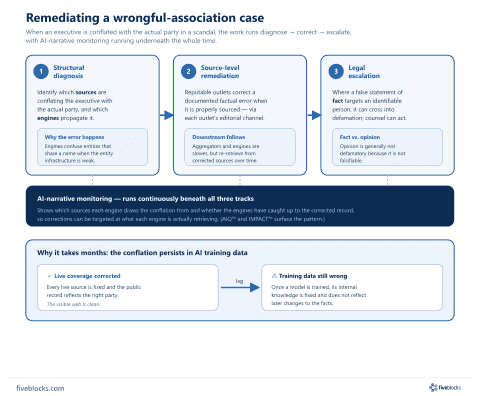
The remediation sequence
- Structural diagnosis. Identify which sources are conflating the executive with the actual party, usually because they share a name, a similar name, or a common employer, and which engines are propagating the error. When entity infrastructure is weak, AI engines confuse or conflate distinct entities that share a name, so both layers have to be mapped: the sources driving the error and the engines repeating it.
- Source-level remediation. Most reputable outlets publish corrections and update policies, and they will correct a documented factual error when it is properly sourced. A conflated identity is exactly that kind of error. Corrections go through each publication’s standard editorial channel. Aggregator sites and AI engines are slower, but they re-retrieve from the corrected sources over time, so fixing the source is what eventually moves the downstream layers.
- AI-narrative monitoring. Monitoring runs continuously beneath the other tracks. AIQ and IMPACT™ show which sources each engine is drawing the conflation from and whether the engines have caught up to the corrected record, so corrections can be aimed at what each engine actually retrieves.
- Legal escalation where defamation applies. A false statement presented as fact about an identifiable individual can cross into defamation. Statements of opinion generally cannot, because they are not falsifiable. Where that line is crossed, counsel can pursue corrections, retractions, or further remedies.
Why it takes months
The conflation usually persists in AI training data after the live coverage is corrected. Once a model is trained, its internal knowledge is fixed and does not reflect later changes to the facts, so a false association learned during training can keep surfacing long after every live source has been fixed. That is why the work is sustained rather than one-shot, and why AI-narrative monitoring stays on through the rebuilding period.
Last reviewed: 19/05/2026
