I sold a company that had a scandal before I joined. My name is now tied to it. What are my options?
Entity disambiguation work separates the individual's digital identity from the former company's history: refreshed bios, authoritative content on the current role, and AI narrative monitoring together shift how leading AI engines represent the person over a six-to-twelve-month horizon.
Old-company-by-association is a familiar pattern with a structured fix. When an executive’s name became tied to a company they sold, especially one that carried a scandal predating their tenure, the engines have built a conflated narrative from whatever sources they had at the time. Correcting it means working at the source layer, not the visible symptom.
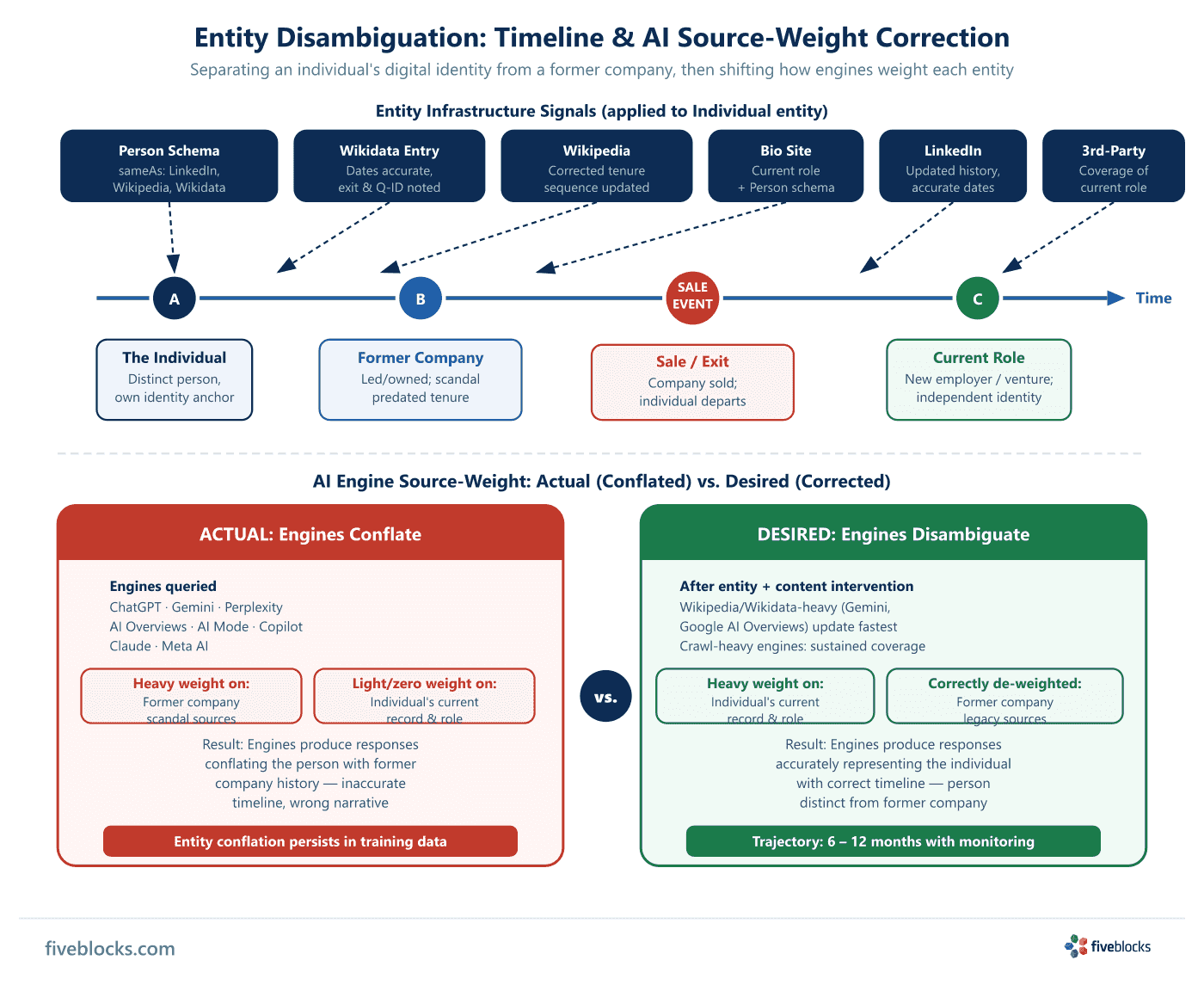
Step 1: Establish the individual as a distinct entity
The first task is entity disambiguation: showing the engines that this person is a distinct entity with their own timeline, not a permanent association with the former company. The technical levers:
- Person schema with
sameAslinks on owned properties, connecting the individual’s bio site to their LinkedIn profile, Wikipedia article (where applicable), and Wikidata Q-ID. These links give engines a clear identity anchor and provide biographical disambiguation signals that separate the individual from the company they once led. - Wikidata entry or update with accurate employment dates, a clear departure date on the former-owner relationship, and a correctly stated current role, so AI engines drawing on Wikidata for entity resolution have the right timeline.
- Wikipedia article or Talk-page edit request so the article reflects the sequence accurately: the scandal predated this person’s tenure, and the individual exited via sale. Wikipedia is among the strongest disambiguation signals search engines use and one of the heaviest-weighted sources in AI engine responses.
Step 2: Refresh and expand the individual’s own content footprint
Once the entity infrastructure sets a clean identity, the content layer gives engines material to weight on the right side of the timeline:
- LinkedIn profile updated with a complete current role description, accurate employment history with dates, and a summary that reflects the individual’s record rather than the former company’s. LinkedIn feeds the entity layer and creates a sameAs path that engines follow.
- Bio site or employer bio page with Person schema markup and authoritative content on current work, professional accomplishments, and public commentary. A bio site with clean schema is a direct entity signal the engines extract.
- Authoritative third-party content covering the individual’s actual record in their current role: thought leadership placements, trade press features, podcast appearances with accurate transcripts, and conference profiles. These give the engines evidence to weight against the legacy association. Engines prefer to cite this kind of fact-dense, named-author third-party material.
- Professional directory and association profiles (relevant board memberships, bar listings, industry registries) that corroborate the individual’s standing and current identity in a way self-published content cannot.
Step 3: Monitor and correct AI narratives across leading engines
Entity infrastructure and content alone are not enough once the engines have already built an inaccurate narrative. AIQ monitoring runs the relevant queries daily across the eight AI engines it tracks and flags when any engine is still conflating the individual with the former company’s history instead of representing the timeline accurately. Conflation often persists because inaccurate information can embed in AI training data and remain even after live coverage is corrected; when it does, source-level work targets the specific inputs each engine is weighting wrongly.
The engines that weight Wikipedia and Wikidata most heavily (Gemini, Google AI Overviews, AI Mode, Perplexity) usually update fastest once those sources are corrected. Engines drawing more on crawled web content may need sustained third-party coverage before the narrative shifts. AIQ shows that engine-by-engine trajectory so the work stays targeted.
What the trajectory looks like
Clean entity infrastructure, refreshed owned properties, authoritative third-party content, and AI narrative monitoring together usually produce meaningful movement over six to twelve months. The movement is not linear. The Google entity panel and Wikipedia-weighted engines often respond within weeks of entity-layer corrections, while the broader AI narrative and SERP picture takes longer as new content builds authority. Strong third-party coverage of the individual’s current work compresses the timeline. Where the former company’s scandal generated durable, heavily-cited long-form coverage, expect the full horizon and sometimes longer before the legacy content loses weight in the engines.
Last reviewed: 19/05/2026
