I have a common name and someone else’s scandal is hurting my search results. What can be done?
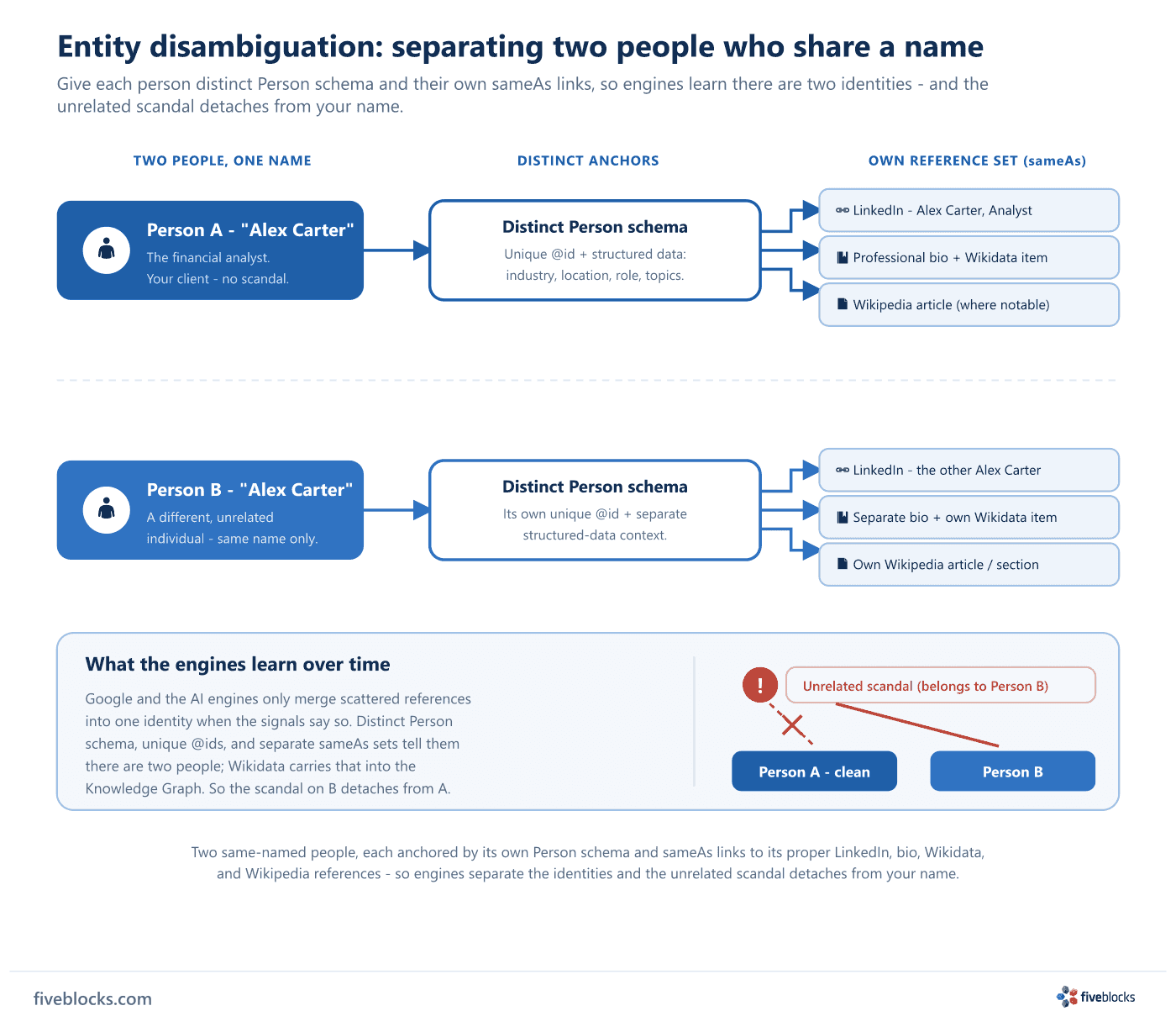
This is a solvable technical problem called entity disambiguation: you give each same-named person distinct Person schema with unique identifiers and sameAs links to their own reference set (LinkedIn, professional bios, Wikidata, and Wikipedia where notable), so search and AI engines learn to treat them as two separate identities and stop attaching the other person's scandal to your name.
Common-name confusion is a known problem, and the fix is technical. The work is called entity disambiguation: making it clear to search and AI engines that two distinct individuals exist and that they are not the same person. Google and AI engines do not automatically assume that a website, a LinkedIn page, a Wikidata entry, and a press profile all describe one person. They resolve scattered references to a single identity only when the signals explicitly say so. The goal is to supply those signals for each person separately.
How the fix works, step by step
- Add distinct Person schema on each person’s owned properties. Person schema markup with unique identifiers can distinguish two individuals to search engines, anchoring each identity to its own bio site and profiles.
- Establish the differences with structured data. Schema markup and structured data help search and AI engines understand what a page asserts and attach it to the correct entity, using contextual signals such as industry, location, role, and associated topics to tell the two people apart.
- Add sameAs links pointing each entity to its proper reference set. The
sameAsproperty in Person schema links each person to their own authoritative profiles: LinkedIn, professional bios, Wikidata, and Wikipedia where notable, telling engines that those profiles are one identity and not the other. - Update Wikidata so the distinction flows into the Knowledge Graph. AI engines use Wikidata for entity disambiguation via unique identifiers and sameAs links, and Knowledge Panel signals can be influenced through Wikidata properties, so a clean, distinct Wikidata item for each person carries the disambiguation into Google’s entity layer.
- Where Wikipedia is involved, clarify the distinction on the affected articles. Google and AI engines disambiguate same-named entities using Wikipedia disambiguation pages and distinct articles; where Wikipedia applies, edit requests on the relevant articles help separate the two identities. (Any Wikipedia work is done as disclosed conflict-of-interest editing.)
Why this works
AI model outputs cannot be edited directly; you shape the sources, entity signals, authoritative content, and structured data that the models draw on. Because sameAs links and Person schema set up a disambiguation that engines learn over time, the engines gradually separate the two identities, and the unrelated person’s scandal stops attaching to your name.
Last reviewed: 19/05/2026
