How do you handle competing narratives about an executive from different career stages?
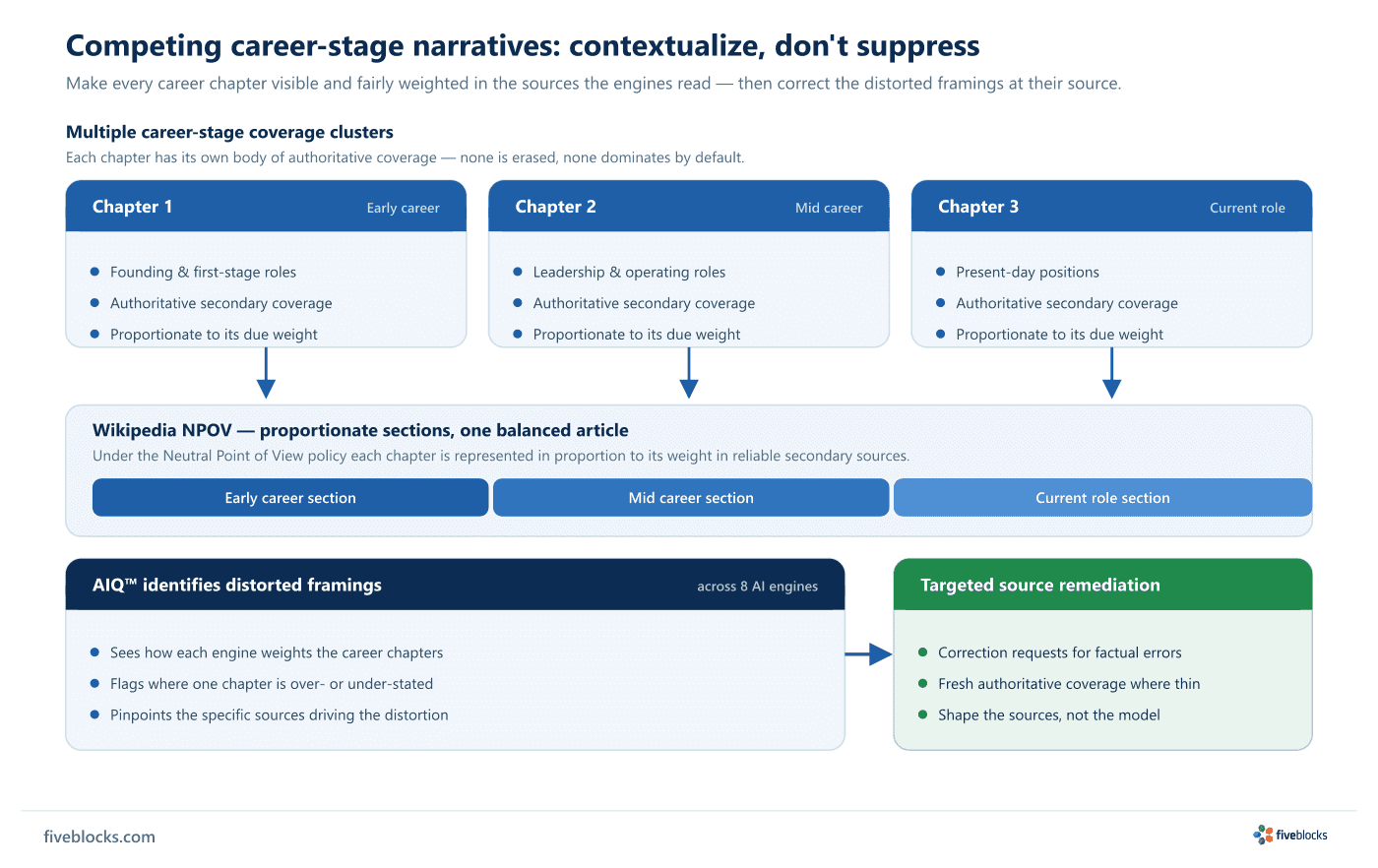
Don't suppress any career chapter; contextualize all of them. Elevate authoritative content that frames each chapter accurately, make sure Wikipedia covers the multiple roles in proportionate sections under its neutral-point-of-view policy, and monitor what each AI engine retrieves so distorted framings can be corrected at the specific sources driving them. This is deliberate, source-by-source work, and it is what a firm like Five Blocks does.
Competing narratives across an executive’s career chapters are a structural problem: the picture stakeholders see depends on which subset of coverage the engines weight most heavily. Suppressing a chapter is the wrong move. The goal is for the engines to see every chapter and read each one in context, which gives a fuller and more accurate picture than a sanitized version that contradicts what credentialed sources have already established.
The structural moves
- Wikipedia handles the multiple roles in proportionate sections. Under the Neutral Point of View policy, an article represents each significant viewpoint in proportion to its weight in reliable secondary sources. Each chapter gets proper sourcing; none gets advocacy.
- Authoritative content exists for each chapter rather than sitting concentrated in a single period, so no single stage dominates by default.
- Wikidata properties cover the full record, so the entity stays anchored across roles for the engines and knowledge panels that query structured data directly.
Where AIQ fits
AIQ shows how each of the eight engines it currently tracks weights the chapters, and which sources drive the distorted framings where they exist. Remediation then works on those specific sources:
- Correction requests where coverage contains factual errors. Most reputable outlets have published corrections processes and will fix documented errors when properly sourced.
- Fresh authoritative content from comparable sources where the picture is incomplete, since engines weight credible independent coverage more heavily than additional owned pages.
AI model outputs cannot be edited directly. Influence comes from shaping what the models draw on: the sources, the entity signals, the authoritative content, and the structured data. Every chapter gets accurate context, so the full record reads as coherent rather than contradictory.
None of this happens on its own. It is source-by-source work: map which sources each engine weights, fill the gaps with credible independent coverage, correct documented errors at the outlet, and keep the entity’s structured signals complete and current. That is the work a firm like Five Blocks does, using AIQ™ to see what the engines draw on and then acting on the sources that shape the picture, so an executive with a many-chaptered career is understood in full rather than defined by a single stage.
Last reviewed: 19/05/2026
