How does reputation management work for digital health and telehealth companies?
Digital health and telehealth companies have to satisfy two sets of standards at once: healthcare's regulatory and accuracy requirements (credentialed provider bios, compliant health-claims language, accurate service descriptions) and consumer tech's expectations (app-store ratings, platform reviews, responsiveness). A reputation program built for only one of them misses half the audience, and AI engines now draw on both halves at once when answering 'is this telehealth service legit and any good.'
Digital health and telehealth companies are held to healthcare’s regulatory and accuracy standards and to consumer technology’s expectations for app-store ratings, platform reviews, and speed of response. A program built for only one of those fails both audiences. The AI engines that answer questions about these companies pull from both sides at the same time.
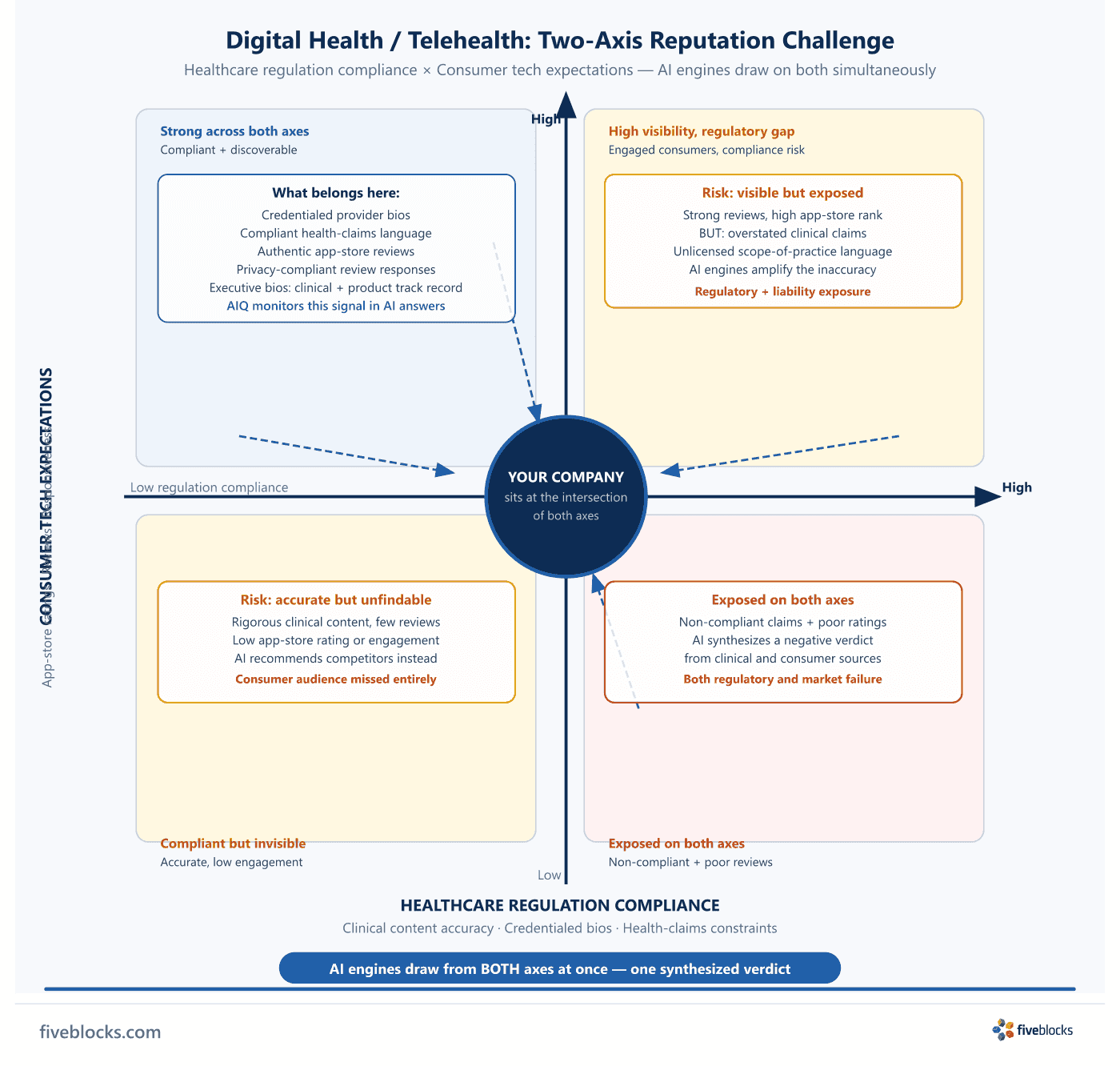
The two-axis challenge
- Healthcare regulation axis: compliant clinical content
- Content describing what a telehealth service does and does not do has to be regulatory-aware. Health claims are constrained. Overstating a service’s clinical scope, implying outcomes that are not established, or describing practitioners in ways that conflict with licensing rules creates both regulatory and liability exposure. Provider bios carry credentials, specialties, and appropriate scope-of-practice language, structured so that search results and AI answers render them accurately. Accuracy here is a compliance requirement, not a marketing preference.
- Consumer technology axis: app-store and review-platform presence
- Adoption for most telehealth products runs through the App Store and Google Play, where ratings and reviews shape store-search ranking and now AI recommendations as well. App store ratings feed the platform’s own search algorithm: Apple’s documented ranking factors include ratings, reviews, and downloads alongside text relevance. AI engines also ingest app store review content when recommending apps. Apple introduced AI-generated review summaries in iOS 18.4, which puts review text formally inside the AI-recommendation layer. Review-platform management for health apps needs a compliant response strategy, since patient-privacy rules apply even outside formal healthcare settings, plus a deliberate program to earn authentic reviews that reflect the current product.
- Executive credibility as a bridge signal
- Investors and partners diligence digital health leadership on both axes: clinical credibility (medical advisory boards, clinical co-founders, regulatory experience) and product credibility (engineering track record, growth metrics, platform security). Credentialed executive bios that speak to both hold up better under that scrutiny.
- AI monitoring across both health and tech contexts
- AI engines do not separate the two axes when they answer questions about a telehealth company. A model asked whether a telehealth service is legitimate and good draws at once from clinical sources (regulatory filings, health journalism, provider-credential signals) and consumer sources (app reviews, product coverage, comparison threads). What comes back is a single verdict that touches both. Monitoring those answers with AIQ™, across health-related prompts and consumer-app prompts, is the only way to see how the two halves combine and to catch the point where an inaccuracy on either side is driving a wrong answer.
Why a single-axis program falls short
A program built only on the healthcare side produces accurate, credentialed content that a general consumer audience never finds. A program built only on the consumer side earns app-store visibility while leaving the regulatory and clinical-accuracy layer exposed, where one compliance misstep or one AI-generated clinical inaccuracy can outweigh months of positive reviews. The program has to hold both axes at the same time, treating accuracy and engagement as requirements that support each other rather than compete.
Last reviewed: 20/05/2026
