How should healthcare companies manage AI-generated health information that mentions them?
Healthcare companies need rigorous AI monitoring because incorrect medical claims tied to the brand can cause patient harm and compliance exposure, not just reputational damage. A 2025 peer-reviewed study found AI engine consistency on clinical questions ranged from 'unacceptable' to 'questionable', which confirms this is a documented, measurable risk. Remediation has to be grounded in authoritative medical sources and clear corrective content.
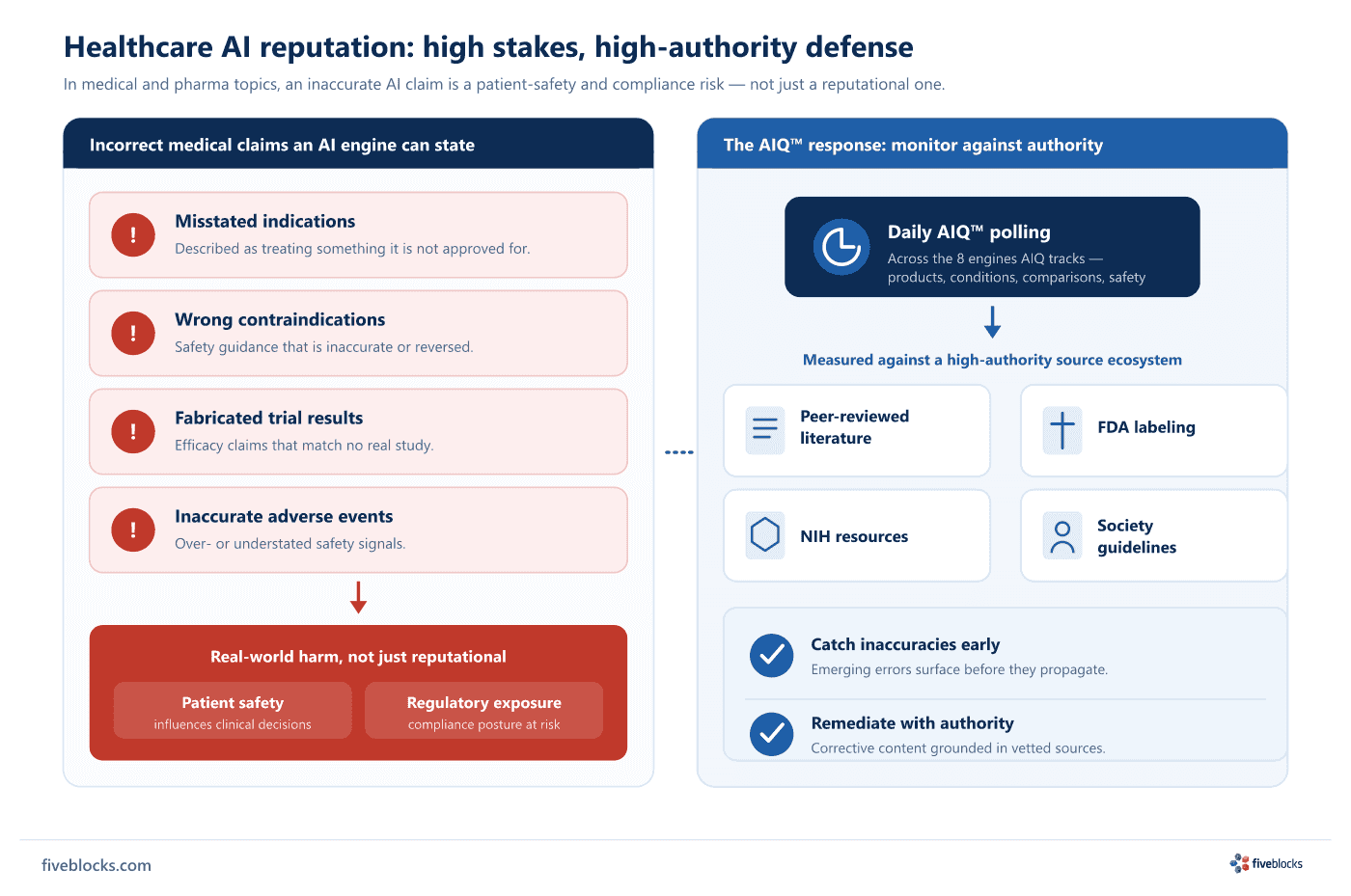
The stakes in healthcare AI reputation work are higher than in most categories. The answers engines give about medical and pharmaceutical topics can influence patient decisions, clinician behavior, and compliance posture, so an inaccurate AI claim is a safety and compliance problem, not only a reputational one. Handling it well means tighter monitoring than most categories and remediation anchored in authoritative medical sources.
Documented risk: AI engines are unreliable on clinical topics
This is a measured problem, not a hypothetical one. A 2025 cross-sectional study in Frontiers in Digital Health tested ChatGPT-3.5, ChatGPT-4o, Copilot, Gemini, Claude, and Perplexity against clinical practice guidelines for lumbosacral radicular pain. Response consistency ranged from “unacceptable” (median 26%) to “questionable” (median 68%) across all engines, and no engine reached a level acceptable for clinical guidance. When AI engines are this unreliable on a studied clinical topic, the same variability applies to their answers about a healthcare brand’s products, indications, and safety profile, claims that can reach patients and clinicians at scale.
Why the stakes are higher in healthcare
AI engines build answers from across a brand’s digital footprint and can state false or inappropriate claims fluently, with fabricated details delivered in the same authoritative tone as accurate ones. When the subject is a medical product or condition, that failure mode does real-world damage. The claims that matter most are:
- Misstated indications: a product described as treating something it is not approved or intended for.
- Wrong contraindications: safety guidance that is inaccurate or reversed.
- Fabricated trial results: efficacy or outcome claims that match no real study.
- Inaccurate adverse-event characterizations: over- or understated safety signals.
Because these errors can affect patient and clinician decisions, the consequences reach past reputation into patient safety and compliance.
Tighter monitoring discipline
Monitoring has to be stricter to match. That means frequent AIQ polling across the engines AIQ tracks, with prompts covering products, conditions, comparisons, and safety topics, so emerging inaccuracies are caught before they spread. Each of the major engines (ChatGPT, Gemini, Copilot, Perplexity, Claude, Grok, Google AI Overviews, and Google AI Mode) can return a different answer to the same clinical query, so cross-engine coverage is a requirement, not an option.
Remediation grounded in authoritative sources
Corrective work should be backed by the highest-authority medical references available: peer-reviewed literature, official drug labeling, government health resources, major medical reference sites, and professional society guidelines. Google, OpenAI, and Anthropic each offer a formal feedback channel for reporting incorrect AI-generated information, which is one part of a remediation strategy alongside improving the source ecosystem the engines draw from. This work is slow and detailed, and in healthcare the cost of skipping it is high.
Last reviewed: 19/05/2026