How quickly are AI models’ perceptions of a brand likely to change?
Expect weeks to months for visible narrative change across all the engines. The pace splits by engine type. Retrieval-first engines (Perplexity, Google AI Overviews, ChatGPT Search) issue a live web search at every query and can reflect new authoritative sources within days to weeks; engines that weight their pre-training baseline heavily update only when the model is retrained, a cycle that runs months. What you are changing matters too: a discrete factual correction moves faster than a tonal or narrative shift, which depends on the wider source ecosystem moving.
How quickly an AI engine updates its perception of a brand is not a single number. Two clocks run at once, one fast and one slow, and the pace splits by engine type and by what you are changing. Expect weeks to months for visible narrative change across all the engines, with early movement in retrieval-first engines within days to weeks of a source change going live.
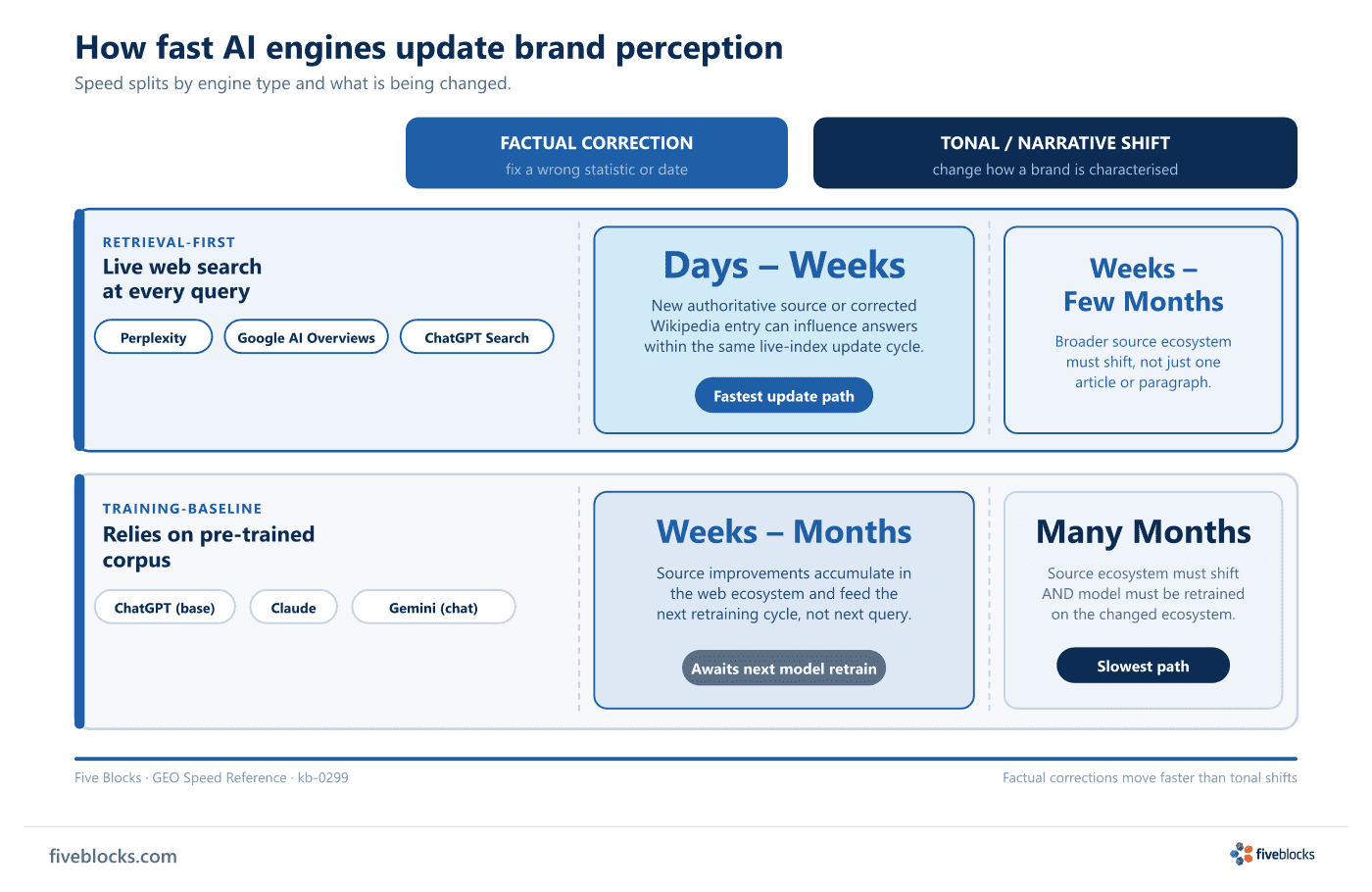
Speed by engine type and change type
| Engine type | Examples | Factual correction | Tonal / narrative shift |
|---|---|---|---|
| Retrieval-first (live web search at every query) | Perplexity, Google AI Overviews, ChatGPT Search | Days to weeks. A newly published authoritative source or corrected Wikipedia paragraph can begin influencing answers as soon as it is indexed | Weeks to a few months. Depends on the broader source ecosystem shifting, not just one article |
| Training-baseline-heavy (relies primarily on pre-trained corpus) | Older ChatGPT configurations, Claude in some modes, Gemini (chat, non-search) | Weeks to months. Source improvements accumulate in the web ecosystem and feed the next retraining cycle rather than appearing immediately | Many months. A narrative shift requires the source ecosystem to change and the model to be retrained on that changed ecosystem |
Note on the tonal-shift row: the distinction between factual corrections moving faster than tonal shifts is practitioner framing derived from the supported source-synthesis mechanism; it is not an independently benchmarked statistic.
Why the two-clock model matters
- Retrieval-first engines issue a live web search at query time. Perplexity describes its own mechanism as providing “real-time access to ranked web search results from a continuously refreshed index.” Google documents AI Overviews as “relying on our core Search ranking systems to retrieve relevant, up-to-date web pages”, grounding responses in the live index rather than static training data. A source change that clears Google’s index can reach these engines within the same update cycle.
- Training-baseline engines reflect no change until the model is retrained or fine-tuned. OpenAI’s published model documentation, for example, records knowledge cutoffs in specific calendar months, which means a model in active deployment may draw on a corpus captured six months or more earlier. Improvements made in the live web ecosystem accumulate and feed the next training cycle rather than appearing on the next query.
- Mixed-engine reality: a reputation program runs across both types at once. Retrieval-first wins appear earliest; training-baseline engines take longer to reflect the same source improvements. AIQ tracks the trajectory across all monitored engines, so clients see direction and rate of change in their monthly reporting rather than waiting in the dark for a final answer.
Last reviewed: 19/05/2026
