What is retrieval-augmented generation and why does it matter for reputation?
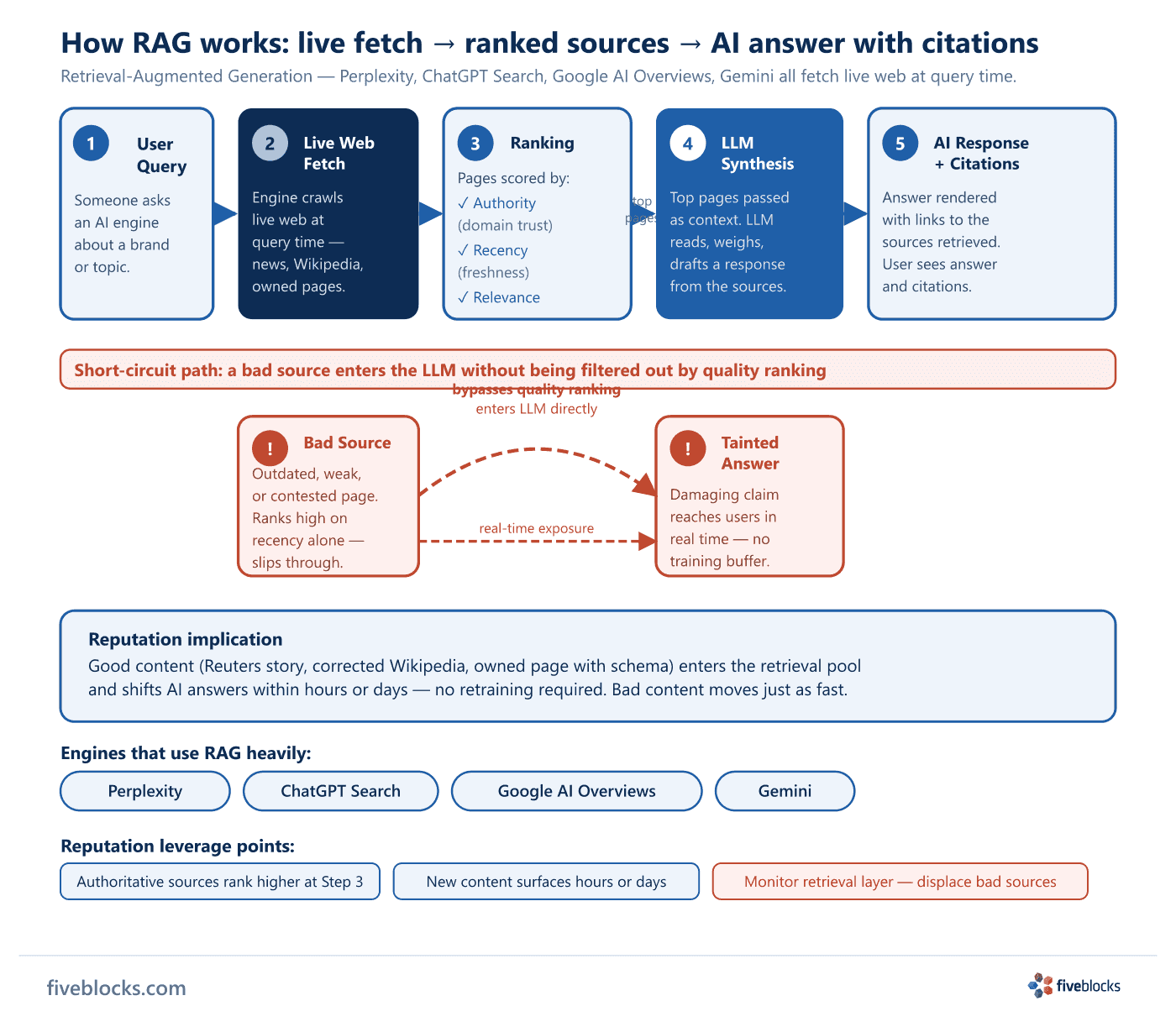
Retrieval-augmented generation (RAG) lets an AI engine fetch live web sources at query time rather than relying only on its training data. For reputation work it shortens the timeline: a new authoritative source can begin shaping AI answers within hours or days instead of waiting for the next training cycle. The same speed means a bad source can enter the answer just as fast, which is why reputation programs focus on source quality at the retrieval layer.
Retrieval-augmented generation, usually shortened to RAG, is the architecture that lets an AI engine fetch live web content while answering a question rather than relying only on what was fixed at its training cutoff. Perplexity is RAG-first: nearly every answer is built from a live web search. ChatGPT Search and Google AI Overviews use RAG heavily, and Gemini uses it for many query types. Engines without retrieval change their view of a brand only when they are retrained, a cycle that runs months. RAG breaks that dependency.
Why the timeline shortens
When an engine fetches live sources at query time, a new piece of authoritative content can start influencing the answer within hours or days. That can be a news story from a credible outlet, a strengthened Wikipedia paragraph, or a well-structured owned page. The retrieval layer is the fastest lever in a reputation program: work that lands in the right source pool can shift what the engine says before the next monthly report arrives.
The trade-off
The same mechanism that lets good content land fast lets a bad source enter fast. Because the engine pulls from the live web at query time, a single weak, outdated, or contested page that surfaces at retrieval can shape the response on the spot, without the filtering a full training cycle would impose. This is why reputation programs focus on source quality at the retrieval layer specifically. It is where the narrative moves quickest, in either direction.
The implication for reputation work: improving sources is the actionable path. A well-placed Reuters story, a corrected Wikipedia article, or an authoritative owned page with clean schema can enter the retrieval pool and move AI answers faster than any other intervention. A low-quality or hostile page that ranks at retrieval can drive damaging answers until it is displaced or corrected at source.
Last reviewed: 19/05/2026
