How often do AI models update their knowledge about companies?
It depends on which mechanism the engine uses. Training-data baselines update only when a model is retrained or fine-tuned, a cycle that runs months, not days. Retrieval-augmented engines such as Perplexity, ChatGPT Search, and Google AI Overviews pull live web content at query time, so a new authoritative source can start shaping answers within hours.
There is no single update interval. It depends on which clock the engine is running on. AI engines draw on two timescales when answering about a company: a slow training-data baseline and a fast retrieval layer.
Training data is the corpus a model was built on, fixed at the training cutoff. Retrieval data is what an engine pulls live at query time. The two move at very different speeds:
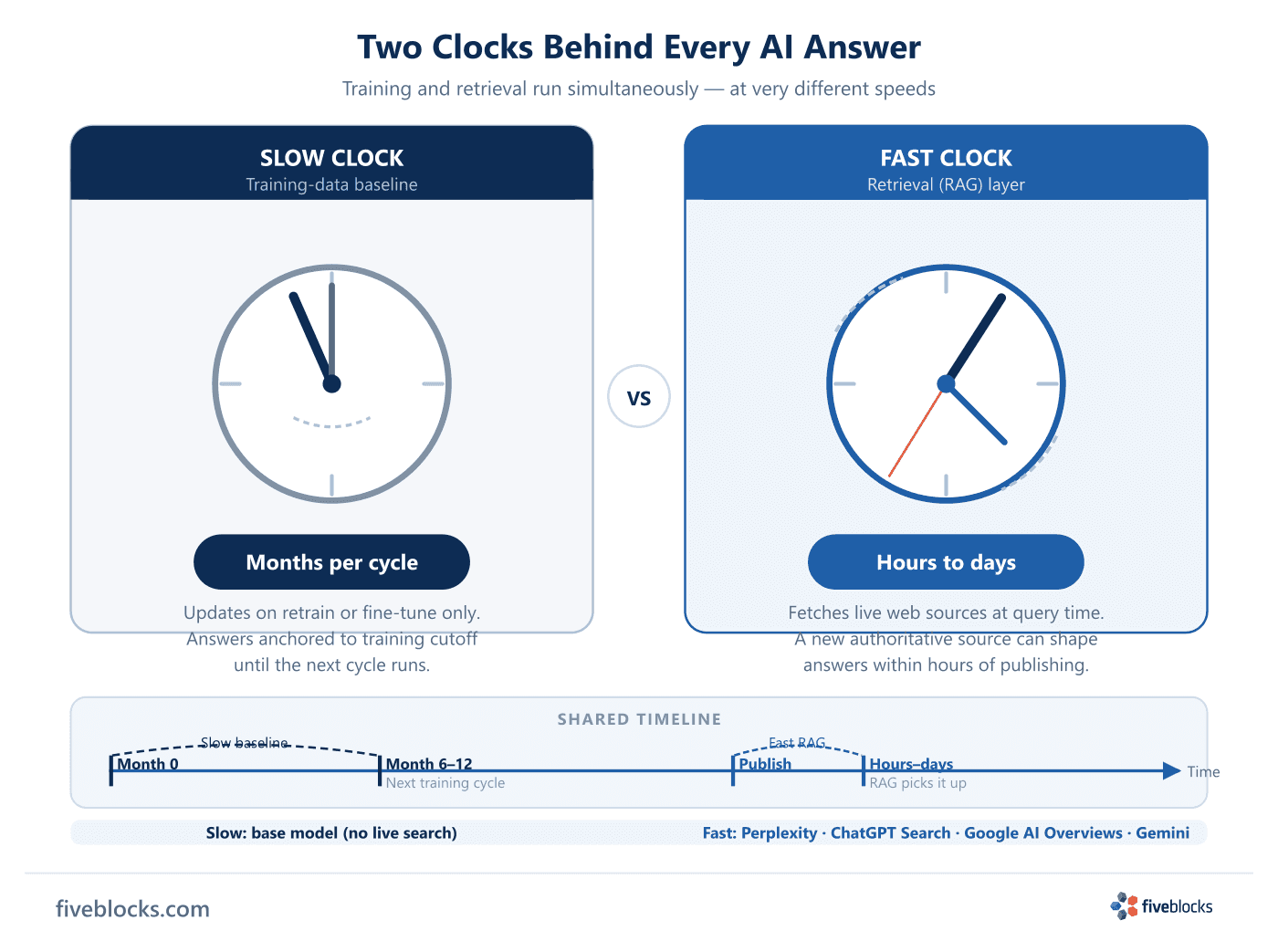
| Mechanism | How it updates | Typical speed |
|---|---|---|
| Training-data baseline | Changes only when the model is retrained or fine-tuned on newer content. Until then, the baseline stays anchored to the corpus captured at the training cutoff, months or more in the past. For example, OpenAI’s published model documentation lists a December 2025 knowledge cutoff for its current flagship model, which shows a multi-month gap between when the training data was collected and when the model is in use. | Months between cycles. |
| Retrieval (RAG) | Fetches live web content at query time instead of relying only on the training set. A newly published authoritative source can be picked up and reflected in responses almost immediately. | Within hours to days. |
Which engines use which clock
- Retrieval-first: Perplexity runs a live web search on every query and works from a continuously refreshed index.
- Retrieval-heavy: ChatGPT Search and Google AI Overviews use RAG heavily, pulling from the live index at query time.
- Mixed: Gemini uses retrieval for many query types and also draws on Google’s entity layer.
- Baseline-weighted: A model that leans primarily on its training data shows no change until it is retrained, so it can stay anchored to a snapshot months old regardless of what has actually changed.
What this means for reputation work
Because the retrieval layer operates in hours while retraining operates in months, the fastest lever for changing how AI engines describe a brand is the set of sources the retrieval step reads. Publishing strong, current, authoritative content shifts retrieval-based answers quickly; waiting for the next training cycle does not.
That speed cuts both ways: a weak or contested source can enter the answer stream just as fast. So reputation programs aimed at AI engines target source quality at the retrieval layer, because that is where the narrative moves fastest in either direction.
Last reviewed: 19/05/2026
