My LinkedIn is the only thing ranking for my name. Is that a problem?
Yes. A name SERP built on one result is fragile: if negative content appears, it lands on a thin page one with nothing already there to absorb or displace it. The fix is a portfolio of authoritative properties: a Person-schema bio, sector directory profiles, Wikidata (and Wikipedia where notability supports it), and a few sustained placements in credentialed outlets. That turns a brittle one-result SERP into a defensible one.
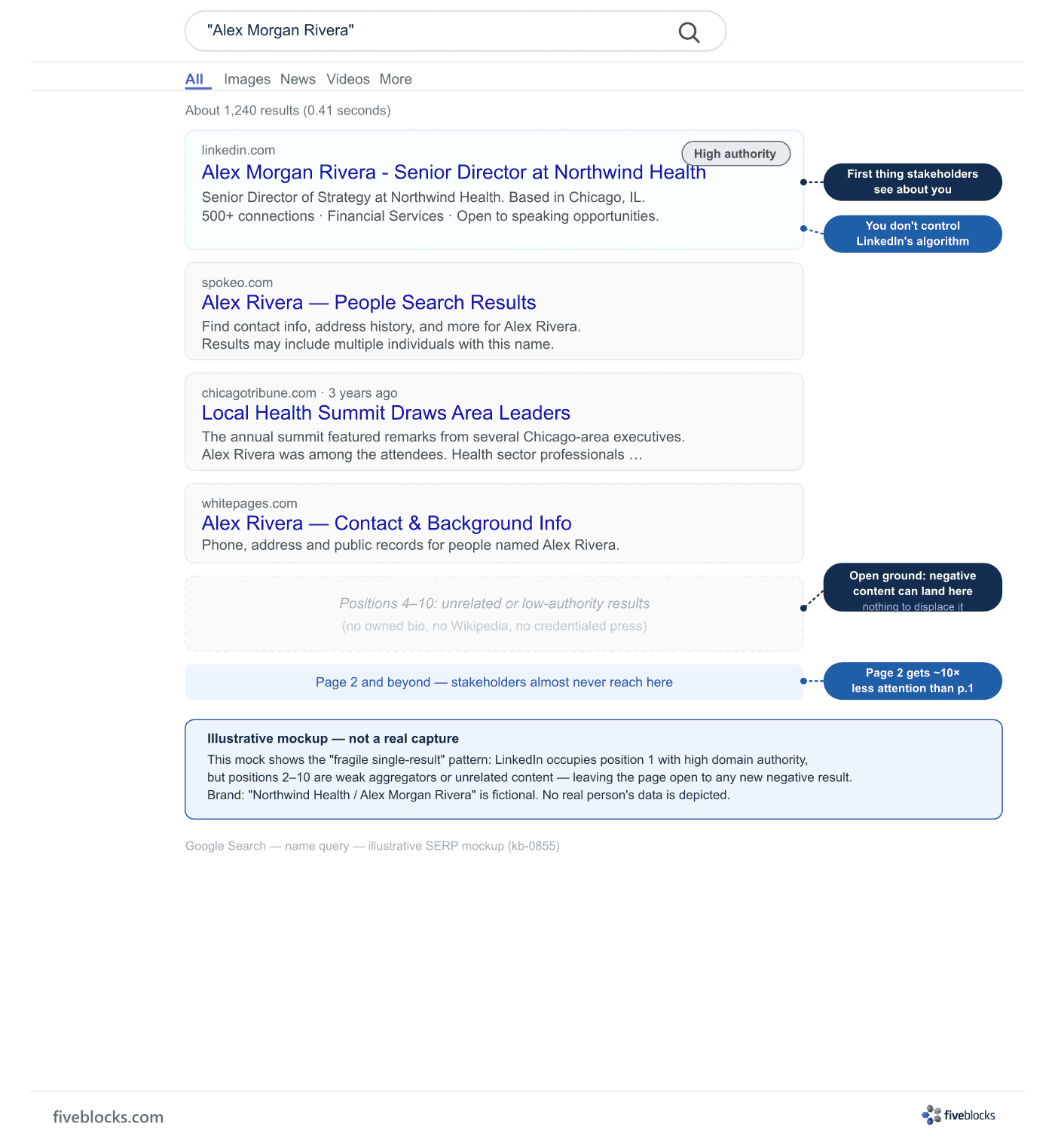
A LinkedIn-only name SERP is one of the most common executive vulnerabilities, and one of the easiest to fix before it becomes a real problem. The profile itself is doing its job: LinkedIn’s domain authority keeps it ranking consistently for individual name queries, often in the top three. The issue is the rest of the page. A page one built on a single strong result is brittle, and that fragility is structural, not cosmetic.
Why one result is fragile
Almost all stakeholder attention on a name search stays on page one; the second page draws roughly an order of magnitude less. The real question, then, is what else holds page one alongside the LinkedIn profile. When LinkedIn is the only thing there, the rest of the page is open ground. If a negative article appears, there is no portfolio of authoritative properties to push back against it, and high-authority negative coverage is hard to displace once it ranks. A thin page rebalances fast toward whatever the new story is, because nothing else is anchored there to hold position.
The fix: build the missing properties
The remedy is straightforward. Give the SERP more authoritative ground to stand on, built at the entity layer so search and AI engines read it consistently:
- A bio marked up with Person schema on a personal site or controlled corporate page. This is the canonical reference, with
sameAslinks out to every other authoritative profile. - Complete third-party directory profiles relevant to the executive’s sector.
- Wikidata regardless, and Wikipedia if notability supports it. Wikidata feeds the Google Knowledge Graph and Knowledge Panel and is read directly by AI engines, so it strengthens the entity even without a Wikipedia article.
- A few sustained content placements in credentialed outlets.
What you are after is portfolio depth: several authoritative properties holding page-one positions, so any new result, good or bad, has to compete for space instead of walking into an empty page. Expect the buildout to take on the order of six to nine months to propagate through Google and the AI engines. At the end of it, a brittle one-result SERP is a defensible portfolio.
Last reviewed: 19/05/2026
