How do you build a portfolio of owned properties that dominate page one?
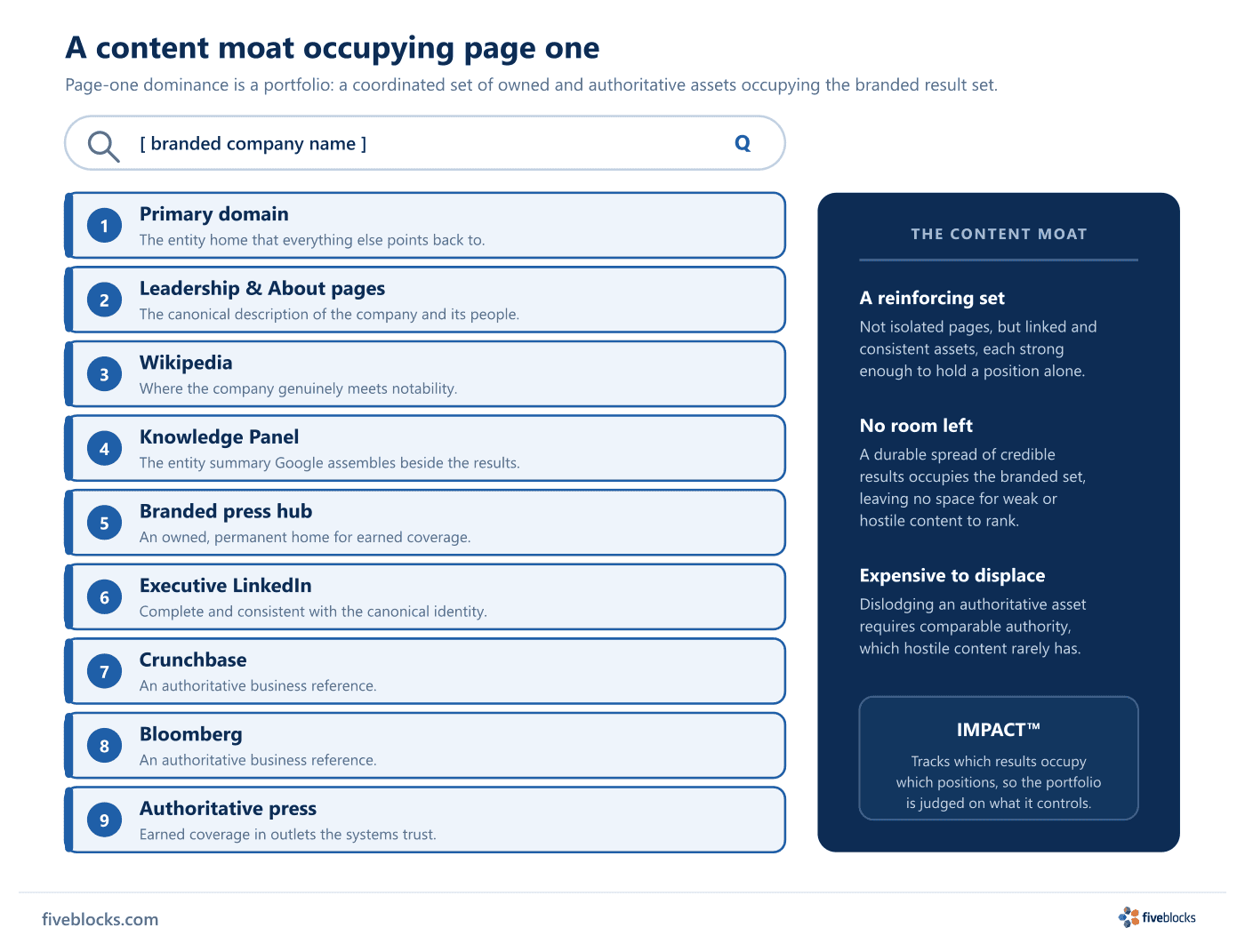
You build page-one dominance as a portfolio, not a single page: a coordinated set of owned and authoritative third-party assets - primary domain, structured leadership pages, Wikipedia where eligible, the Knowledge Panel, a branded press hub, executive LinkedIn, Crunchbase and Bloomberg, and authoritative press - linked and consistent enough to occupy the branded result set and leave no room for weak or hostile content.
Dominating page one of a branded search is a portfolio problem, not a single-page one. The goal is to occupy enough of the result set with authoritative, company-aligned content that no room is left for weak or hostile material to rank. No single asset does this; a coordinated set does.
The assets that make up the portfolio
The portfolio combines owned properties with authoritative third-party references:
- Primary domain, the entity home that everything else points back to.
- Structured leadership and About pages, the canonical description of the company and its people.
- Wikipedia, where the company genuinely meets notability.
- The Knowledge Panel, the entity summary Google assembles alongside the results.
- A branded press or newsroom hub, an owned, permanent home for earned coverage.
- Executive LinkedIn profiles, complete and consistent with the canonical identity.
- Business references such as Crunchbase and Bloomberg.
- Authoritative press placements, earned coverage in outlets the systems trust.
Why a coordinated set works
The portfolio holds because these are linked, consistent pages rather than isolated ones, each strong enough to hold a position on its own. Together they form a content moat: a durable spread of credible results that is expensive for anything negative to displace, because dislodging an authoritative asset requires comparable authority, which hostile content rarely has.
Measure what actually ranks
Page-one dominance is measured by what holds the branded positions, not by what was published. We track which results occupy which positions across the branded query with IMPACT™, so the portfolio is judged on the result set it actually controls.
Last reviewed: 20/05/2026
