What is the ideal distribution of owned, earned, and third-party content on page one?
There is no fixed ratio, but a healthy branded page one is weighted toward owned and entity properties - the corporate site's deep pages, Wikipedia where notability supports an article, LinkedIn, and the Knowledge Panel - with a meaningful share of earned third-party press and a smaller portion of authoritative directory or business-reference profiles such as Crunchbase or Bloomberg. Where a client's page diverges from that pattern, the gaps tell you what to build.
The ideal split of owned, earned, and third-party content on page one is a recognizable pattern rather than a fixed ratio. The balance leans toward owned and entity properties, carries a meaningful share of earned coverage, and leaves a smaller portion for authoritative directory and business-reference listings. Where a real SERP diverges from that distribution, you learn where the work needs to start.
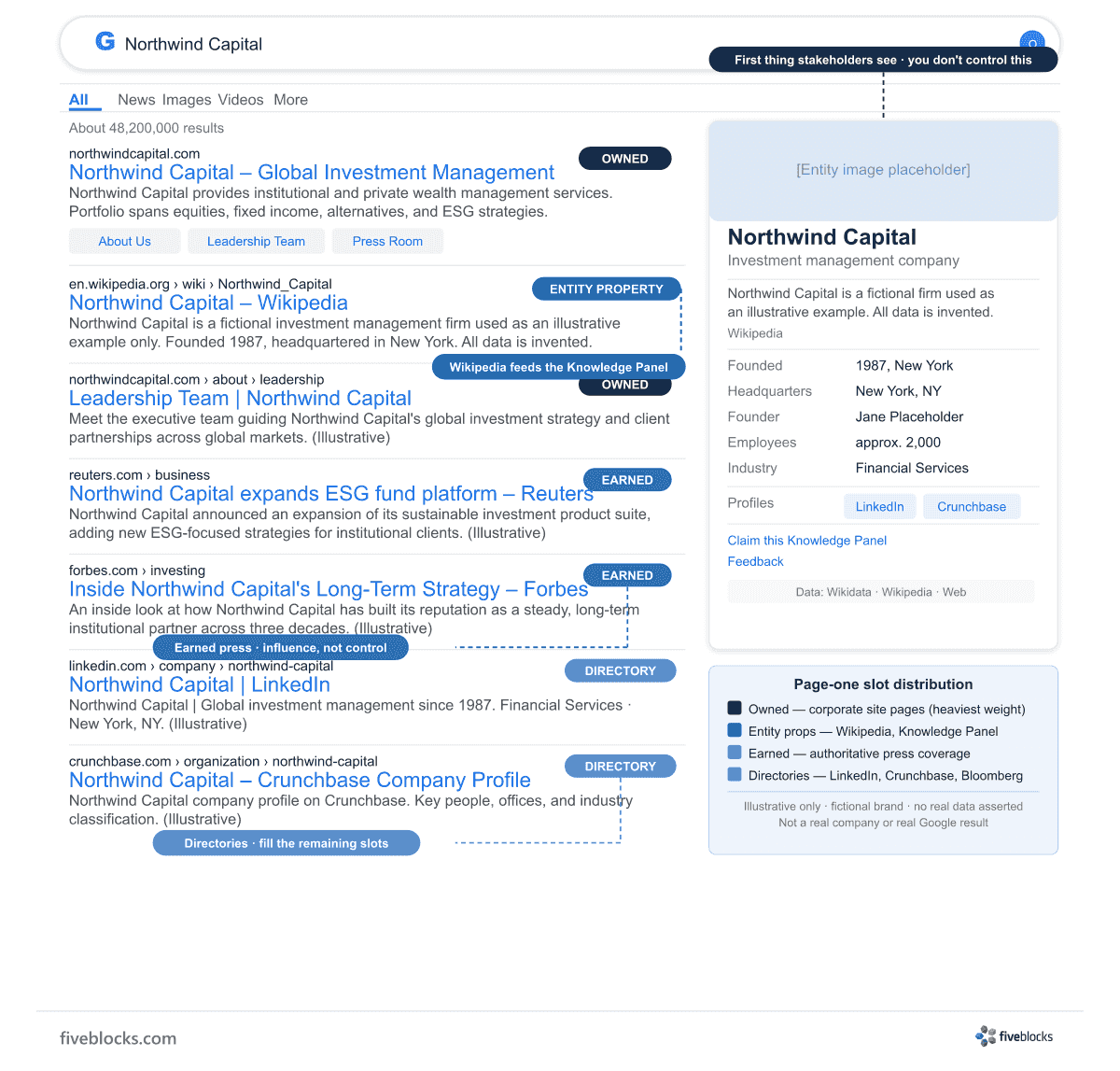
How an ideal branded page one distributes
- Owned and entity properties carry the most weight. The corporate site typically holds several slots through its About, leadership, press, and product pages. Wikipedia sits at or near the top where independent notability supports an article. LinkedIn ranks for the company page and, on executive name queries, for personal profiles that often land in the top three because of LinkedIn’s domain authority. The Knowledge Panel sits in the upper-right of the desktop SERP and draws its data from Wikidata, Wikipedia, the Knowledge Graph, and other authoritative sources across the web.
- Earned coverage takes a meaningful but smaller share. Authoritative third-party press from outlets such as Reuters, Bloomberg, Forbes, and relevant industry publications rotates through several slots as recent coverage breaks and freshness signals decay.
- Authoritative directories and business references fill the remainder. Structured third-party profiles tend to appear in the lower half of the page – LinkedIn ranks for people while Crunchbase and Bloomberg rank for companies – alongside industry-specific directory listings on the relevant queries.
Reading the gaps
Because the distribution is predictable, the places a client’s page one diverges from it tell you what to fix. A missing Wikipedia article, a weak or absent Knowledge Panel, thin owned coverage that cedes top slots to third parties, or no earned press in the mix each mark where the reputation work needs to begin. What is under-weighted on the branded SERP is as useful to read as what is already there.
Last reviewed: 19/05/2026
