What types of content rank well in Google for branded searches?
A healthy branded SERP for a recognized organization is made up of a predictable set of authoritative sources: the corporate site (several deep pages such as About, leadership, press, and product), Wikipedia where notability supports an article, LinkedIn for the company page and executive profiles, the Knowledge Panel entity card, business references like Crunchbase or Bloomberg on corporate queries, recent news, and authoritative directory listings. Where that set is broken, the gaps usually point to where reputation work needs to start.
A well-managed branded SERP for a recognized organization is usually made up of a predictable set of authoritative sources. Reading it works in both directions: a full set means a healthy footprint, and the missing pieces usually point to where the reputation work needs to start.
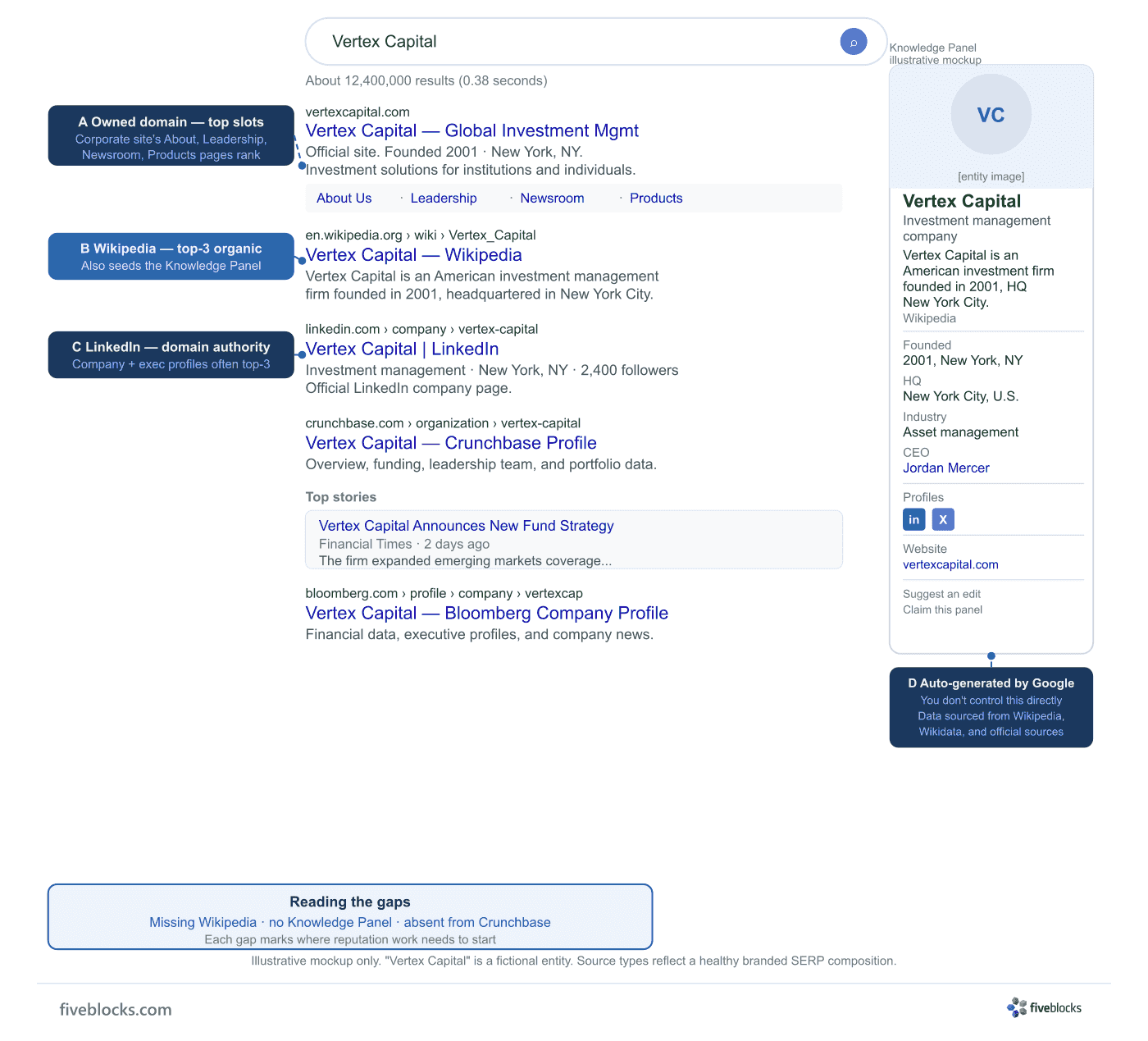
What a healthy branded SERP is made of
- The corporate site, across several deep pages. The owned domain typically holds multiple top slots through its About, leadership, press, and product pages.
- Wikipedia, where notability supports an article. A Wikipedia article is only viable when independent, reliable coverage establishes notability. Where it exists, it commonly ranks at or near the top.
- LinkedIn, for the company and its executives. The company page holds a position, and on executive name queries personal LinkedIn profiles frequently sit in the top three results because of LinkedIn’s strong domain authority.
- The Knowledge Panel. For a recognized entity, Google’s automatically generated entity card sits at the upper-right of the desktop SERP, drawing its data from Wikidata, Wikipedia, the Knowledge Graph, and other sources across the web.
- Business references such as Crunchbase or Bloomberg. On corporate and financial queries, structured third-party directories tend to appear: LinkedIn ranks for people while Crunchbase and Bloomberg rank for companies.
- Recent authoritative news. Coverage from outlets Google trusts rotates through the page as stories break and freshness signals decay.
- Authoritative directory listings. Industry-specific and structured business directories fill out the page on the relevant queries.
Reading the gaps
Where this set is broken – a missing Wikipedia article, a weak or absent Knowledge Panel, no Crunchbase entry, an outdated LinkedIn presence – the gap usually marks where the reputation work needs to begin. What is absent tells you as much as what is present.
Last reviewed: 19/05/2026
