How does Google rank search results for branded queries?
Google ranks branded queries on a mix of classical signals (domain and page authority, relevance, freshness, click and engagement behavior) and an entity layer (Knowledge Graph recognition, sameAs links, structured data, Wikidata attributes). The entity layer has gained weight over the last five years and now also determines what AI engines say about a brand.
Branded query ranking in Google combines two overlapping signal layers: a classical layer that has governed search for two decades, and an entity layer that has gained weight as Google’s Knowledge Graph has matured. Working on one layer without the other leaves the job half done.
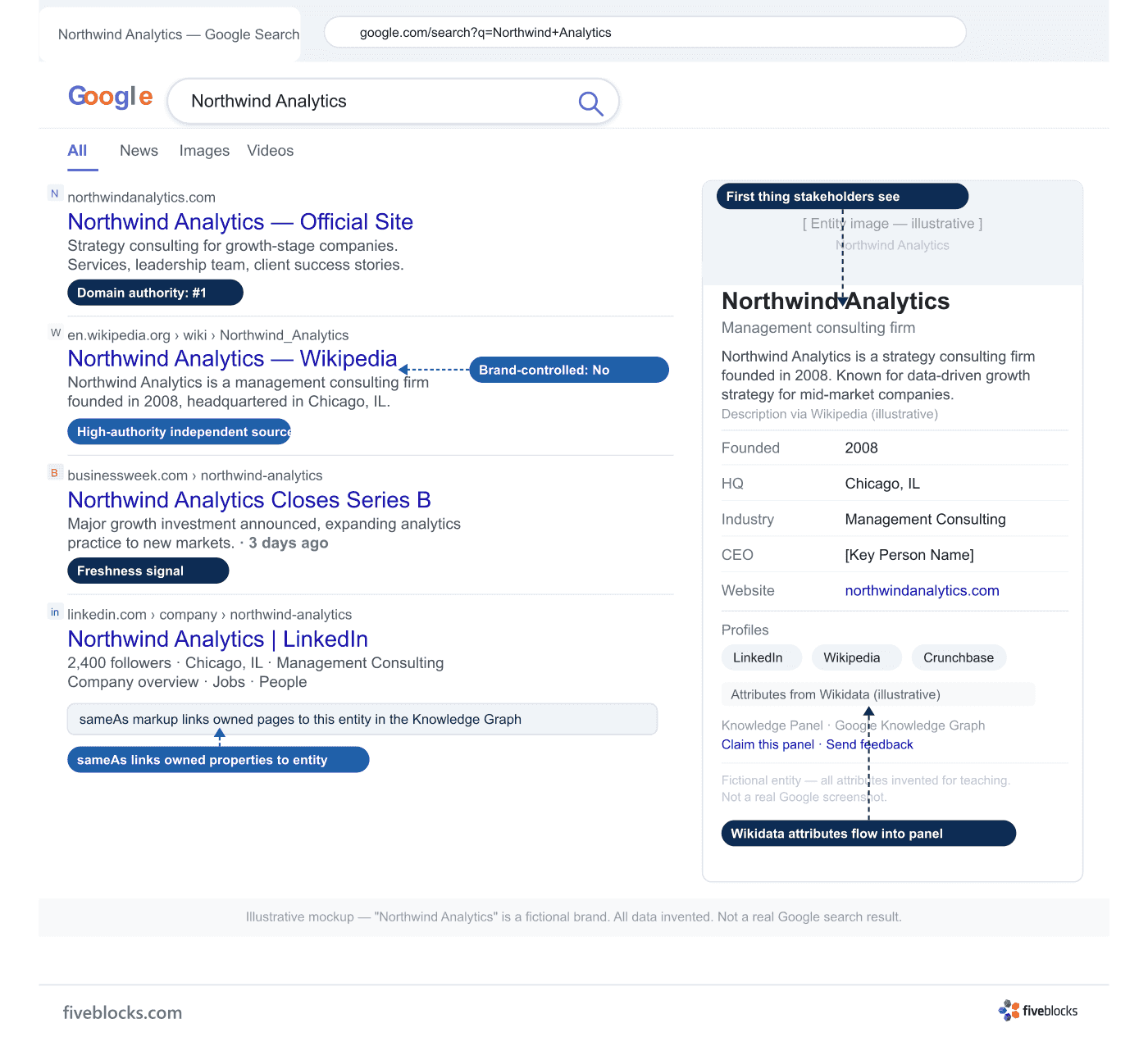
Classical ranking signals
- Domain authority
- The cumulative trust a domain has earned through inbound links, age, content depth, and citation patterns. High-authority domains (Google’s own properties, LinkedIn, Wikipedia, Crunchbase, Bloomberg, Glassdoor) hold top positions for most branded queries without extra optimization. For owned properties, authority comes from sustained authoritative content and genuine inbound links, not volume tactics.
- Page authority
- Domain authority applied to the specific URL. A strong domain with a thin or poorly linked page on the subject will rank below a moderate domain whose page has earned direct inbound signals.
- Relevance to the query
- Google evaluates hundreds of on-page and off-page factors to judge whether a URL answers what the searcher intended. For branded queries, pages that use the brand name prominently and are editorially connected to the brand’s activities usually clear this bar.
- Click and engagement behavior
- Aggregate click-through rates, dwell time, and pogo-sticking tell Google’s ranking systems whether results satisfy searcher intent. A result that ranks but is consistently skipped or abandoned tends to drift down over time.
- Freshness
- Google applies freshness signals selectively. For news-like branded events (an executive departure, a product launch, a legal development), recently published content from indexed news outlets can jump to the top of the SERP. For stable informational queries, freshness counts for less and authority carries most of the weight. Freshness signals on older articles decay, which is one reason negative coverage from several years ago can be displaced by a sustained content program.
Entity-layer signals
- Knowledge Graph recognition
- Google’s Knowledge Graph is a database of entities (people, organizations, places, things) and their relationships. When Google recognizes a brand as an entity in the Knowledge Graph, it surfaces a Knowledge Panel alongside the SERP and routes entity-attribute queries straight to that panel. Knowledge Graph inclusion is a prerequisite for the entity layer to work at all.
- Wikidata attributes
- Wikidata is a primary structured-data input to the Knowledge Graph. The attributes stored in a brand’s Wikidata item (founding date, headquarters, people, industry classification, related entities) flow directly into the Knowledge Panel and into how AI engines describe the brand. A stale or incomplete Wikidata entry produces stale or incomplete panel data.
- Wikipedia article
- Wikipedia typically ranks first or second for branded queries where a notable article exists, and the article’s content feeds both the Knowledge Panel description and the training and retrieval corpora of major AI engines. A well-maintained, well-sourced Wikipedia article is one of the highest-leverage assets in the branded SERP.
- sameAs links and structured data
- Schema.org markup on owned web properties lets Google connect those pages to the entity in the Knowledge Graph. The sameAs property links a brand’s web presence to its canonical identifier, which reduces the risk that pages are treated as unrelated assets instead of one coherent entity footprint. Without this markup, authority earned by one property may not build on authority earned by others.
- E-E-A-T signals
- Google’s quality framework (Experience, Expertise, Authoritativeness, Trustworthiness) overlaps with the entity layer. Pages with identifiable expert authorship, within-text citations, and clear topical authority earn E-E-A-T signals that reinforce domain and page authority.
Diagnosing which factor is weakest
Because the two layers reinforce each other, find the binding constraint before you intervene. A few diagnostic questions:
- Is there a Knowledge Panel? If not, the entity layer is essentially absent and the priority is establishing Knowledge Graph recognition, usually starting with a clean Wikidata entry and a Wikipedia article where notability supports one.
- Is the Knowledge Panel accurate and complete? If the panel shows stale data (wrong CEO, outdated description, missing attributes), the issue is in Wikidata or Wikipedia content, not in the classical layer.
- What domains occupy page one? If negative or uncontrolled third-party properties hold the top positions, the question is whether those positions are held by domain authority (LinkedIn, Glassdoor, Bloomberg) or by freshness from a specific news event. Each requires a different intervention: authority is addressed by content and entity work on owned properties; freshness is addressed by publishing more recent authoritative content on the same topic.
- Are owned properties connected to the entity via structured data? If the brand’s website lacks sameAs markup and Organization schema, authority earned on the site may not compound with the entity’s Knowledge Graph footprint.
- Is there coverage of the brand on authoritative domains? If Wikipedia, Crunchbase, Bloomberg, and industry-relevant publications are absent or thin, the entity layer has no scaffolding and ranked-page authority is all that remains.
Last reviewed: 19/05/2026
