What content signals does Google use when deciding what ‘defines’ a brand search?
Google builds the brand-defining result for a branded search from several trusted signals rather than any single page: structured data on the official site, Wikipedia and Wikidata, citation patterns across authoritative third-party sources, and entity-recognition signals such as sameAs links. The signals Google weights most heavily are a consistent official-site link with Organization schema, a Wikipedia article, and structured-data consistency across those anchors. When those three agree, the Knowledge Panel and branded SERP reflect them.
Google builds the brand-defining content for a branded search from several trusted signals rather than any single source. No one page controls the outcome. The Knowledge Panel, featured snippet, and page-one composition come from the consistency and authority of the whole entity stack. When those signals are strong and agree, Google shows an accurate, company-aligned picture. When they conflict or are missing, it hedges or falls back on less reliable sources.
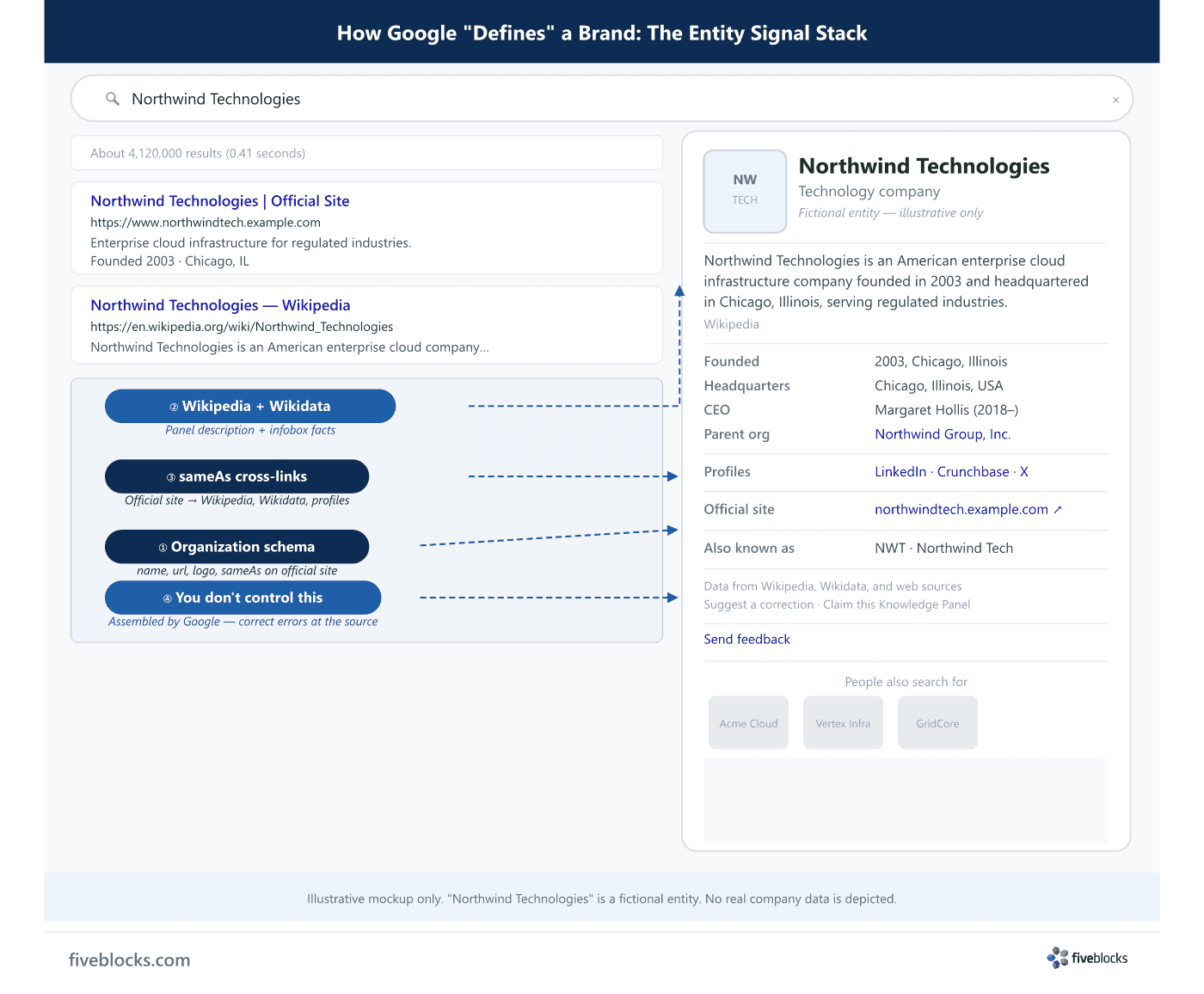
- Official site with Organization schema
- The corporate website carrying
Organization(orPerson) schema markup is the primary first-party signal Google uses to identify and define the brand. Schema fields, legal name, description,url,logo, andsameAslinks to authoritative profiles, tell Google which entity the site is about and how to connect it to the rest of the entity graph. When the official site carries clean, accurate structured data and other authoritative sources link back to it, Google can resolve all incoming signals to one well-defined entity with more confidence. This is the signal category the brand controls most directly, and the one Google reads first. - Wikipedia and Wikidata
- Wikipedia is the most heavily weighted third-party input into Google’s Knowledge Panel for notable entities. The panel’s description, main attributes, and infobox data come largely from the Wikipedia article and its underlying Wikidata entry. Google’s Knowledge Graph is built largely on top of Wikidata’s structured facts, founding date, headquarters, leadership, parent/subsidiary relationships, and Wikipedia’s narrative. A well-sourced, accurately structured Wikipedia article with complete infobox fields is therefore the third-party asset with the most influence over what the Knowledge Panel displays. Panel errors almost always trace back to errors in Wikipedia or Wikidata rather than to Google itself; correcting the panel means correcting the source.
- Structured-data consistency across anchors
- Google’s entity-recognition confidence rises when the same name, description, and main attributes appear consistently across the official site (via schema), Wikipedia, Wikidata, LinkedIn, Crunchbase, and authoritative industry references.
sameAslinks, on the official site’s Organization schema pointing to the entity’s Wikipedia article, Wikidata Q-ID, and authoritative profiles, connect those anchors explicitly, telling the systems that all these references describe one entity. Inconsistencies across those anchors, a different name variant on Crunchbase, a conflicting description on LinkedIn, a stale Wikipedia infobox, make the systems hedge or fall back on lower-confidence sources. Consistency amplifies the authority of each individual signal by confirming they all point to the same entity. - Citation patterns from authoritative third-party sources
- Beyond Wikipedia, Google’s entity layer reads how the brand is described by authoritative third-party sources: tier-one news outlets, industry databases, regulatory filings, and credible review platforms. How often and how consistently the brand is named in authoritative contexts, and how those references describe it, act as corroborating entity signals. A brand cited accurately and consistently across Reuters, Bloomberg, and its industry press carries stronger entity recognition than one whose only authoritative citation is its own website. Earning and maintaining authoritative third-party coverage of current, accurate brand information is therefore a direct input into the brand-defining signal set, not only a PR objective.
- Click behavior and user engagement
- Google also reads behavioral signals, whether users searching the brand name click on the corporate site, how they engage with the Knowledge Panel, which result they return to, as confirmation that the assembled brand picture matches what users expect. These signals reinforce the authority ranking of owned and authoritative third-party assets over time. Note: click and engagement signals are inferred from how Google describes its ranking systems. Google does not publish a detailed breakdown of how engagement data interacts with entity-layer signals, so treat this category as directional rather than precisely documented.
Which signals to prioritize
Because Google does not publish a weighted formula, exact priority is inferred from practitioner evidence and Google’s own documentation on entity recognition. The practical order is:
- Official-site link with Organization schema and sameAs, the brand’s direct first-party signal, and the highest-leverage place to start any entity work.
- Wikipedia article with accurate infobox, the primary third-party input for the Knowledge Panel and AI engines; correcting errors here cascades into Knowledge Panel corrections.
- Wikidata entry with complete, sourced statements, the structured-data layer Wikipedia’s infobox feeds into; completing it speeds up Knowledge Panel accuracy and AI engine fact resolution.
- Structured-data consistency across authoritative profiles: LinkedIn, Crunchbase, industry databases, with sameAs links from the official site connecting them into one entity graph.
- Authoritative third-party citation patterns, sustained coverage in outlets the engines trust, describing the brand consistently with the canonical entity definition.
The practical takeaway: no single page controls the brand-defining result set, so reputation work has to address the whole entity layer to move it reliably.
Last reviewed: 20/05/2026
