What is the role of brand mentions without links in entity optimization?
Unlinked brand mentions still build entity authority because Google and the AI engines use named-entity recognition to extract and attribute a brand from natural language, independent of any hyperlink. A brand named in a credible context becomes a co-occurrence and topical-association signal, so the mention itself counts.
Brand mentions without links build real entity authority because current search and AI systems extract and attribute entities from natural language, independent of hyperlinks. When a brand is named in a credible context, named-entity recognition lets Google and the AI engines identify the entity, register the mention, and use it to build co-occurrence and topical-association signals. The hyperlink that classic SEO relied on is no longer required for the mention to count.
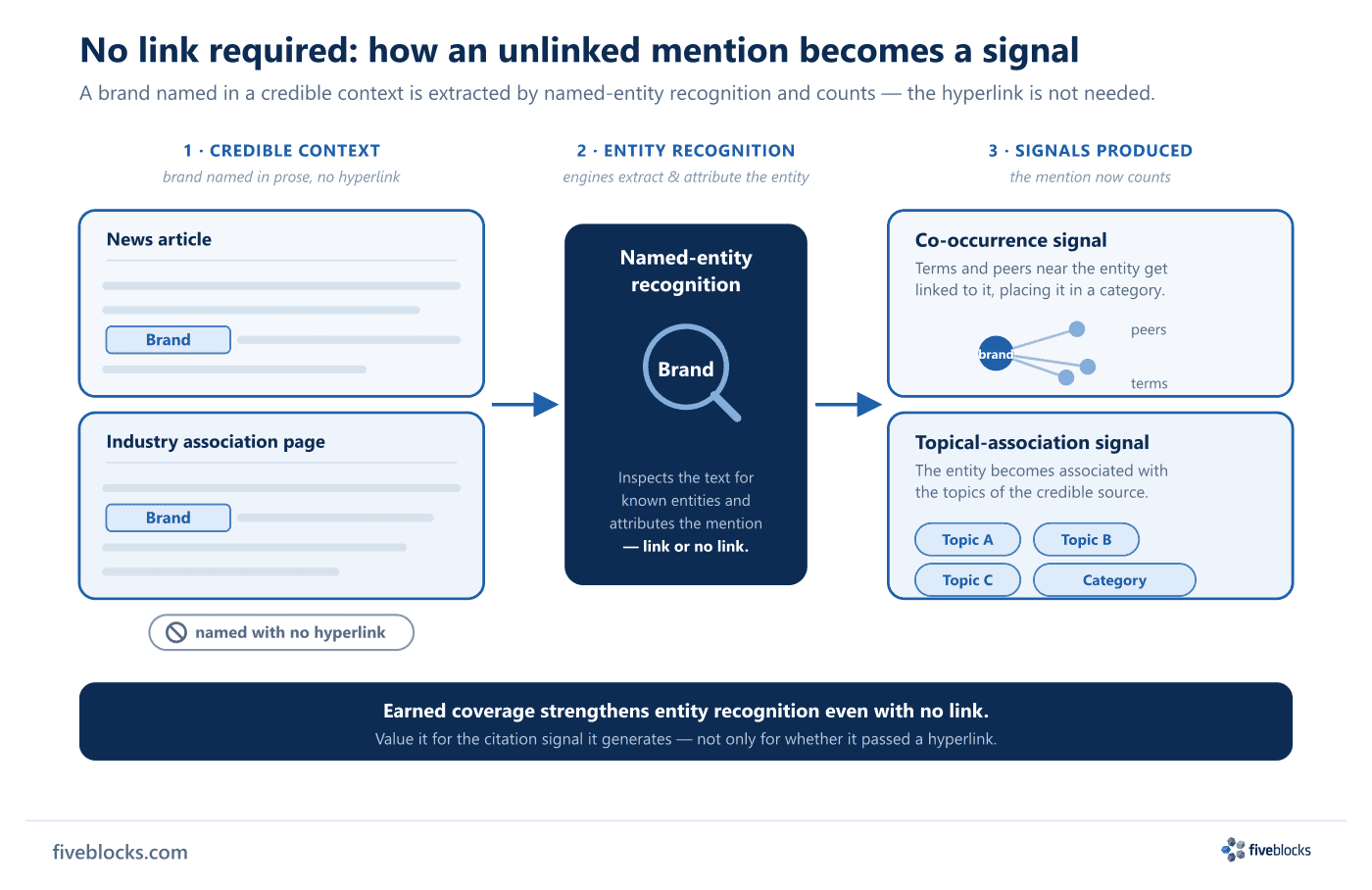
How an unlinked mention becomes a signal
- Named-entity recognition extracts it. The engines inspect natural-language text for known entities, proper nouns such as brands, people, and places, and attribute the mention to the entity whether or not a link was included.
- Co-occurrence places it. The terms and peers that appear near the entity in the text get linked to it, so the systems infer the entity’s category and topical associations from the company it keeps.
- Co-citation corroborates it. When two separate sources name the entity, not necessarily with a link, the systems read the shared citation as evidence of who is who.
Credible contexts where this happens
The qualifying contexts are authoritative places a brand gets named in prose. A news article or an industry association page are clear examples, where the entity sits among related topics and peers. The common thread is an authoritative source and a relevant context. What matters is the credibility of the publisher and where the mention sits, not whether it carries a hyperlink.
What this means for strategy
This changes how reputation work is valued: earned coverage strengthens entity recognition even when it carries no link, so it should be judged by the citation signal it generates rather than by whether it passed a link. The engines weight authority and entity recognition heavily, so a credible publishing source counts for more than the raw number of articles, and the quality and context of the source matter more than the link itself. This is a shift from classic SEO, which weighted links heavily: Google’s ranking long rewarded natural, authoritative links and downgraded manipulative ones. We treat authoritative unlinked mentions as real contributions to the entity layer and monitor how they shape what the AI engines say with AIQ.
Last reviewed: 20/05/2026
