What is the role of co-occurrence and co-citation in entity building?
Co-occurrence is when an entity appears alongside particular topics, terms, or peers in authoritative content; co-citation is when authoritative sources mention an entity together with related entities, even without linking them. Both are unlinked signals search and AI systems use to infer an entity's category and associations. A firm consistently discussed beside distressed-debt investing gets read as a distressed-debt entity.
Co-occurrence and co-citation are two ways search and AI systems infer an entity’s category and associations from natural language, without being told directly and without hyperlinks. Both describe where and beside what an entity is mentioned in credible content, and systems read those patterns to place the entity.
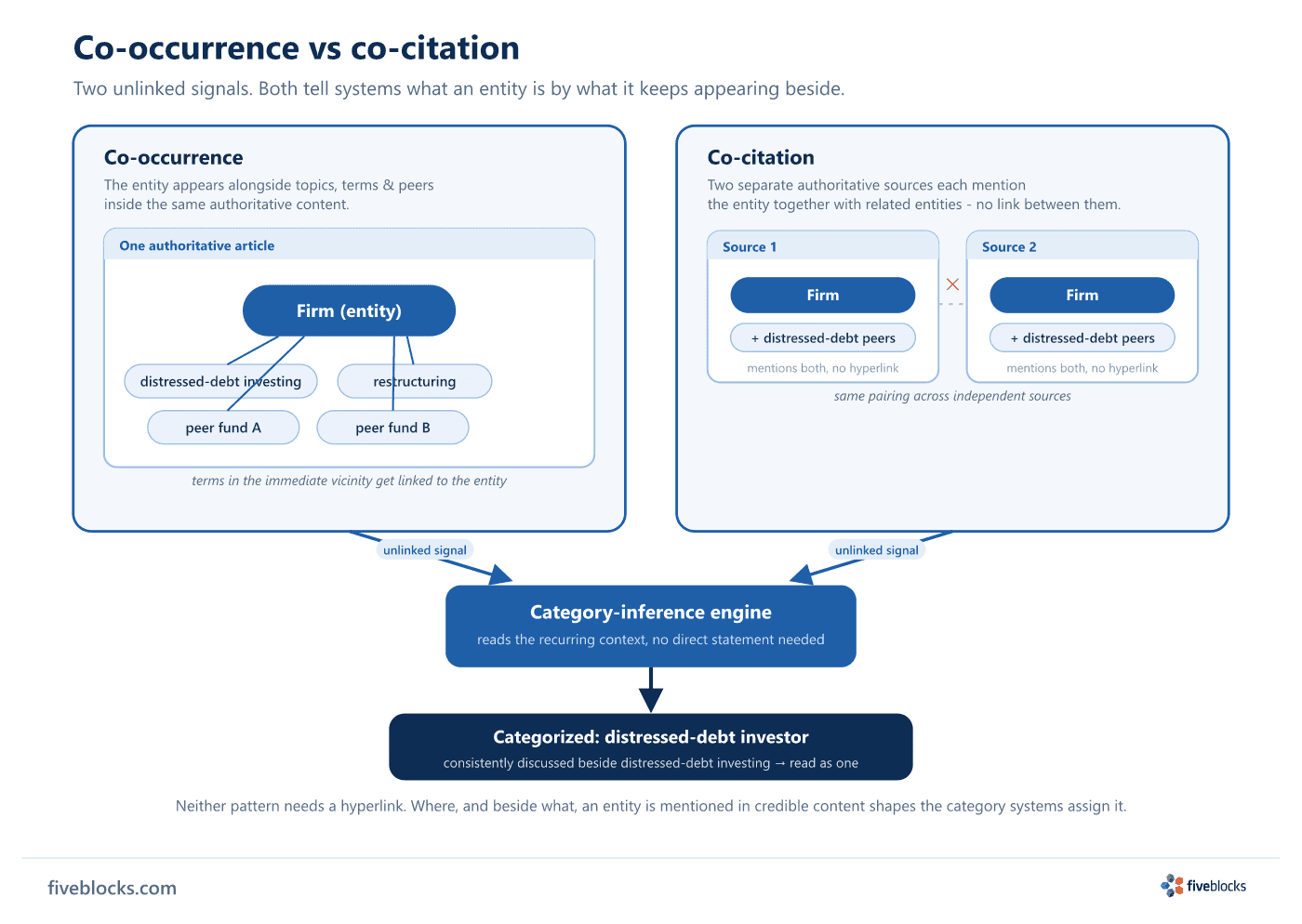
The two patterns
- Co-occurrence
- An entity appears alongside particular topics, terms, or peers in authoritative content: an executive repeatedly named in articles about an industry, or a firm named beside its competitors. Search and AI systems track these patterns in natural language, not only links, and use them to infer what an entity is associated with and which category it belongs to. Terms that sit near a named entity get linked to it.
- Co-citation
- Authoritative sources mention an entity together with related entities, which tells the system they belong to the same set or category. In the SEO literature, co-citation means a brand is mentioned by two different sources but not necessarily linked, so the association registers even with no hyperlink between them.
How systems use these signals
Named-entity recognition lets Google and the AI engines extract a brand from the surrounding text and attribute the mention to it, independent of any link, then store the attributes and related entities pulled from that content against the entity. Systems disambiguate and categorize using contextual signals, industry, role, and associated topics, alongside structured identifiers. If credible sources consistently discuss a firm in the context of distressed-debt investing, the engines have strong contextual grounds to read it as a distressed-debt entity. What counts is where and beside what an entity gets mentioned, not only that it is mentioned.
Why it matters for reputation work
These association patterns shape how systems categorize an entity, so earning the right co-occurrences, in the right contexts and beside the right peers, is part of shaping how the entity is understood. We track these patterns and how they affect AI framing with AIQ.
Last reviewed: 20/05/2026
