What types of content rank best for branded searches?
A branded SERP for a well-known company usually shows a consistent set of result types: the company's official website at the top, then third-party authority sources like Wikipedia, LinkedIn, Crunchbase, Bloomberg, and news mentions. Search engines rank owned properties highest on a branded query and mix in outside sources that corroborate the company.
The branded results for a recognized company combine owned pages with external authority sources. The corporate website comes first, then a predictable run of third-party results: Wikipedia, LinkedIn (employee and company pages), Crunchbase (company databases), financial press such as Bloomberg, and recent news. Each of these answers a different question a searcher has about the company.
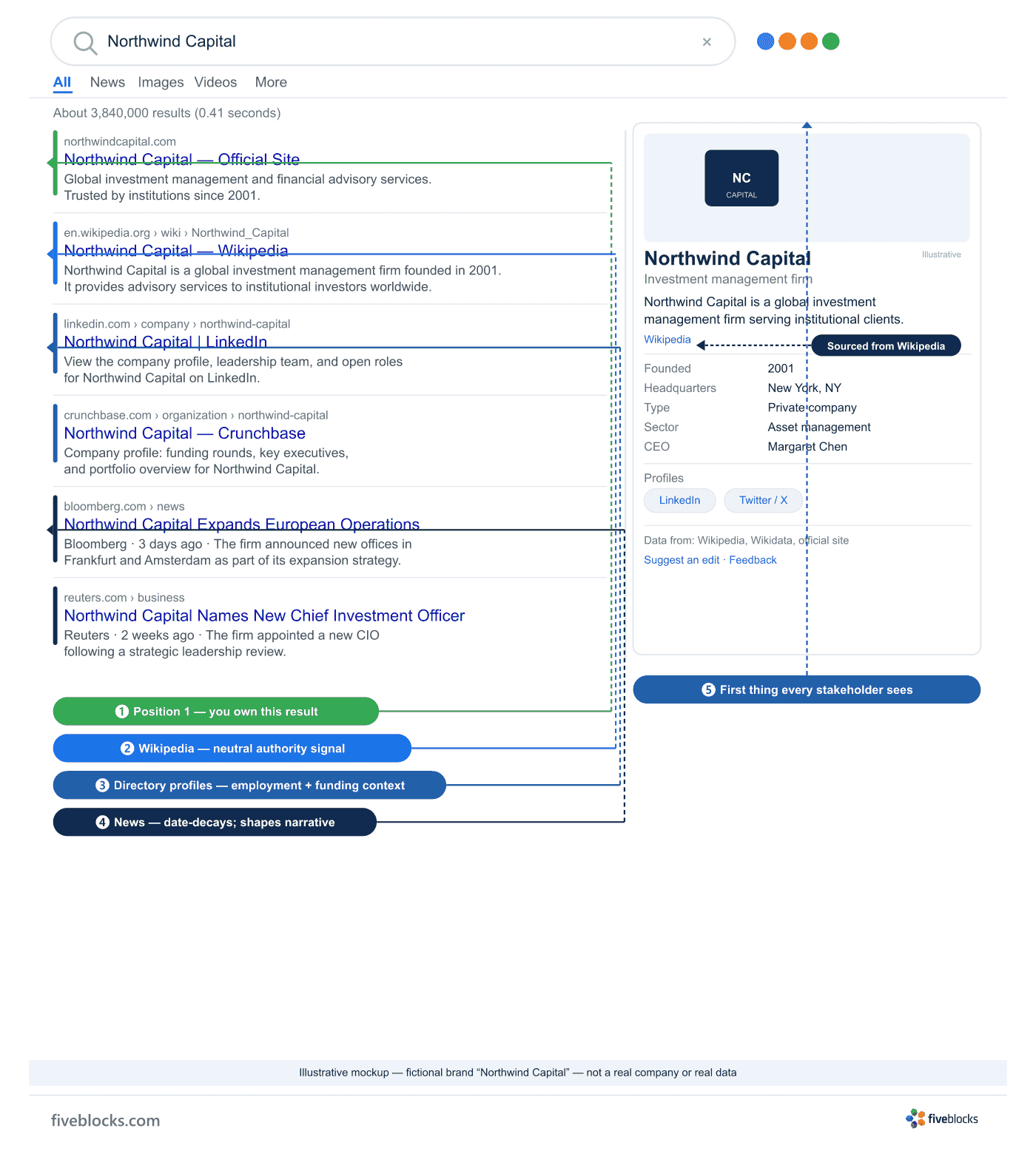
Typical positions in a branded company SERP
- Position 1, official corporate website
- The company’s primary domain (homepage or a relevant landing page) holds the top result. Search engines rank owned properties highest on a branded query.
- Position 2-3, Wikipedia or a major directory
- For established companies, Wikipedia usually ranks second or third. It is a neutral, externally maintained reference that adds authority and breadth to the company profile. For B2B or less-documented companies, a major industry directory or similar source often fills this slot instead.
- Positions 3-5, LinkedIn and Crunchbase
- LinkedIn (company page and executive profiles) and Crunchbase (company profile) appear in the next tier. They supply employment context, funding information, and leadership visibility, answering ‘who works here’ and ‘what is this company’s funding and stage.’
- Positions 5-7, news and financial press
- Recent news and financial press (Bloomberg, Reuters, or the Wall Street Journal, depending on the company) usually fill positions 5-7 and show current activity and outside coverage. These results decay over time, and older coverage drops as new news is published.
- Positions 8+, additional directories, reviews, or legacy content
- Below the first page you find more directories (Better Business Bureau, industry-specific listings), review aggregators where relevant, older owned content, and archived pages.
Why this pattern matters for reputation
This mix tells searchers and AI engines that the company is established, recognized, and corroborated by outside sources. A branded SERP missing Wikipedia, LinkedIn, or recent news points to a company that is young, obscure, or the target of suppression efforts. And a branded SERP where hostile content ranks in the top 5 rather than below position 8 is an immediate warning: the company’s authority signals are too weak to push it down.
Last reviewed: 20/05/2026
