How do you optimize a company’s about page to rank on page one for branded searches?
A company About page that ranks on page one for branded searches needs Organization schema (with founder, foundingDate, headquarters, and sameAs links), a narrative with descriptive headings, leadership content with Person schema on named executives, FAQPage schema for branded Q&As, authoritative external citations, and regular updates to reflect current reality. These six elements make the page readable to Google's entity layer and AI engines, not just to human readers.
About pages sit where branded search intent meets entity signals. When someone searches the brand as an organization, the page Google returns is usually the corporate About page, and its contents shape both the SERP impression and what AI engines extract. Most corporate About pages were written years ago and never touched since. Refreshing them is one of the higher-return jobs in a typical engagement.
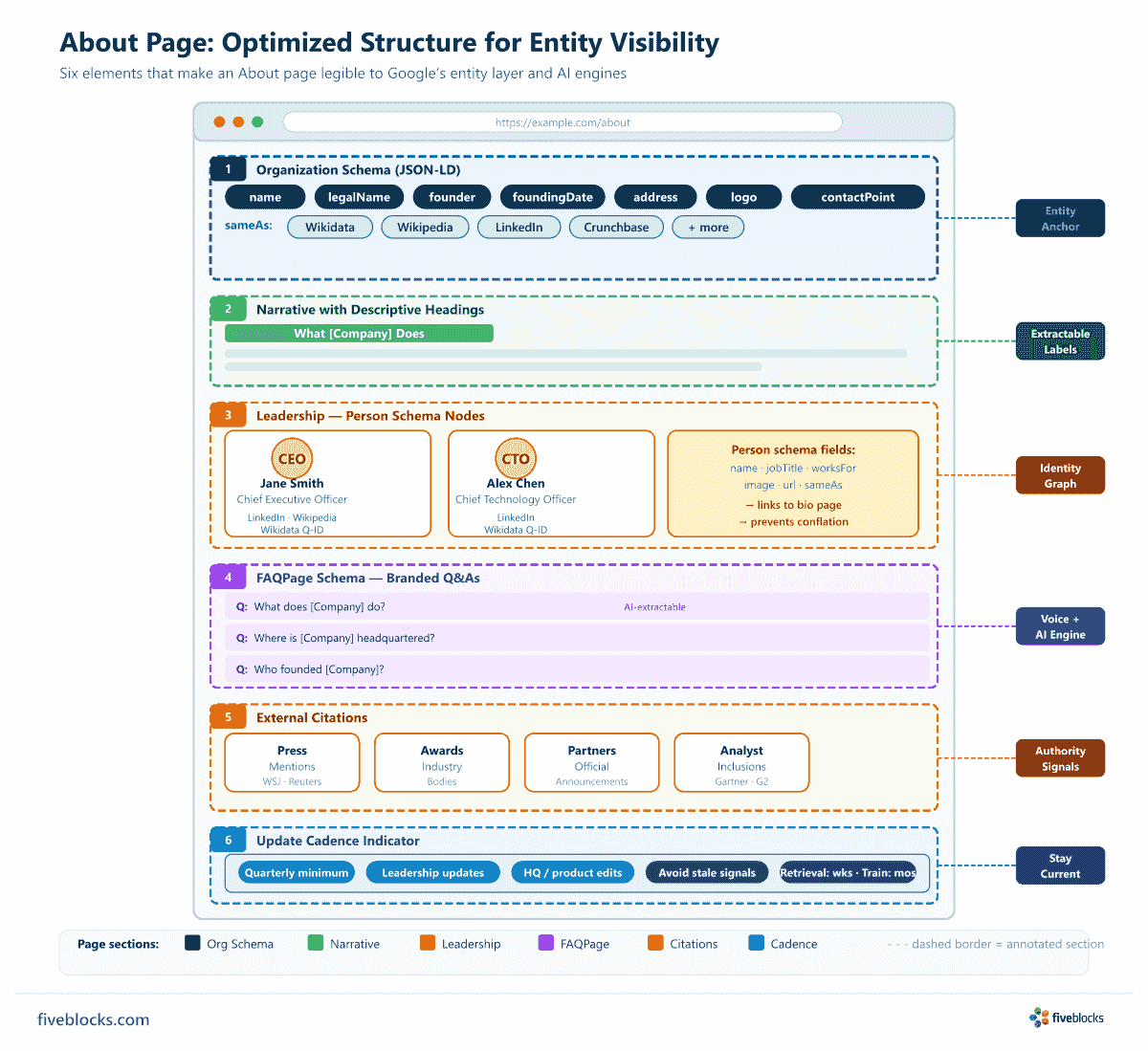
Step 1: Organization schema, the entity anchor
Organization schema in JSON-LD is the machine-readable foundation. It carries fields that search and AI engines read directly: name, legalName, url, logo, founder, foundingDate, address (headquarters), and contactPoint. The sub-element that matters most is the sameAs array: links to the company’s Wikidata entry, Wikipedia article, LinkedIn page, Crunchbase profile, and other authoritative directories. These sameAs links tell Google and AI engines which entity the page is about and connect it to the wider entity graph. Without them, the page is just prose.
Step 2: Narrative with descriptive headings
The body copy should say what the company does, for whom, and to what end, written to be extracted rather than merely read. Use descriptive <h2> and <h3> headings that work as extractable labels (for example, “What [Company] Does”, “Markets Served”, “How We Work”). Skip heading text that is decorative or meaningless on its own. AI engines build entity answers from owned web properties, and structured prose with clear headings is extracted more reliably than a wall of marketing copy.
Step 3: Leadership section with Person schema
Each named executive should appear with Person schema markup that specifies name, jobTitle, worksFor, image, url, and sameAs links to their LinkedIn profile and, where available, their Wikipedia article and Wikidata Q-ID. These sameAs links tie the individual to their machine-readable identity and stop engines from confusing them with same-named people. Each Person node should link out to a deeper bio page. That spreads entity signals across the site and gives engines a fuller identity graph for the leadership team.
Step 4: FAQPage schema for branded questions
Include a set of branded Q&A pairs covering the questions most likely to come up in a branded search session, “What does [Company] do?”, “Where is [Company] headquartered?”, “Who founded [Company]?”, and mark them up with FAQPage schema. FAQPage schema makes question-and-answer content explicitly machine-readable and extractable by AI engines and featured snippet algorithms. One caveat: as of May 2026, Google retired FAQ rich results, and FAQPage markup no longer generates an FAQ accordion in the organic SERP. The schema still helps with AI engine extraction and voice assistant answer selection, but it will not produce a visible SERP enhancement in Google Search.
Step 5: External citations section
Reference recent authoritative third-party coverage on the page itself: press mentions, awards, partner announcements, analyst inclusions. These citations do two things. They give engines live outbound signals to follow when confirming the entity’s authority and recency, and they cue engines to read the page as a credible, current entity document rather than evergreen marketing copy. AI engines treat authoritative sources, mainstream news, awards bodies, official partner networks, as trust signals when they build entity answers, so surfacing those citations on the About page connects the entity to that authority chain.
Step 6: Update cadence
Keep the page current. Retrieval-based AI engines can pick up content changes within weeks; training-based engines pick them up at the next training cycle. An outdated About page, stale leadership, an old headquarters, discontinued products, creates factual conflicts that make engines hedge or surface wrong information. A dependable maintenance cadence, quarterly at minimum, keeps the page matched to current reality and tells crawlers the content is actively maintained.
Last reviewed: 19/05/2026
