A court ruled the defamatory content must be removed. Why is it still on Google?
Court orders bind specific named parties, usually the original publisher or host, not Google. When content still appears in Google after a removal order, the content persists on mirror sites, aggregators, syndication partners, cached snapshots, or forum quotations that were never subject to the order. Each persistence point needs its own enforcement action: a Google de-indexing request under applicable right-to-be-forgotten frameworks, a DMCA copyright removal where a copyright angle exists, or direct legal action against secondary publishers.
A court order requiring removal of defamatory content is addressed to specific named parties, the original publisher, and sometimes the hosting provider, but it does not bind Google as a search engine in most jurisdictions, and it does not trigger automatic de-indexing. When the content stays visible in Google after the order is enforced at the source, the content has not actually left the web. It still lives on one or more secondary locations, and each one needs separate enforcement.
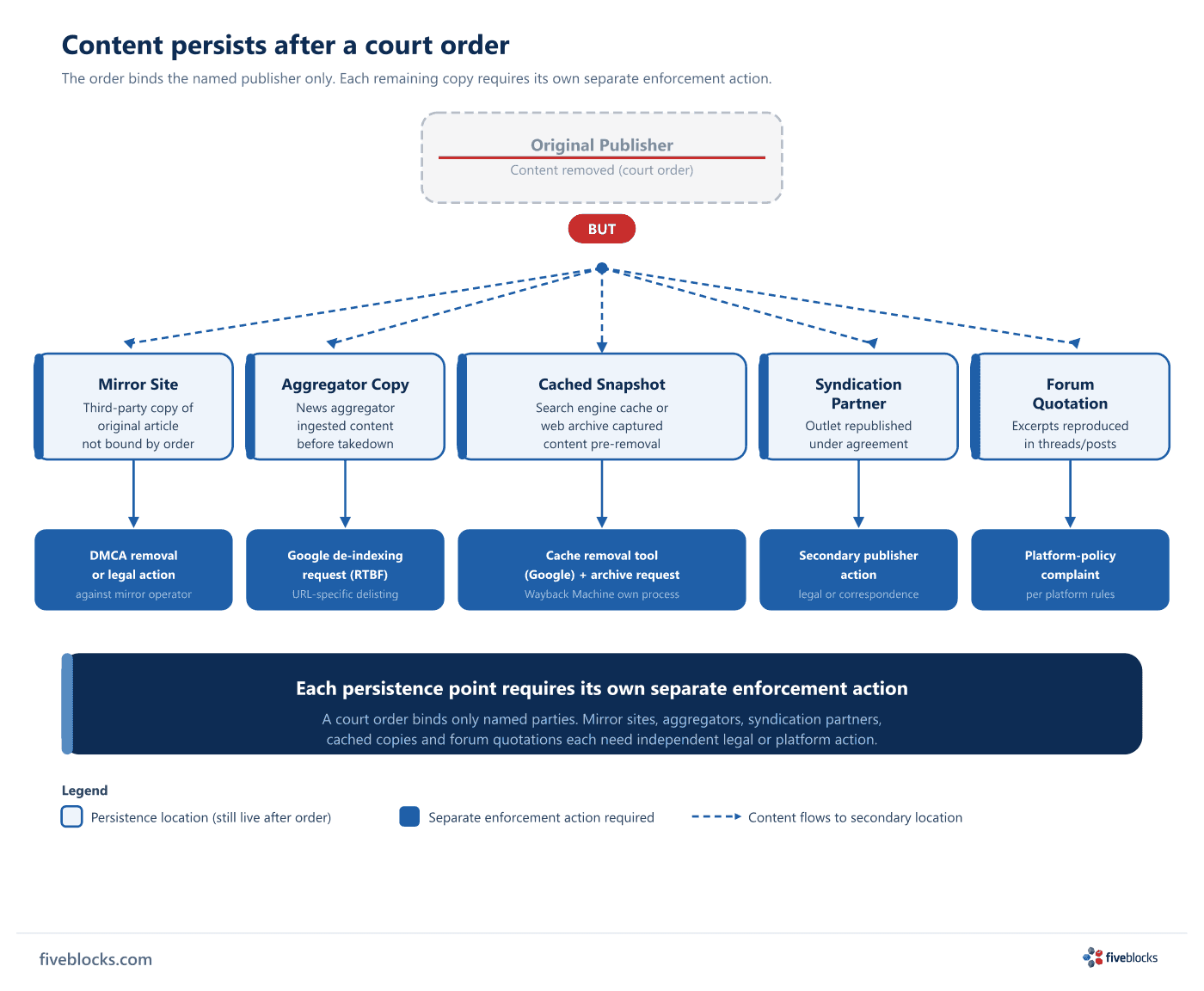
Why content persists after a removal order
- Mirror sites, third-party sites that copied the content before or after the original publisher took it down.
- Aggregators, news aggregators and content-scraping services that ingested the article before the takedown and were not parties to the court order.
- Syndication partners, outlets that republished the original article under a syndication agreement; each is an independent publisher with its own legal status.
- Cached snapshots, search engine caches, web archive services, or platform caches that captured the content before removal.
- Forum quotations and social posts, excerpts or full reproductions quoted in threads or social platforms, each a distinct piece of user-generated content.
The enforcement channels for each persistence point
- Google de-indexing request (RTBF): Where the right-to-be-forgotten framework applies (EU/UK), a successful request stops Google returning the specific URL in search results for the person’s name. The content still exists and stays accessible directly; this is a search-result delisting only, and it does not extend to other search engines or to non-name queries.
- DMCA copyright removal: Where the original content is protected by copyright and has been reproduced without authorisation, a DMCA notice to Google or the hosting platform can remove or disable access to the infringing copy.
- Secondary publisher action: Aggregators, syndication partners, and mirror-site operators that were not named in the original order have to be addressed separately, through legal correspondence, additional court proceedings, or platform-policy complaints where the platform’s own policies prohibit the content.
- Cache and archive removal: Google’s cache URL removal tool covers cached Google copies; web archive services (e.g., the Wayback Machine) have their own removal request processes.
What this means in practice
Digital cleanup after a court order is almost never instant and is rarely complete in a single action. We coordinate this work with counsel on every matter: mapping all the live persistence points before filing requests, sequencing enforcement to avoid creating new indexing signals, and managing the SERP composition while enforcement runs. The timeline from order to clean search result is months, not days.
Last reviewed: 19/05/2026
