How do you monitor regulatory filings and their impact on search results?
Monitoring runs on the official systems: SEC EDGAR in the US, Companies House in the UK, and equivalent international registries. Filings matter beyond the regulator that received them because they often rank in search and feed the AI engines that ingest public filing data.
Regulatory filings are public documents. They often rank for branded queries, and the AI engines now draw on them, so a filing can shape how an organization is seen far beyond the regulator that received it.
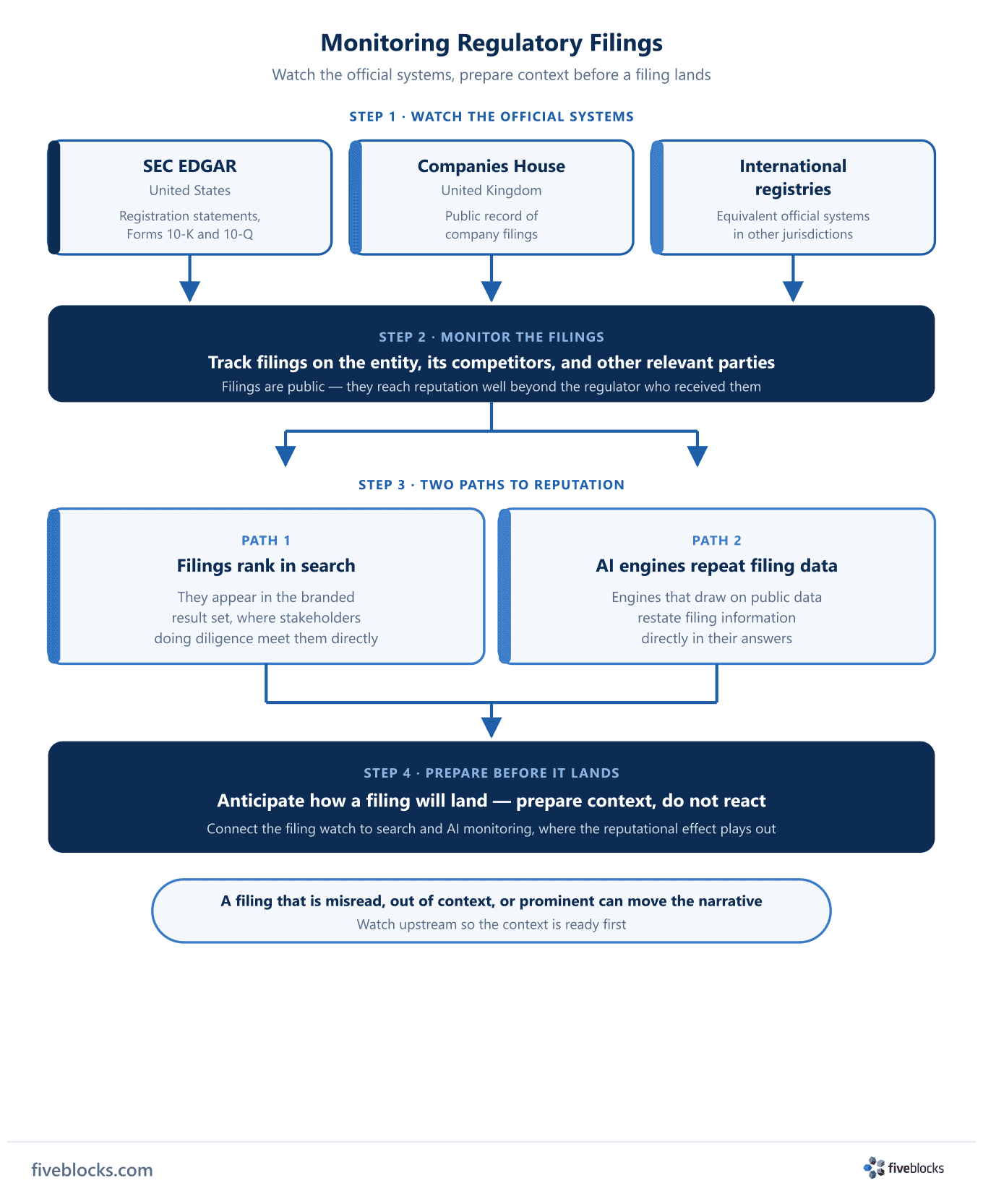
Where the monitoring happens
The watch runs on the official systems and covers filings involving the entity, its competitors, and other relevant parties:
- SEC EDGAR (US) – the SEC’s public system, with free access to registration statements, prospectuses, and periodic reports such as Forms 10-K and 10-Q.
- Companies House (UK) – the UK registrar’s public record of company filings.
- Equivalent international registries – the corresponding official systems in other jurisdictions.
How a filing reaches your reputation
A filing reaches a reputation program two ways:
- Filings rank in search. They show up in the branded result set, where stakeholders running diligence read them directly.
- The AI engines repeat filing data. Engines that draw on public data restate what a filing says in their answers.
A filing that is misread, stripped of context, or simply prominent can move the narrative through either path.
Why watch upstream
Watching the filing systems buys time: an organization can prepare context before a filing lands instead of reacting after it does. What makes that work is the link to search and AI monitoring, because that is where a filing’s reputational effect shows up. We track that downstream effect through IMPACT™ and AIQ™.
Last reviewed: 20/05/2026
