We were told by counsel to avoid all public statements. Can ORM still work under those constraints?
Yes. When public statements are off the table, reputation work moves to structural channels: owned-property content, editorial correction requests to outlets, Wikipedia Talk-page accuracy work, and entity-layer updates (schema markup, Wikidata). None of these require public engagement, and they still move the picture.
No-comment situations, litigation holds, regulatory reviews, and sensitive negotiations are common, and reputation work is still possible under them. What changes is the channel mix, not the goal.
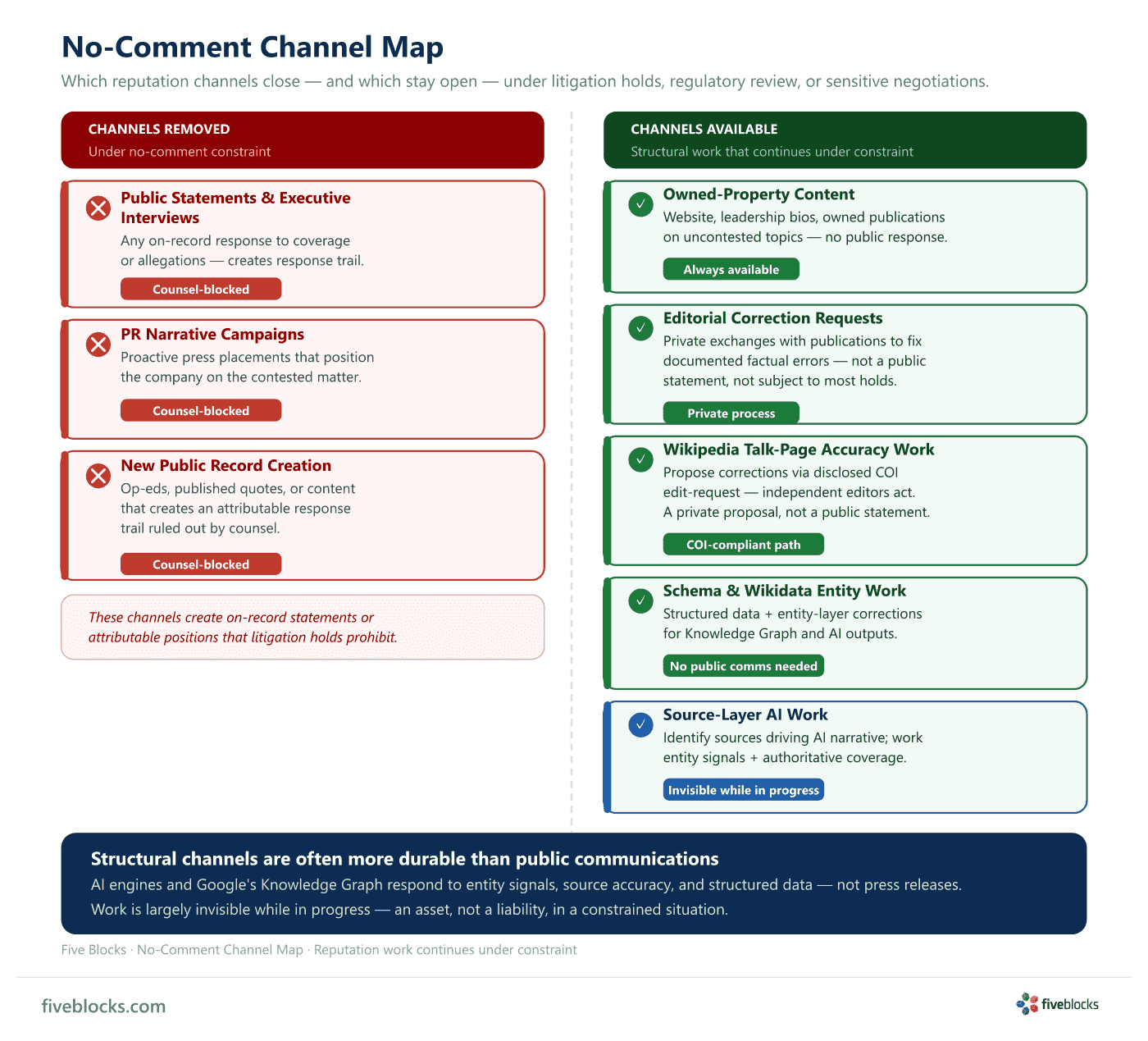
Channels removed under no-comment constraints
- Public statements and executive interviews, anything that puts a new on-record response to coverage or allegations on the record.
- PR-led narrative campaigns, proactive press placements that position the company on the contested matter.
- New public record creation, op-eds, published quotes, or any content that creates an attributable response trail counsel has ruled out.
Channels available under no-comment constraints
- Owned-property content, building out the company’s website, leadership bios, and owned publications on background topics that are accurate and uncontested. This establishes an authoritative voice without touching the disputed subject.
- Editorial correction requests, submitting factual corrections to outlets through standard editorial processes. These are private exchanges between the requesting party and the publication, not public statements, and under most litigation holds they do not require counsel approval.
- Wikipedia Talk-page accuracy work, proposing corrections to factual inaccuracies through Wikipedia’s disclosed conflict-of-interest edit-request process. The request goes to the article’s Talk page and is implemented by independent community editors, not by the party making the request. It is a private proposal, not a public statement.
- Schema markup and Wikidata entity updates, deploying structured data across owned properties and correcting the entity layer so the company is represented correctly in the Knowledge Graph and in AI engine outputs. These technical updates require no public communications.
- Source-layer AI work, identifying which sources are driving the AI narrative and working the structural inputs (entity signals, authoritative third-party coverage on uncontested topics) that influence what AI engines retrieve and surface about the entity. This work stays invisible to the outside world while it is in progress.
What this looks like in practice
Engagements run entirely within no-comment constraints still move the picture, and the structural channels are often more durable than public communications anyway. AI engines and Google’s Knowledge Graph respond to entity signals, source accuracy, and structured data, not to press releases. The work stays largely invisible while it is in progress, which helps rather than hurts in a constrained situation.
Last reviewed: 19/05/2026
