How do you manage reputation for a co-founder team?
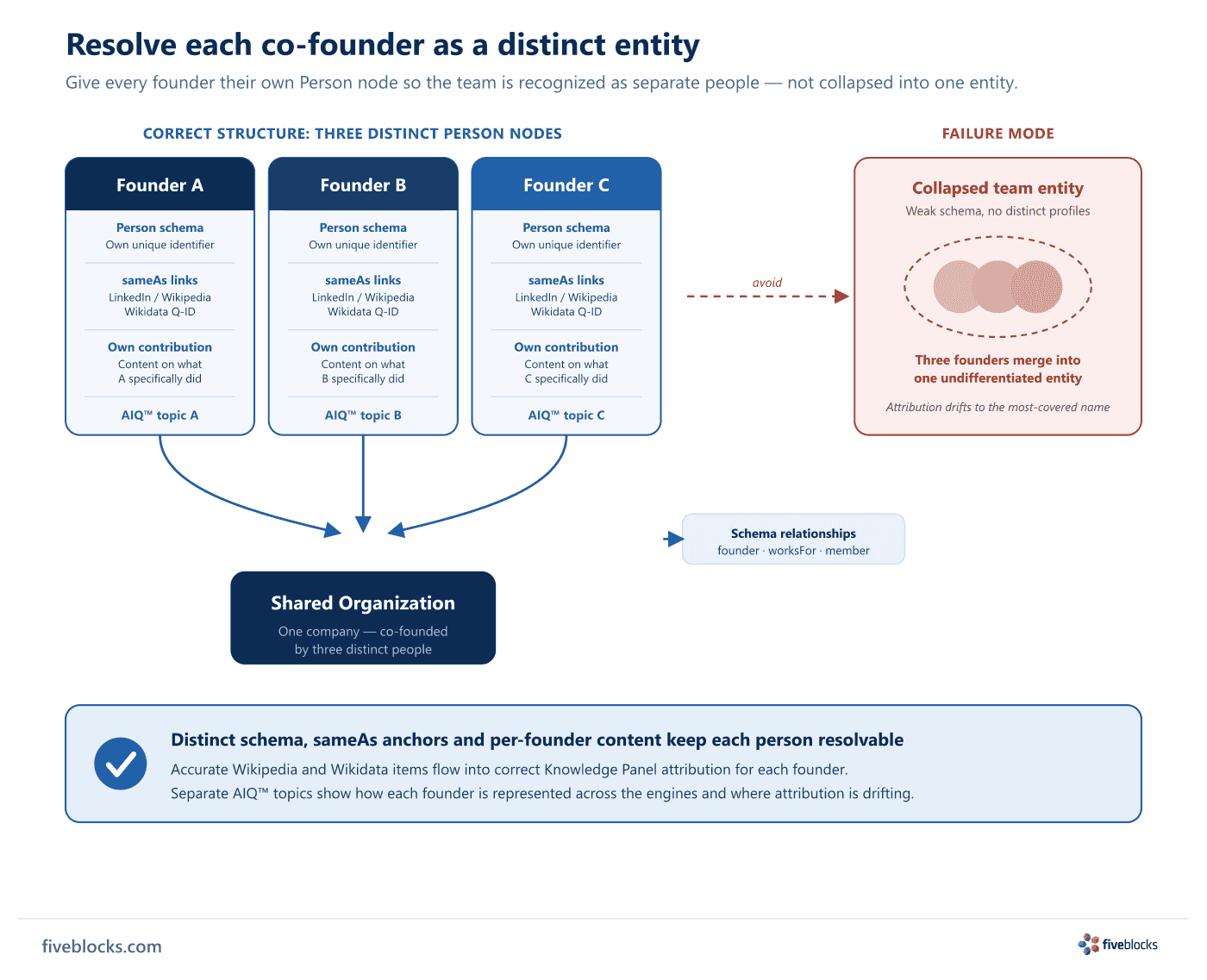
Give each founder a distinct Person entity: their own Person schema with sameAs links to their own authoritative profiles, accurate Wikipedia and Knowledge Panel attribution, content covering what each founder specifically did, and a separate AIQ topic per founder so attribution is tracked individually instead of collapsing into one team.
A co-founder team is harder to manage than a single founder because the engines have to resolve several people as related but distinct entities, each with their own role in the venture. You want every founder resolvable on their own, without the team collapsing into one entity and without everything attaching to whichever founder gets quoted most.
Why co-founder reputation needs deliberate structure
When entity infrastructure is weak (no clean schema, no distinct profiles, no disambiguation anchors), AI engines conflate people who appear together, and attribution drifts toward the most-covered name. For a co-founder team that produces two failure modes: the founders merge into one “team” entity, or a less-quoted founder’s contributions get reassigned to a more visible co-founder. Both are unfair to the under-covered founders and misleading to stakeholders trying to work out who did what.
How to keep each founder a distinct entity
- Distinct Person schema per founder
- Each founder gets their own Person schema with unique identifiers. That is what lets search and AI engines tell two associated individuals apart instead of merging them.
- sameAs links to each founder’s own profiles
- Person schema carries
sameAslinks pointing to that founder’s authoritative profiles: their LinkedIn, their Wikipedia article, their Wikidata Q-ID. Those anchors give the engines biographical disambiguation and tie scattered references back to one identity. - Explicit founder-to-company relationships
- Schema.org’s
founder,worksFor, and related properties connect each Person to the shared Organization. The engines can then see what is actually there: separate people who co-founded one venture, not a single blended entity. - Accurate Wikipedia and Knowledge Panel attribution
- Where founders are notable, Wikipedia covers each one’s contributions in their own article or section, and Wikipedia disambiguation plus distinct Wikidata items keep each person tied to their specific role. Knowledge Panels are generated from those underlying sources, so correct attribution there follows from getting Wikipedia and Wikidata right.
- Content that covers each founder’s specific contribution
- Per-founder content describing what each individual actually did, rather than one shared team narrative, gives the engines distinct, attributable material for each person.
- Separate AIQ topics per founder
- Set up an AIQ topic for each founder individually plus a topic for the company itself. You can then see how each founder is being represented across the AI engines and exactly where attribution is drifting between them, and correct the underlying sources before the drift hardens.
Together these signals get the engines to recognize the team’s real structure: several distinct, correctly attributed founders behind one company, instead of one merged entity.
Last reviewed: 19/05/2026
