How do you optimize entity signals for a person who holds multiple roles?
Treat the person as one canonical entity, not several partial ones: mark each role on its own dedicated page with schema tied back to the same Person, give each context (corporate, author, board) its own authoritative bio, link them with sameAs to context-specific profiles, and keep one coherent Wikipedia entry where the person is notable.
A person who holds multiple roles – an executive who is also an author and a board member, say – is a disambiguation problem run in reverse. You are not trying to separate two people; you are trying to keep one person coherent across distinct contexts so the systems do not split them into separate, partial entities. A few techniques do this, and all of them anchor back to a single canonical identity.
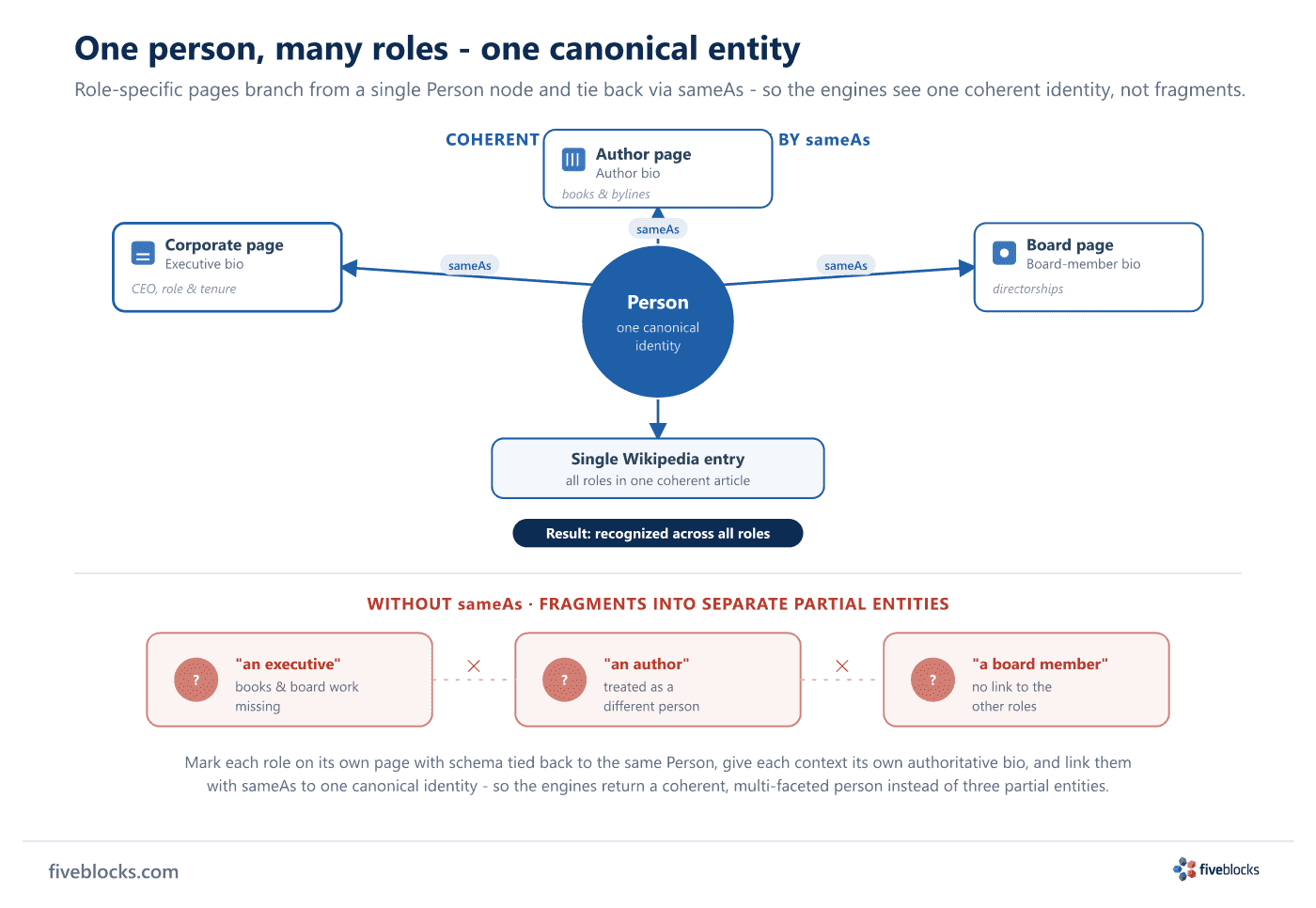
How to keep one person coherent across roles
- Schema marking on dedicated pages
- Each role can live on its own page, with Person schema that establishes that role and ties it back to the same underlying Person entity instead of creating a new one.
- Distinct authoritative bios per context
- Write a separate bio for each context – corporate, author, board. The systems can then read the different facets without contradiction, provided the core identity facts stay consistent across all of them.
- sameAs links to context-specific profiles
- sameAs structured links connect the role-specific profiles back to one canonical identity, telling search and AI systems that these references are all the same person.
- A single coherent Wikipedia entry
- Where the person is notable, the Wikipedia article can hold the multiple roles in one entry instead of leaving them scattered across disconnected mentions.
The balance to strike
You want recognition across all the roles without fragmentation into separate partial entities. Check it by confirming that the AI engines return a coherent, multi-faceted picture of the person rather than emphasizing one role at the expense of the others, tracked with AIQ.
Last reviewed: 20/05/2026
