How do you build a digital presence for a private individual?
For a private individual the goal is sufficiency, not visibility: a verified personal site marked up with Person schema as the canonical anchor, one authoritative profile (LinkedIn or a relevant association listing), sameAs structured data tying those properties together, and a few accurate third-party citations. Wikipedia and broad social presence are left out on purpose. The footprint stays small and coherent, which is all engines need to resolve one clean identity without drawing public scrutiny.
Building digital presence for a private individual is different from executive reputation work because the goal is sufficiency rather than visibility. A private individual needs a small set of properties that establish the identity unambiguously and keep engines from filling gaps with fabricated or conflated detail, without drawing the scrutiny a public-facing program invites.
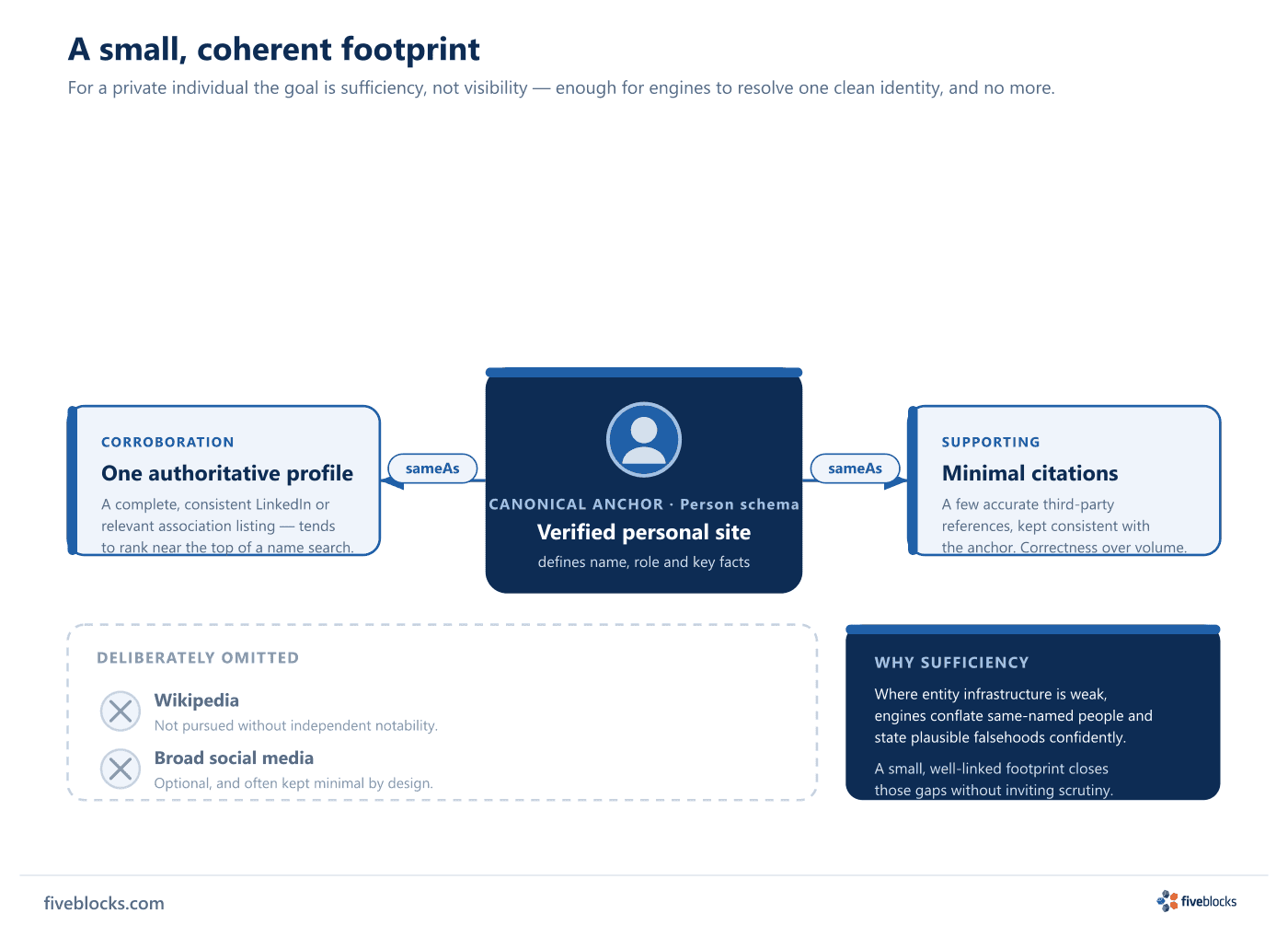
The minimal stack
- Verified personal site with Person schema
- The canonical anchor. A personal site carrying
Personschema defines the identity – the name form, the role, the basic facts – that every other reference should match. When the official site carries Person schema and other signals link back to it throughsameAsand consistent descriptions, search and AI engines resolve scattered references to one identity with higher confidence. - One authoritative profile
- A single independent profile that corroborates the anchor – usually a complete, consistent LinkedIn profile, or a relevant professional or association listing. LinkedIn tends to rank near the top of a name search because of its domain authority, so one well-formed profile does most of the corroboration a small footprint needs.
- sameAs structured data
- The
sameAslinks on the entity home point explicitly at that profile, which tells search and AI systems the two are one identity. Engines do not assume a website and a profile describe the same person; consistent descriptions andsameAslinks have to say so. - Minimal, accurate third-party citations
- A few accurate external references, kept consistent with the anchor. Correctness and consistency are what matter, not volume – extra properties add nothing once the canonical anchor is in place and linked.
What is deliberately left out
- Wikipedia – generally not appropriate without independent notability. Wikipedia’s general notability standard requires significant coverage in multiple reliable, independent, secondary sources. An article pursued without that risks being taken to Articles for Deletion, and pressing it would invite exactly the scrutiny a private individual is trying to avoid.
- Broad social media – optional, and often deliberately minimal.
Why sufficiency is the goal
Where entity infrastructure is weak, AI engines tend to conflate distinct people who share a name, and they produce plausible-sounding false statements in the same confident tone as true ones. A small, well-linked footprint closes those gaps: it gives engines enough to resolve one clean identity, and no more. Most of this work is invisible from the outside, which is the point for clients who do not want a public profile.
Last reviewed: 19/05/2026
