How do you build a digital presence for an executive who values extreme privacy?
Even an executive who wants extreme privacy needs a baseline of entity hygiene: accurate Person schema, accurate Wikidata, and an accurate Wikipedia entry where one is warranted. That lets AI engines and search disambiguate and describe them correctly without any active visibility. The discipline is restraint, not absence.
An extreme-privacy preference does not remove the need for entity work; it changes what kind of entity work is appropriate. The goal shifts from visibility to accuracy: a small, controlled footprint that lets engines identify and describe the executive correctly, and nothing beyond that. Some executives also do not get a full opt-out. Public-company CEOs and public-fund principals are operationally relevant, so for them the work is light-touch but still required.
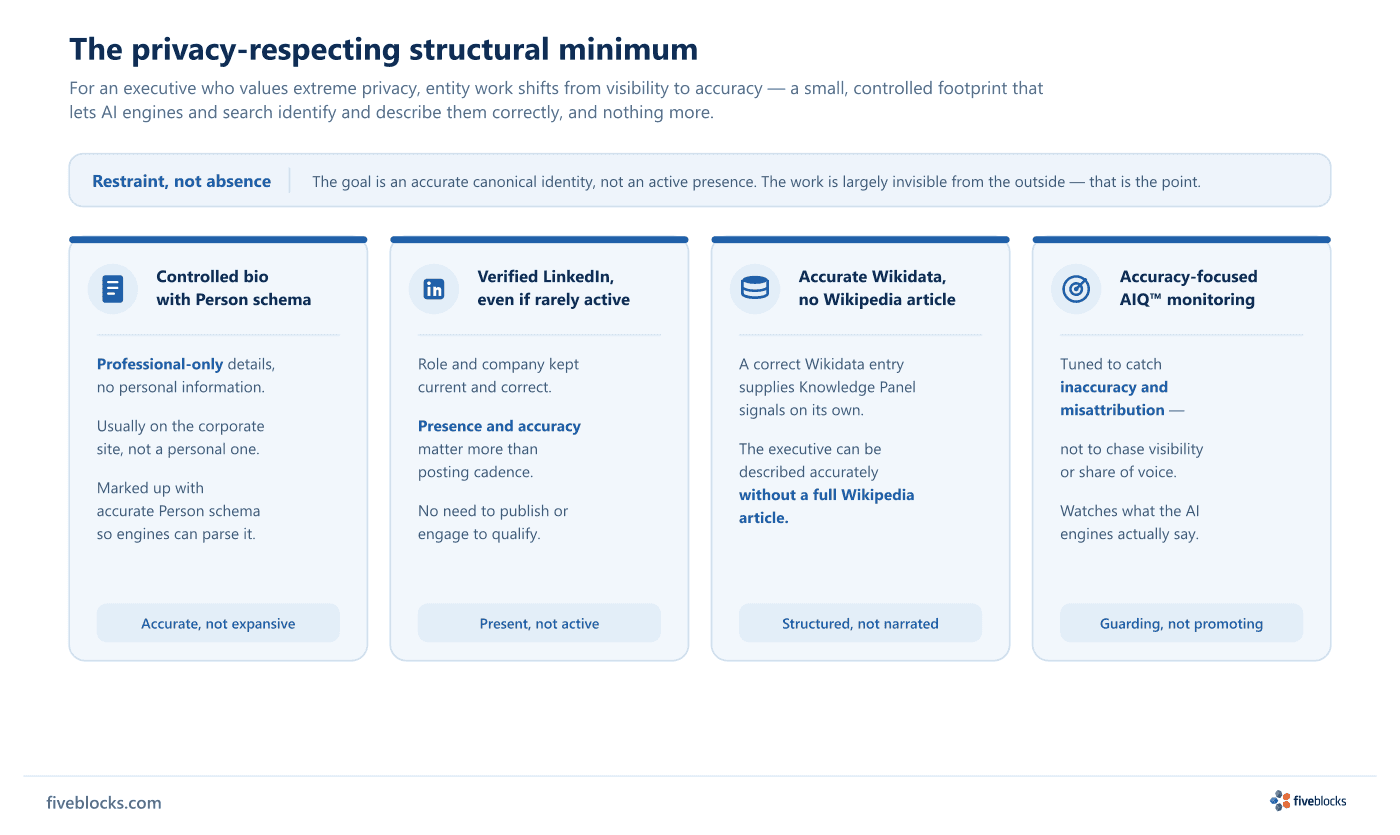
The privacy-respecting structural minimum
- Controlled, professional-only bio with Person schema
- Usually on the corporate site rather than a personal one. Professional details only, kept accurate, with no personal information.
- Verified LinkedIn, even if rarely active
- Keep the role and company current. Presence and accuracy are what matter here; posting cadence is not.
- Accurate Wikidata, even with no Wikipedia article
- A correct Wikidata entry supplies Knowledge Panel signals on its own, so the executive can be described accurately without a full Wikipedia article.
- Accuracy-focused AIQ monitoring
- Tuned to catch inaccuracy and misattribution rather than to chase visibility or share of voice.
Restraint, not absence
None of this work is visible from the outside, which is the point. It gives engines a canonical, accurate identity to work from and leaves the executive’s chosen privacy intact.
Last reviewed: 19/05/2026
