How do you build entity authority for a private individual?
Build a personal website marked with Person schema as the entity home, then corroborate it with complete, consistent authoritative profiles: LinkedIn, professional and association profiles, and Wikipedia only where the person is genuinely notable. Keep the bios aligned and connect everything with sameAs structured data.
Building entity authority for a private individual follows the same logic as for any entity, but consistency and disambiguation matter more. Individuals are easily fragmented or conflated with same-named people when the underlying infrastructure is weak, so much of the work is resolving one clean identity rather than just accumulating signals.
Start with the entity home
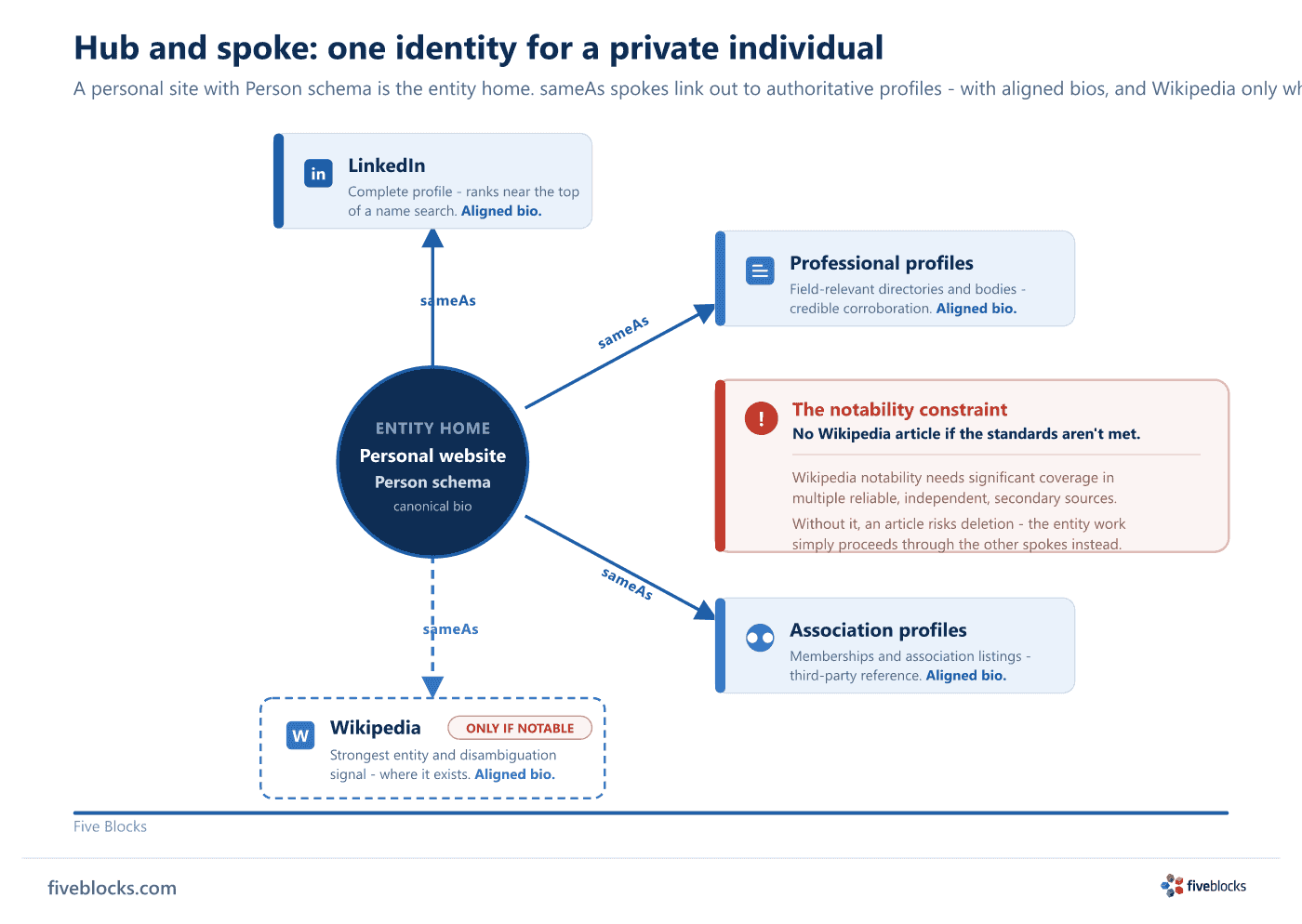
The anchor is a personal website marked with Person schema. This entity home defines the canonical identity: the name form, role, and facts that every other source should match. When the official site carries Person schema and authoritative profiles link back to it, search and AI engines can resolve scattered references to one person with higher confidence.
Corroborate with authoritative profiles
From the entity home, add the profiles that independently confirm who the person is:
- LinkedIn: a complete profile that, on its own, tends to rank near the top of a name search and supplies a strong professional reference point.
- Professional and association profiles: memberships, directories, and bodies relevant to the person’s field, which add credible third-party corroboration.
- Wikipedia: only where the person is genuinely notable. Where it exists, it is one of the strongest entity and disambiguation signals search and AI engines use.
Align the bios
The bios across all of these have to agree: the same name form, the same role descriptions, the same facts. Conflicting bios are what let the systems fragment one person into half-formed entities or merge them with a namesake, so consistency raises the engines’ confidence.
Connect it with sameAs
sameAs structured data on the entity home links explicitly to each profile, telling search and AI that the website, LinkedIn, the association profiles, and any Wikipedia article all refer to one person. The engines will not assume those references are the same individual unless the signals say so: consistent descriptions plus sameAs links.
The honest constraint on notability
A private individual who does not meet Wikipedia’s standards should not pursue an article. Wikipedia’s general notability bar requires significant coverage in multiple reliable, independent, secondary sources, and chasing an article without it risks deletion. The entity work proceeds through the other layers instead. We verify the result by how the AI engines describe the person with AIQ.
Last reviewed: 20/05/2026
