What should every PR professional know about AI reputation management?
Quick answer
It comes down to five points. AI engines now shape stakeholder perception alongside earned media; you influence what they say through the underlying sources rather than by editing model output; different models can each say something different about the same company; monitoring has to be continuous; and working with reputation specialists is now standard practice.
For a PR professional, AI reputation management comes down to five points. Get these right and the rest is detail.
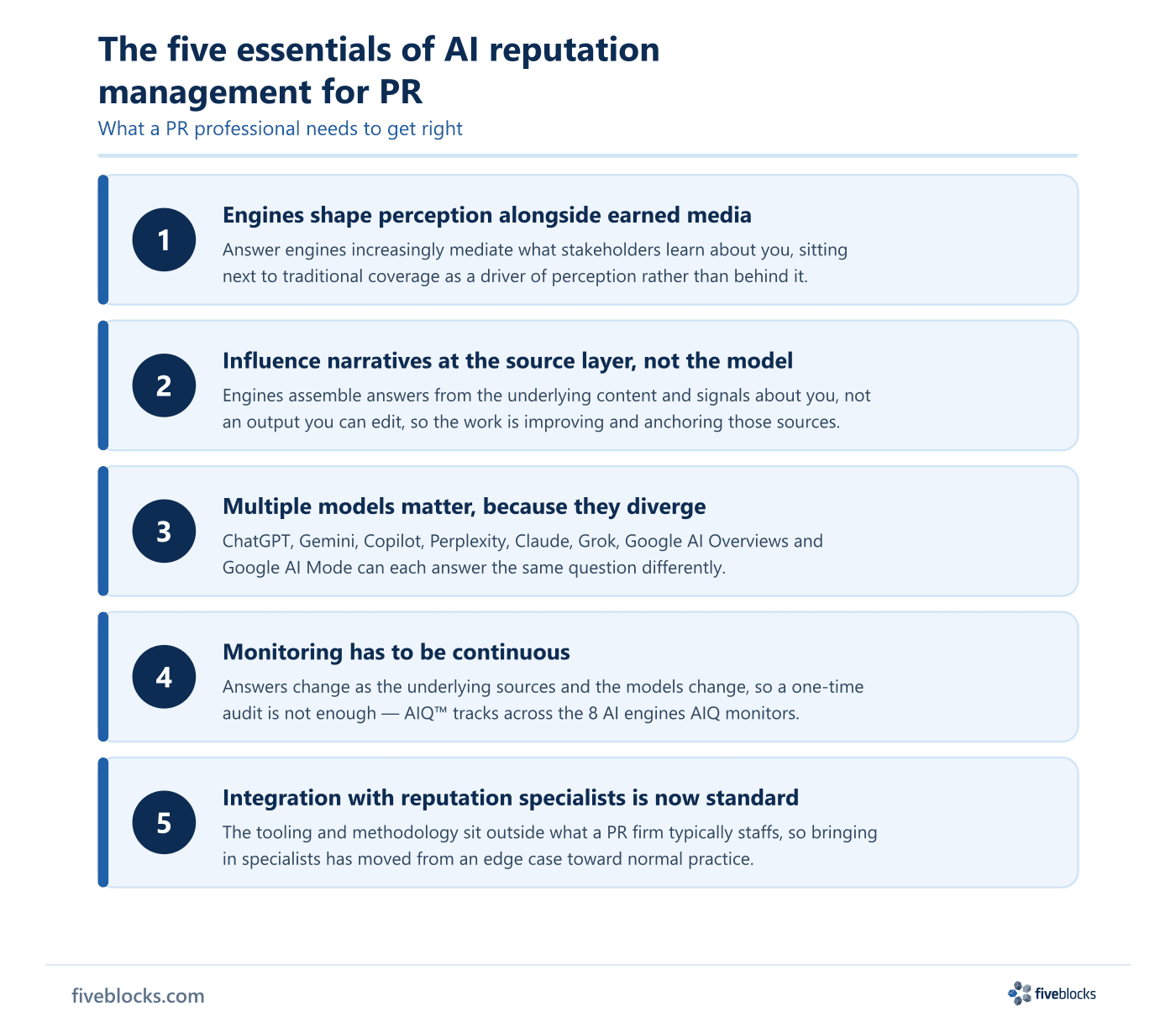
The five essentials
- AI engines now shape perception alongside earned media. Answer engines increasingly mediate what stakeholders learn about a company. How an engine describes you now counts alongside traditional coverage as a driver of perception, not behind it.
- You influence narratives at the source layer, not the model. Engines assemble answers from the underlying content and signals available about you. There is no output you can edit directly, so the work is improving those sources and anchoring them in authoritative places.
- Multiple models matter, because they diverge. ChatGPT, Gemini, Copilot, Perplexity, Claude, Grok, Google AI Overviews, and Google AI Mode can each answer the same question about the same entity differently. Managing one is not managing the others.
- Monitoring has to be continuous. Answers change as the underlying sources change and as the models change, so a one-time audit is not enough. AIQ™ is built to track this across the eight major engines.
- Integration with reputation specialists is now standard. The tooling and methodology for AI reputation work sit outside what a PR firm typically staffs, which is why bringing in specialists has gone from an edge case to routine.
Last reviewed: 20/05/2026
