How does a PR professional explain AI reputation management to a client?
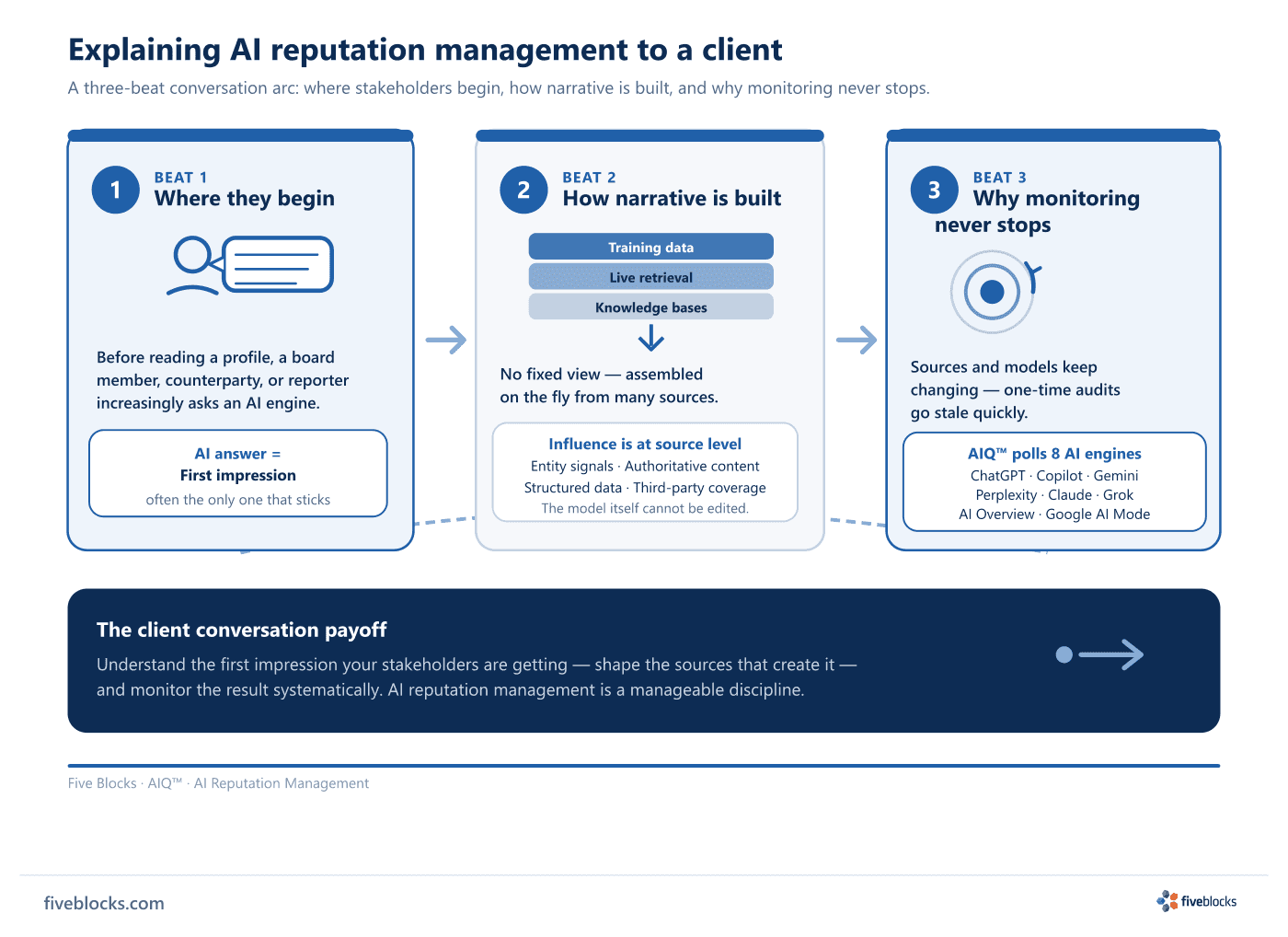
AI reputation management starts where stakeholders start: an AI engine's synthesized answer is usually the first impression. That answer gets assembled at query time from many sources, so you influence it by improving those sources, not by editing the model. The sources and the models both keep changing, so monitoring has to be continuous and systematic.
Start with where the client’s stakeholders now begin. Before a board member, counterparty, or reporter reads a profile, many of them ask an AI engine first, and the synthesized answer they get becomes the first impression of the brand.
Beat 1: where stakeholders now begin
AI engines are the first stop for a lot of due diligence and background research. What the stakeholder reads is a narrative the model has assembled from sources across the web, not a list of links. Often it is the only impression they form.
Beat 2: how AI builds that narrative, and how you influence it
- No fixed view. The narrative is assembled on the fly. The AI holds no stored opinion of a company. It builds the answer at query time by synthesizing training data, live retrieval, and structured knowledge bases, so the answer moves with the source layer beneath it.
- Influence happens at the source level, not inside the model. You cannot edit the model, so the lever is the sources it draws on: authoritative content, entity signals, structured data, third-party coverage, and knowledge-base accuracy. Improve and anchor those sources and the narrative follows.
Beat 3: why monitoring has to be continuous
The sources change and the models change, so a one-time audit goes stale fast. Ongoing monitoring means the same prompts run across the major engines, sources attributed for every answer, and trends tracked over time. AIQ™ does that work: it polls eight major AI engines (ChatGPT, Copilot, Gemini, AI Overview, Perplexity, Grok, Claude, and Google AI Mode), attributes the sources driving each answer, and tracks how the narrative shifts.
Framed this way, AI reputation management stops sounding mysterious. Find out what first impression stakeholders are getting, shape the sources that produce it, and monitor what changes.
Last reviewed: 20/05/2026
