How do PR professionals monitor what AI says about their clients?
Monitoring what AI says about a client needs purpose-built tooling, not manual spot-checks. Tools like AIQ™ poll multiple engines on consistent prompts at a regular cadence and report three things: what each model says, which sources shape those answers, and how both trend over time. The source view is where you act, because the AI narrative changes when the underlying source layer changes, not when you argue with the model.
Monitoring what AI says about a client is a tooling problem, not a manual one. Asking ChatGPT a question once and reading the answer tells you almost nothing. The response varies by phrasing, by model, and by day, and one check cannot establish a trend.
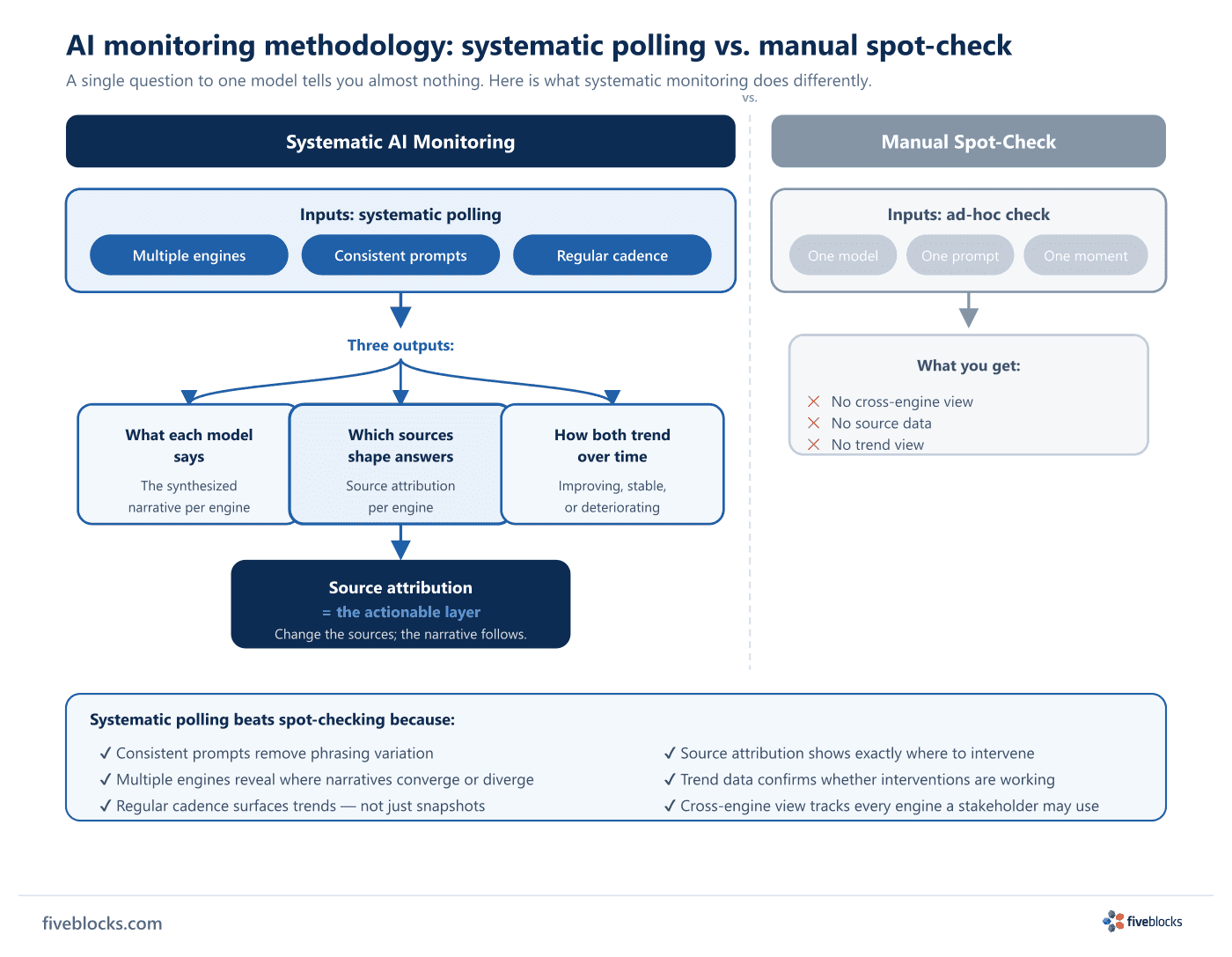
What systematic AI monitoring does
Purpose-built tools poll multiple AI engines on a consistent set of prompts at a regular cadence and record three things:
- What each model actually says about the entity: the synthesized narrative, not a one-off snapshot.
- Which sources are shaping those answers. This is the source attribution layer, and it shows where the narrative is being built.
- How both trend over time, so you can see whether a narrative is improving, deteriorating, or stable on each engine.
Why source attribution is the actionable layer
The source view is where the work happens. The AI narrative changes when the underlying source layer changes, not when you argue with the model. Once you know which sources are shaping an answer, you know where to intervene: a coverage gap to fill, an inaccurate article to correct at the source, a high-authority reference to add.
Which tools do this
- AIQ™ (Five Blocks) covers ChatGPT, Gemini, Copilot, Perplexity, Claude, Grok, Google AI Overviews, and Google AI Mode. Its focus is reputation monitoring: narrative and source attribution across the eight engines AIQ currently monitors.
- Profound and Peec.ai come at a related problem from the marketing and visibility side. They track citation frequency and brand mention rates rather than reputation narrative.
Manual spot-checking vs. systematic polling
- Manual spot-check: one question, one model, one moment, no trend, no cross-engine view, no source data.
- Systematic polling: consistent prompts, multiple engines, regular cadence, what each model says, which sources shape it, and how both change over time.
The point holds across tools: systematic polling and source attribution beat hand-checking. The goal is a reliable, current picture of how the AI layer represents the client on every engine a stakeholder might use, and a single data point does not give you that.
Last reviewed: 20/05/2026
