How do you measure the impact of Wikipedia changes on overall reputation?
Measure a Wikipedia change by treating the edit as an upstream cause and tracking its effects in the layers Wikipedia feeds: the Google Knowledge Panel, the AI narrative across the major engines, and the Wikipedia article's own search position. Confirming that the edit stuck says nothing about its impact.
An edit to a Wikipedia article rarely matters on its own. Google and the AI engines lean on Wikipedia as a source, so a change is measured by treating the edit as an upstream cause and following its effects outward through the layers Wikipedia feeds. Confirming that the change stuck is bookkeeping. Three downstream signals tell you whether it did anything.
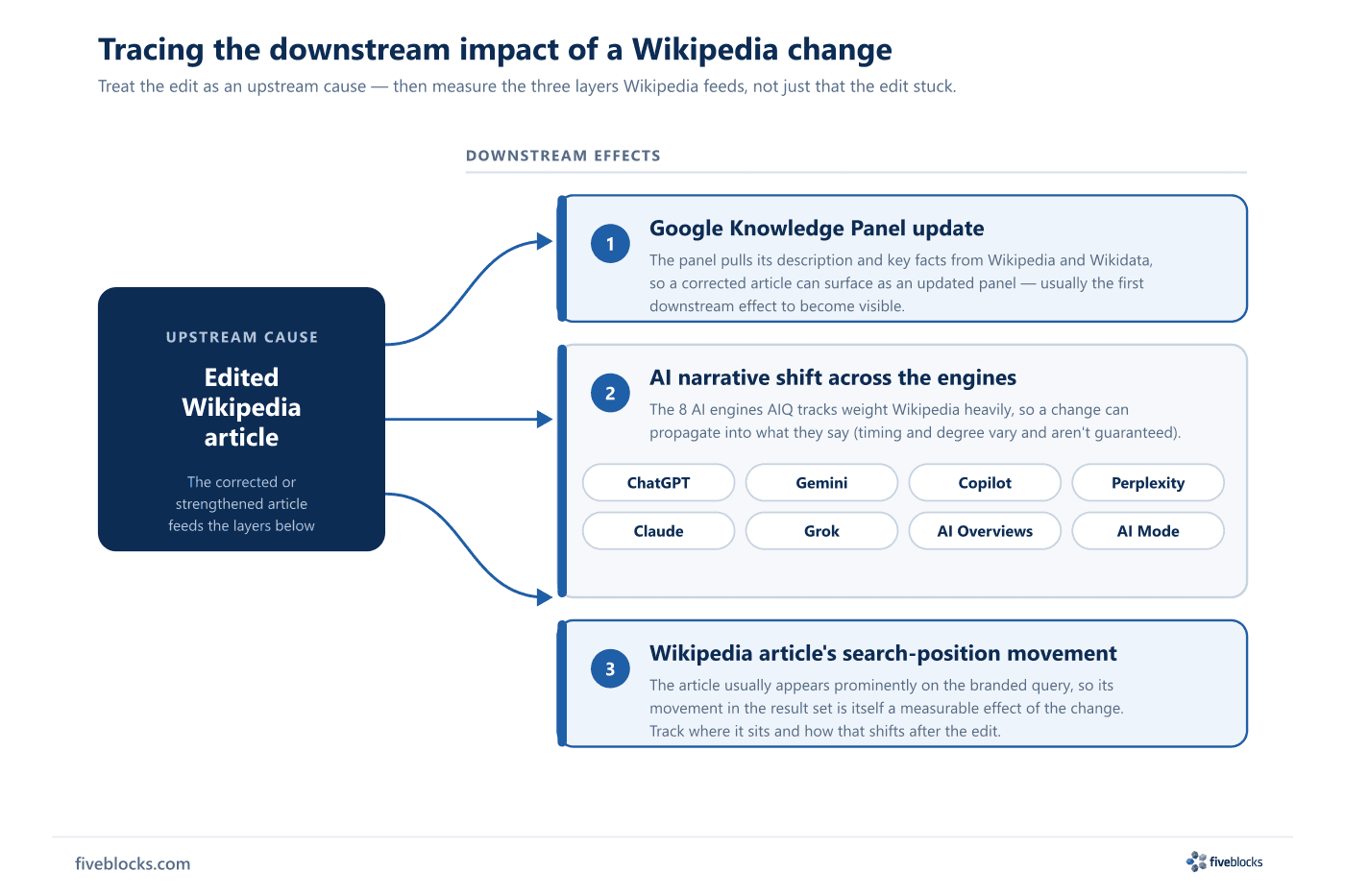
Trace the change through three downstream layers
- Watch the Google Knowledge Panel. The panel takes its description and core facts from Wikipedia and Wikidata, so a corrected or strengthened article can show up as an updated, more accurate panel on the branded query. This is usually where a downstream effect appears first.
- Watch the AI narrative across the engines. ChatGPT, Gemini, Copilot, Perplexity, Claude, Grok, Google AI Overviews and Google AI Mode all weight Wikipedia heavily, in training and in retrieval, when they answer questions about an entity, and Wikipedia is among the most-cited sources in AI answers. A change to the article can therefore carry through into what the engines say about the entity. Timing and degree vary by engine, and neither is guaranteed.
- Watch the Wikipedia article’s own search position. The article usually sits prominently on the branded query, so its movement in the result set is itself a measurable effect of the change. Note where it sits and how that shifts after the edit.
The discipline: measure effects, not just the edit
Following the edit through these connected layers is what separates impact measurement from a change log. Watch whether the panel, the AI narrative and the search position actually move, and be candid about the timing: these are downstream, lagged signals, and they respond when the underlying platforms re-index and re-retrieve, not on a fixed schedule.
In practice we monitor the article itself with WikiAlerts™, the Knowledge Panel and search position with IMPACT™, and the AI narrative shift with AIQ™.
Last reviewed: 20/05/2026
