How do you build a predictive model for reputation risk?
A predictive model for reputation risk combines three inputs: historical incident data (what events the entity and comparable organizations have faced, and what preceded them), leading indicators that tend to run ahead of trouble (sentiment shifts, source-quality decay in what AI engines draw on, AI narrative drift, rising social velocity), and scenario weightings that assign rough likelihoods to plausible events. Together they show where risk is concentrated. The output is a probability estimate and a prompt to prepare, not a prediction to be trusted blindly.
A predictive model for reputation risk estimates probability and improves preparation. It does not forecast the future precisely, and saying so plainly is what keeps it useful. What the model does is concentrate attention where risk is likeliest, so a program builds its defenses before an event rather than after.
The three inputs
A workable model draws on three kinds of input, each answering a different question.
- Historical incident data, what has happened before
- The reputation events the entity and comparable organizations have experienced, and the signals that preceded them. This grounds the model in observed patterns rather than an abstract checklist of things that could go wrong.
- Leading indicators, what tends to run ahead of trouble
- Signals that often move before a reputation event lands. Read together, they give an early sense of emerging risk:
- Sentiment shifts in the result set, tracked as a trend. Treat sentiment as a directional signal and pair it with human judgment, since automated classification is imperfect on nuance, sarcasm, and context.
- Source-quality decay in what the AI engines are drawing on. A narrative built on weakening or hostile sources is fragile whatever its current tone.
- AI narrative drift. Engine answers are generated fresh, vary from one engine to another, and drift over time. A change in what the engines say or cite can precede a wider shift.
- Rising social velocity, conversation gaining speed before it becomes a story.
- Scenario weightings, how likely each plausible event is
- Rough likelihoods assigned to the plausible events the indicators point to, which tells you where preparation effort is best spent.
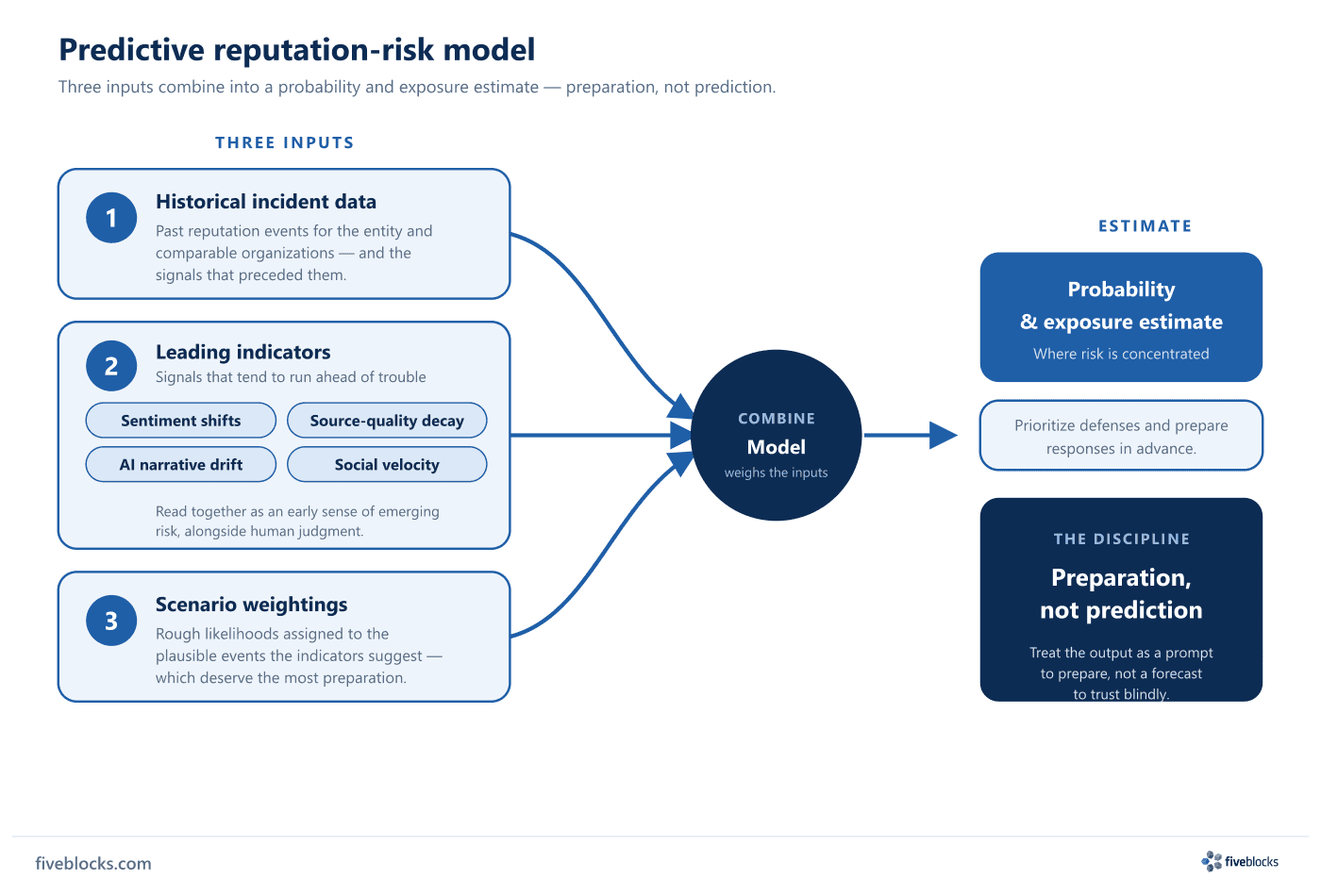
Probability, not prediction
Combined, these inputs show where risk is concentrated and what is likelier to materialize. That is enough to prioritize defenses and draft responses in advance instead of improvising under pressure. The discipline is to treat the output as a probability estimate and a prompt to prepare, never as a prediction to be trusted blindly. A model that overpromises certainty is worse than none, because it invites misplaced confidence.
We feed models like this with the leading indicators we track across search and the AI engines through IMPACT™ and AIQ™. AIQ™ monitors what the major engines say across ChatGPT, Gemini, Copilot, Perplexity, Claude, Grok, Google AI Overviews, and Google AI Mode.
Last reviewed: 20/05/2026
